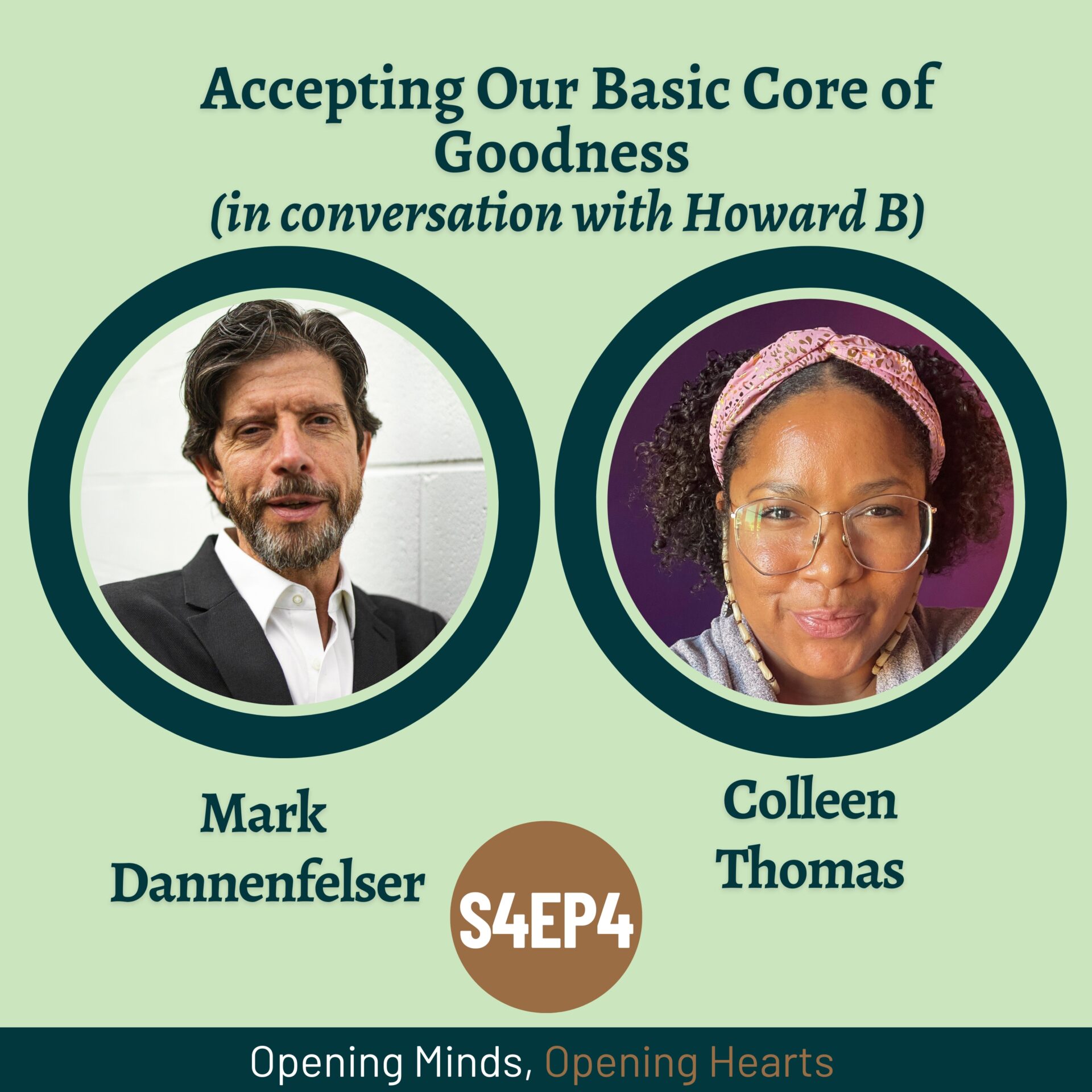
Accepting Our Basic Core of Goodness
Opening Minds, Opening Hearts Podcast Season 4 Episode 4 with Howard B
Title: Accepting Our Basic Core of Goodness
"This journey is a process of dismantling the monumental illusion that God is distant or absent."
- Howard B
We are so glad you are joining us for a conversation that weaves together three profound healing modalities in unexpected and illuminating ways. In this episode, we are joined by Howard, a psychotherapist, retreat leader, and long-time practitioner of both 12-step recovery and Centering Prayer, for a warm and unflinchingly honest exploration of how these disciplines work together to liberate us from the false self and restore us to our basic core of goodness.
Howard came to Centering Prayer through his recovery in 12-step programs after a crisis that landed him in a psychiatric institution. He has since devoted himself to the contemplative path, working as both a psychotherapist specializing in trauma and a Centering Prayer retreat leader. His integration of 12-step wisdom, contemplative practice, and professional psychotherapy offers a rare and grounded perspective on what genuine healing looks like, not as a destination, but as an ongoing journey of service and increasing presence.
"Healing is not just so that we can be fixed. It's so that we can offer ourselves to others."
- Colleen Thomas, on Henri Nouwen's Wounded Healer
- Howard's path from addiction and psychiatric crisis to recovery and Centering Prayer, and the moment when his practice shifted from struggling to achieve something to simply receiving what was already there
- The paradox of acceptance: that we must know and believe in our basic core of goodness before we can safely look at the false self and the shadow material we have repressed
- How 12-step recovery, psychotherapy, and Centering Prayer each create conditions for the acceptance and integration of our whole selves, not as competing practices but as companions on the same journey
- The difference between knowing intellectually that we are loved and actually inhabiting that knowledge in a lived, embodied way, and why that embodiment changes everything about how we relate to ourselves and others
- The essential role of service and community in anchoring this acceptance, and why the healing we receive in silence must always flow outward into relationship and presence with others
- Visit our website: contemplativeoutreach.org
- Find us on Instagram: instagram.com/prayerofconsent/
- Like us on Facebook: facebook.com/prayerofconsent
- Check out our YouTube channel: youtube.com/@prayerofconsent
If you are a grateful and generous listener who would like to support this podcast, please visit: contemplativeoutreach.org/opening-minds-opening-hearts-podcast-donation/ to make a donation of any amount.
Listen to the Opening Minds, Opening Hearts Podcast NOW for FREE on YouTube, Apple, Google, Amazon and more!
This season of Opening Minds, Opening Hearts is produced by 🫶🏾 Rachael Sanya 🫶🏾 👉🏽 rachelsanya.com
				Opening Minds, Opening Hearts Podcast Season 4 Episode 4 with Howard B

Title: Accepting Our Basic Core of Goodness

Welcome to Opening Minds Opening Hearts, a podcast about the transformative practice of Centering Prayer. In each episode, we will talk to friends of Contemplative Outreach about their personal practice. Listen in as our guests share insights about the teachings of Father Thomas Keating, how the practice impacts their work in the world, and their thoughts about how Centering Prayer connects to the living traditions of contemplation and meditation.

We are your hosts, Colleen Thomas and Mark Dannenfelser, Centering Prayer practitioners and contemplative life seekers who love to talk a little too much about how the practice of contemplative prayer transforms our inner and outer worlds. Our hope is to open the door for you to explore more deeply this powerful practice of Centering Prayer.

Colleen: Welcome to season four of the Contemplative Outreach Podcast, Opening Minds, Opening Hearts. I'm your host, Colleen Thomas.

Mark: And I'm your other host, Mark Dannenfelser

Colleen: Hi, Mark.

Mark: Hi, Colleen. How are you?

Colleen: Oh, I'm doing well. Nice rainy day. Preparing for spring here.

Mark: Spring has sprung in Atlanta, and I've got the pollen-coated nostrils to prove it.

Colleen: Oh, no. You guys get an early spring down there.

Mark: Yes, very early.

Colleen: And a hot summer to look forward to.

Mark: Yeah. We've also got a hot season going on here, don't we? In terms of the podcast.

Colleen: We do, if healing is hot, which ... I think it is these days.

Mark: Well, I'm loving these conversations about healing and Centering Prayer and Thomas Keating's Divine Therapy.

The more we're talking about it, and the different people that we're talking to, I'm realizing how essential this is in terms of the contemplative path.

Colleen: Yeah.

Mark: It shows up in every contemplative tradition, it seems, this thing about suffering and healing. Certainly, it's Jesus' central to his ministry. The Buddha, too, was interested in healing. That's what motivated him to seek the spiritual life, and Prophet Muhammad is always talking about suffering, and it's in every contemplative tradition, it seems. So it's a critical conversation for us to be having across not just traditions, but also different aspects of people's lives.

Colleen: Yeah, and I think we're really on the right track here with making sure that we place Centering Prayer in the context of other healing modalities.

Mark: Oh, yeah.

Colleen: I was just away on a retreat with Cynthia Bourgeault, and it's always a great refresher to be on a Centering Prayer retreat, especially with master teachers like Cynthia and David Frenette, and there were a lot of new folks there, too, and so they're people new to Centering Prayer, new to Thomas Keating, and they were emphasizing this understanding that Centering Prayer is not this pathway to bliss, and certainly not in the time of prayer does it feel like peace and, "Ah," you know?

So we've gotta talk about ways to support ourselves in the practice, which really just brings up a lot of stuff.

Mark: A lot of stuff. Yeah. And it does. The practice supports us in that stuff that emerges, and then these other disciplines, and I'm excited about our guest today, who's really so well-suited to speak to this.

Colleen: Me too.

Mark: Maybe you can introduce us to him.

Colleen: Yeah. Well, I'd be happy to introduce our listeners to Howard. I met Howard at the Contemplative Outreach Global Conference in Atlanta. Where you live, Mark, but you were out of town, so you didn't get to meet him in person. And we're not gonna cross paths with Howard too much because he lives on the other side of the pond, as they say, in the UK.

So he's joining us today from there. Howard is in 12-step recovery. He's also a retreat leader and works as a psychotherapist, both of which are supported by his long-term twice-daily Centering Prayer practice. So we're excited to have this conversation and introduce you all to Howard. Welcome, Howard.

Mark: Welcome, Howard.

Howard: Hey, Colleen. Hey, Mark. Lovely to be here with you.

Colleen: Yes, likewise Okay. Well, we're gonna get into this conversation about Centering Prayer as the divine therapy.

Howard: Mm-hmm.

Colleen: One of the things I'm excited about talking to you about is how you experience Centering Prayer as therapy, the divine therapy.

But just to begin and ease us into the conversation and acclimate our listeners, can you tell us how you first came to the practice of Centering Prayer?

Howard: Of course, yeah. I'll have a go. Firstly, thank you for honoring my anonymity and 12-step anonymity. That's rather marvelous of you. Thank you. And just to say that we're talking about the false self and divine therapy, and that your invite onto this esteemed podcast show --

Mark: We should have had you sooner on as a guest.

Howard: I'm a fan, by the way. So the invite onto this esteemed podcast show fired off this sort of the absolute carnival of fools that live inside of me.

So thank you for giving me that opportunity to see some darkness in me that I didn't know was there. So bless you both.

Colleen: You're most welcome.

Mark: We're very happy to introduce you to, or reintroduce you to your dark side.

Howard: It doesn't take much, honestly. It doesn't take much.

So yeah. Yes, so I'm in 12-step recovery, and I'm really hoping that I can try and make this conversation relevant to non-addicts or muggles, as we call you. So Thomas said that from the perspective of the false self, we are all in recovery. It's just that addicts and alcoholics are more blessed than everybody else because the consequences of us not really treating that false self or having it treated for us are quite severe, so we've got a head start in that respect, I suppose, which is quite good.

But I also, just so you can identify, I also do have some more subtle ones like workaholism and perfectionism and my higher power might be what you think of me or what I think you think of me. So all of that stuff is in there, and I hope we get into that today. How did I get into it? Well- So you get into recovery.

For me, it was, I was put in a psychiatric institution, which I didn't think was appropriate, but apparently it was, and apparently I thought I worked there, but I didn't, which was a bit of a shock. And then you get into 12-step recovery, and then part of that requirement of 12-step recovery is daily meditation.

It says, so step 11, "We sought through prayer and meditation to improve our conscious contact with God, praying only for His will for us and the power to carry that out." So that seemed like a pretty good idea. Originally, it was, I think I was in a dry house, which was a pretty mad environment.

I was nowhere near my family 'cause I was too poorly to go back home, and somebody threw a Jon Kabat-Zinn CD into the room and left very quickly 'cause I probably looked quite scary and mad, and I wore that thing out. It saved my life. And the most valuable thing, probably one of the most precious gifts I've ever been given, was that I'm not my thoughts Who knew, right?

I'm not my thoughts. What a shocking idea. I thought everything that appeared between my ears was true until that moment. Fast-forward a few years and my body, my sort of temporary earth suit had enough of years and years of narcotic abuse. And even though I was in recovery and being a very well-behaved young man, my body fell apart and I became pretty much bedbound.

So that was quite distressing. And the only thing I had was step 11, meditation, and then being on the phone to other people in recovery, so, sponsoring guys and things. But where Centering Prayer came in was I was meditating for hours and hours a day in order to try and change how I felt about my life.

I'd made a vow to myself that I'd caused my family enough pain, and that I promised myself that I would never inflict that pain on them again. But here I was clean and sober, and yet I felt awful, and I was angry, and I was upset, and I was disappointed, and I was heartbroken that life had turned out like this.

And even though I was meditating like my life depended upon it, which it probably did, I wasn't getting any better. And so in my head, I was failing at meditation.

Colleen: Mm-hmm.

Howard: Not because of how I was taught it. I was hanging out with some really cool Buddhists. I went, managed to go on some retreats, but I would sit there.

But I remember I have a vivid moment. I was down in the southwest of England at an amazing retreat, and we were doing Metta. And I think in my mind there were— there probably weren't, but in my deranged little mind, there were probably sort of saffron-robed monks around. There was probably a lotus pond outside, and we were doing Metta for an hour, and I was in unbearable physical and psychological pain.

And I'd open my eyes and see these beatific smiles on these other retreatants' faces, and, I just wanted to kill them.

Colleen: Very kind of you.

Howard: Yeah. Obviously, Metta was working great, right?

Mark: They're all just fine, and you're the only one suffering there.

Howard: Yeah, absolutely. And so there was this, it's not working for me.

And there was a cool community I was involved in, and we were all sharing practices, and I was aware from day one of Thomas Merton and Thomas Keating, and I used to get the two mixed up, but they were around. And then I think something landed, and it was a spiritual quote sent to me, divine indwelling, the foundational presence of God within.

And there was a method to get to it, and that just chimed with a really famous quote from the Big Book of Alcoholics Anonymous, which is the inroad for most people, which is this, "So actually we were fooling ourselves, for deep down in every man, woman, and child is the fundamental idea of God. It may be obscured by calamity, by pomp, by worship of other things, but in some form or other it was there.

For faith in a Power greater than ourselves and miraculous demonstrations of that Power in human lives are facts as old as man himself. We finally saw that faith in some kind of God was a part of our makeup, just as the feeling we had for a friend. We found the great reality deep down inside." So that was the world I was living in.

I was clean and sober. I couldn't keep myself clean and sober. The 12 Steps had separated me from drugs and alcohol, and yet there was this weird sort of split personality going on where my sobriety was taken care of by a power greater than me. But when it came to meditation, it was completely on me. It was back to I was self-powering it, and I was failing at meditation.

Thomas came into my life, and it just changed from being an attention practice that I was failing in to an intention practice, and everything changed from there on in. I think within days I had found an introduction to Centering Prayer in Sedona. It was about a year in advance and this is a clue to how deranged I am.

It was an introduction to Centering Prayer retreat for beginners, so I thought, "Well, I have to be an expert at it before I get there." So I never did less than two sits a day from day one, and mostly I did more than that. So yeah, that's roughly the journey.

Mark: Mm-hmm. Thank you for sharing that- Yeah ... Howard, and it strikes me, I love that you mentioned Jon Kabat-Zinn as my primary teacher in the mindfulness work that I do, and I just love to hear all those bridges and these different entry points into what is really the contemplative life, and also how much that is completely linked to working with our own suffering and our own healing.

You frame it so beautifully, too, how that journey for you, but that's an ongoing thing, is it not? Dealing with what Keating calls the wounds of a lifetime, which sounds a little overwhelming, so I'm wondering how you understand even healing, knowing that you're on that journey of healing and addressing the suffering and the wounds.

Howard: It's so hard to quantify, isn't it? Yeah. I see it in the rear-view mirror, in God's rear-view mirror. I don't know about you two, but in real time, do I get it in real time? Probably not. I've heard Colleen before, and you've said the sits aren't that much fun, and I certainly don't get stroked by angels during the sits.

It feels more like an extreme sport. Yeah. It's a contact sport, and it's gradual. The best thing I... Give you an example, right? So I was waiting to come on here today, and the little boy inside of me who, um... So yeah, I've got some childhood trauma. I was given away twice as an infant, and I've got a quite a loud, damaged little fella who lives inside of me that I have to listen to quite a lot, and, I have a very compassionate relationship with him.

I tell him things like, "Okay, we're gonna go and do this now. I've got this. You're safe, and, if you behave, we might have some ice cream after. Everything's gonna be all right." And he's going, "Ar, ar, ar." And then he's saying things like, "Well, don't you know that they had previous guests on who are your heroes?

You're gonna just be exposed. You're gonna be exposed as this abs... It's gonna be awful." And I can go, "Right. Okay, that's fine." And then because that energy's kicking off, I might go to, "Well, I haven't heard from my wife. She hasn't sent me a text saying good luck to do the show." Right? And then, and then I'm chuntering away doing that, going, "Well, she hasn't.

Does it..." And then I open my phone, and there's a really beautiful message from my wife saying, "Good luck for the show. You'll be great." And then it's just like, "Oh. Oh, right, yeah." My grasp of reality is quite tenuous actually most of the time. Left to my own devices, this clown car inside of my head just makes stuff up.

But what happens, I think, is whereas I used to believe things for 20 years, that my wife didn't care What happens now is I believe things for maybe a couple of minutes at most. It's what Gerald May talked about, that first and second gaze. I still have the first gaze. My little boy inside of me is very loud.

"It's a threat. This isn't safe. They're judging you." And then he's like, "Oh, okay. Yeah, I see that. I see what you're doing. Oh, I see. It's okay. We got this. Yeah." And then it happens again.

Colleen: Yeah.

Howard: So that's what it looks like inside of me. If you can call that healing.

Colleen: Yeah. Well, it's a great example because I think it's so relatable.

We all have this little person in us that wants to run the show. What I'm also hearing in how you're bringing healing, and if we could define it, which we're not gonna try to do, but what I sense is this idea that I'm even sitting with now. In the Contemplative Outreach app, a little plug, we have an app, and it's a wonderful app, and you can not only set a timer for your sits, but you can choose the readings that come before your sit and the prayers that will close your sit.

Well, the one I happen to be on in this season is from the guidelines for Christian life growth and transformation that are in the back of Opening Mind, Opening Heart, and it's that our basic core of goodness is our true self. Its center of gravity is God. The acceptance of our basic goodness is a quantum leap in the spiritual journey.

And that's the essence of healing for me, is that there's something that needs to be transformed in me that understands that my and our basic core of goodness is my true self.

Howard: I love the way you read that. I think there was something about the way you read it, it sounded like there was a yearning inside of you to believe that and live from that place. And I have that yearning inside of me that I want to believe that, and I want to live always from that place, but God, I do not have the ability to do it, and I fall short all the time, and I need to be reminded on a regular basis. But it is that. It is that basic core of goodness.

If I didn't tap into that, I wouldn't dare look at this false self stuff. It's too scary, right? So I have to have, I think for me, I have to have sat and sat and sat and sat, and I know that stuff. I know the literature pretty well. But there's a difference between knowing and believing, and there's a difference between believing and inhabiting and living from that place. And it happens sometimes for me, mostly in service.

I joked about thinking that my wife hadn't texted me, right? Now, if I didn't have that basic core of goodness, that ground from where I live from, that would just set me adrift. I would be an empty crisp bag blowing around a playground.

I would have nothing to hold me down. But instead, now I do have that grounding in the basic core of goodness, and I believe it, it's in you and in me. That's important, right? I believe it's in you, so you're not a threat to me now because I believe this is universal. And so if I have that basic core of goodness, if I believe that, then the false self just becomes like this distracting, noisy, sometimes spiteful, sometimes humorous party that goes on.

But it allows me to look at my shadow side, which I probably couldn't have done before because it was just too personal.

Mark: Yeah. And it seems like both things can be possible, that we have this essential and basic core of goodness or wholeness, which to me is another word for healing. We are already whole.

Colleen: Mm-hmm.

Mark: And as Merton says, but we imagine that we're not, we imagine that we're separate, and that causes the struggle. So it's both things. We're already there, but also we need to continue to do the work, to live from that place.

You work as a psychotherapist as well as are a Centering Prayer practitioner.

I'm wondering too, what are some of those, and this is some of what we're exploring really throughout the whole season, what the other disciplines are that can help support us in our contemplative practice and also complement the contemplative practice. I wonder if you could speak from that, either from your own experience or from the work that you do in psychotherapy and where that kind of relationship is and how that can work together the practice of psychotherapy and the practice of Centering Prayer.

Howard: Yeah. Thank you. To me it feels that the three main things in my life, the three disciplines or modalities or actually there's more because actually I'm a contemplative parent, I'm a contemplative husband, a contemplative podcast guest, I'm a contemplative neighbor. I wanna live from that place all the time, right?

So the three things that I do would be 12-step, so sobriety. I can't keep me sober, I can't get you sober, but I can help you create some conditions whereby you might get sober if you do what I did. Centering Prayer, I can teach you how to do Centering Prayer But I can't make divine union happen in me, and I can't make it happen in you.

But I can show you what I've done. I'm on a path, and you could get on that path, too. And psychotherapy feels the same. I cannot heal you, but I am quite adept at creating conditions whereby, as is often said, something that I cannot make happen overtakes us and does that for us. Now, that's not a great advertising slogan, is it?

I can't heal you, but I'm quite good at making some conditions happen. It certainly, if I had a website, I certainly wouldn't put it on there. But I think that's the truth, is that there's this, and I'm not being obtuse, but it just all feels the same. That i- in the moments of healing that I witness and the great blessing of my life is that I pretty much every day in my life, I get a ringside seat for God showing off.

I get to see this stuff happen in 12-step and in psychotherapy, working in trauma. I get to see that if I turn up and I have, as Carl Rogers said, the six necessary and sufficient conditions. So if I am congruent, if I'm authentic, if I am transparent, then that is one of the conditions. If I can offer you unconditional positive regard, and that feels like God's gaze towards me.

That all, like Thomas said— it was Teresa of Lisieux, wasn't it? "All God wants is for you to let him love you." And there's a sort of an embodiment of that happens in psychotherapy, in contemplative psychotherapy, I think, and it's just an absence of something. I become more aware of it when I feel I've got to be clever or I feel I've got a theory coming on, or I can join some dots for somebody, and that, that's a different part of me happens then.

And I notice then there's maybe a disconnect. But as soon as I am comfortable with me and my humanness, something else arises and it feels completely akin to 12-step therapy, Centering Prayer, and psychotherapy. They feel very similar to me.

Mark: Yeah, I experienced that as well in my own work.

Even the way Keating framed the wounds of a lifetime, he's using that language around addiction, and you could also say just attachment, which maybe we hear that term more in the contemplative world. But he says in Imitation of Love, "The false self is invested in the emotional programs for happiness, and it seeks to satisfy them through attachment to persons, places, and things."

That's what I relate to. It's like I become more aware of when my ego is asserting itself or when my anger is getting... but I don't necessarily wanna give it up.

Howard: No.

Mark: I'm attached to it also. So it seems that the Centering Prayer practice really helps us, maybe psychotherapy helps us to see it, but Centering Prayer can really help us to let go.

Howard: Well, it's a process of reduction, isn't it? This, what is my favorite to me, this journey is a process of dismantling the monumental illusion that God. And I imagine I'm walking through a jungle, and it's like, "Oh, it, it's that leaf. Oh, oh, no, it's not that. Oh, oh, it's that.

No, no, it's not that. Oh, it, it's this. No, no, it's not that." And so I become aware of the healing, not in what it is, but what it isn't.

I thought that it was prestige. I thought it was relationships. I thought it was this. I thought it was what I thought you thought of me. And as the volume on the false self lessened, the healing is, oh, it isn't that anymore.

For me, anyway, but it's very difficult to quantify what it is. I'm just more present with is-ness. And the is-ness can only come up because I'm not going, "Oh, it's that. Yeah, if I'm being clever, they'll love me."


In the Christian tradition, contemplative prayer is the opening of your mind and heart to God who is beyond thoughts, words, and emotions. Centering Prayer is a method designed to facilitate contemplation. The method suggests four guidelines. One, choose a sacred word as the symbol of your intention to consent to God's presence and action within you.

Two, sit comfortably and relatively still, close your eyes or leave them slightly open and silently introduce your sacred word. Three, when you notice you have become engaged with a thought, simply return ever so gently to your sacred word. And four, at the end of the 20 minute prayer period, let go of the sacred word and remain in silence for a couple of minutes.

The additional time invites you to bring the atmosphere of silence into everyday life.


Colleen: It also strikes me that it's not fixing, it's not doing it right. Something about your story earlier about the transition from an attention practice, although those are necessary aspects of our practice, to the intention practice that Centering Prayer is.

There's something in that, too, and in this how we engage in the work of psychotherapy, but also how we engage in a Centering Prayer practice. There's a need for a sense of safety, even though that's one of our emotional programs for happiness, right? Safety and security. But in this practice of intention, Centering Prayer being a prayer of relationship, there's some aspect of the healing that also creates in us a space to experience love- Yeah

divine love within ourselves, but also that there is an Other that is loving. And I'm curious how you came to your understanding of Higher Power in 12-step language in that regard. Because that can be a challenge for people in recovery. But also, it's an essential aspect of the program. All of the steps are built upon some need for a power greater than ourselves.

But when we've experienced power as harmful, that can be a huge barrier.

Howard: Absolutely. No, really well put. When I sit in newcomers meetings, and I hear somebody using the word God, I feel like it's the one word that should almost be banned because so many people come in with preconceptions and baggage with that word that we have to make that window, those small windows of opportunity for healing and recovery, as wide as possible.

Personally, I think my, and I'm really glad of this, that I can't-- The spiritual journey is like trying to catch gravy, isn't it? It's like it's knitting smoke. And as soon as I think I've got it, then I absolutely know I haven't got it. So it's constantly evolving. Where I feel the love, which, as somebody with the start in life that I had, and I'm a badly put together robot, it feels sometimes, is that I feel it with you.

I feel it with you because there were so many walls and so many conditions and so much fear inside of me. Drugs and alcohol did a fantastic job at quietening that stuff down until it stopped working, and then you're left with you, and it's terrifying. Absolutely terrifying. So then the Divine Therapist has worked on me for years and years very patiently. And those things lessen, which means that when I am in relationship with you, I feel love.

I don't get burning bushes, but I do feel connection at a deep level with human beings, which I never thought was possible, and that is this sort of love as a verb that the mystics talk about. It's a love in action. If all you're doing is sitting with a view to your own healing, I think you're missing out on what it's about.

I think Thomas says here, it's like, "We do not complete the purification of the unconscious just from the prayer itself, but through both the prayer and the bringing of its fruits into daily life. Divine love has to be manifested as well as experienced."

And I mean, that's 12-step. The co-founder, um, a guy called Dr. Bob, in his final speech, said it, the 12 steps could be reduced down to two words, love and service. Love and service. So I think I, yeah, I have to go into the Divine Therapist's office. I have to shut my inner door, go to my secret room. I get treated. But unless I'm then taking that out into the world somehow and interacting with you, I don't experience it.

It is in the service that I experience it. Love and service, love and service, and that's where I experience God “Godding.”

Mark: I love that. As you're talking, I'm wondering if some of our listeners, I know certainly for me, I like that idea that it would go out from me, and I could be more loving, and it also feels like a bit of a risky proposition 'cause there's a vulnerability there.

And it seems to me that's part of what Keating helped us to see more clearly when he talked about these emotional programs for happiness, that they're meant to protect us. It's not like when we say false self or something, it's not like bad self. Yeah. It has a place to protect us, but over time and with trust and with our own sense of being loved, we're able to start to release that to some degree.

But it feels like, for me anyway, the anxiety could go up just in even understanding that that's happening, 'cause now I'm more vulnerable.

It almost has me re-invest at times in the false programs.

Howard: Yeah.

Colleen: Yeah. And it's important too to, I think I always have to remind myself, which Keating reminds us of always in his teachings, that this is the human condition, right?

And one thing he says too in his conversation on addiction and the divine therapy is that- It becomes necessary for the psyche to repress the events that are most painful in the unconscious.

This is part of the process. We experience pain and suffering often in childhood - that things are done to us, and there's nothing we can do about that.

And our natural response is to repress these events because they're painful, of course. Why would we not do that? And then in the prayer, we are gifted the grace of this unloading of the unconscious.

Everything that we repressed comes to the surface, which is where I think we really need the support of psychotherapy, spiritual direction, and 12-step fellowship to process through this repressed material that arises in safe and trusting environments.

And yet, too, Howard, I'm thinking about actually the fourth step in the context of this conversation, especially when one of the anchors for this season is that Thomas Keating is reminding us that contemplative prayer without working on the shadow side is impossible. We've got to deal with that. And the fourth step invites that process of working on the shadow too, but frames it in this, making “a searching and fearless moral inventory of ourselves.”

Is there anything you can share about that fourth step process that relates to this discussion?

Howard: I think so. Yeah, I'll have a go. A couple of things. Yeah, I mean, you hear people talk about fourth step or about se- searching fearless moral inventory, and people go, "Ooh, crikey, that sounds terrible." I've sat through more than I care to remember.

A sponsor's prayer when listening to that inventory in Step five is, "God, please help me hear something I haven't heard before.” We've all done that. We've all felt that about that, and there's a sort of a leveling with that, and that's a good starting place. I was blessed with spending some time with Thomas, and I asked him, "Your treatment center set up in America is incredible.

You can wanna get sober in Phoenix at lunchtime, make a phone call, and you'll be in treatment in the afternoon." It's very, very different in the UK. You might try and get treatment and they'll say, "Well, if you can stay sober in the community for nine months, then maybe you can get something."

Right? Yeah. So a few years ago, we were detoxing people in the community using Centering Prayer. So they were titrating down off methadone or whatever it was. They were in fellowship and so when I met Thomas, I said, "Look, what do you think about that? That before the first step we give these people, like do a minute of Centering Prayer?"

And he was spot on. He said, "Yeah, before they get anywhere near inventory or anything like that, absolutely give them Centering Prayer." I was like, I don't think he'd met many English crackheads 'cause he said, "Don't let them do more than two lots of 20 minutes a day." Dude, you'll be lucky if you get two lots of two minutes, but yeah.

But he said, "Do not give them Centering Prayer unless they are in service." I was like, "Wow, okay." So he was saying to me, "Yes, take it in and let it out. Take it in, let it out. Breathe in God, breathe out service. Breathe in love, breathe out service."

Now that may sound like I've sidestepped the inventory, but I think by the time you get to the inventory, if you have that rhythm within you that I am... how do I get self-esteem? By doing esteem-able things. I'm gonna turn up, I'm gonna put the chairs out. I've got a week sober, I'm gonna phone somebody who's a day sober, and this rhythm of I'm breathing in love, I'm breathing out service, I'm breathing in love, I'm breathing out service. And then when I get to that stuff about, "Oh, I did this, I played doctors and nurses when I was this age," or, "I did this," everybody has done it.

Everybody has done some stuff. And you go, "Yeah, I know, yeah." And at that point, people are taking it less personally, and it's not like, "This is the worst thing ever." But doing that without a sense of love moving through me might feel too painful because I would be hanging onto it. My false self would still be, "If I admit this, I will be destroyed.

I will be annihilated because this system," as you just beautifully said, "is keeping me safe." There's nothing wrong with the false self. It's absolutely doing a fantastic job. I would've died if these guys hadn't have been looking after me. But now, okay, so gently, gently, how do I let go of that? And like with psychotherapy and like with sitting with Intelligent Love in my sits, the room's gotta be warm enough before I take my coat off.

The room's gotta be warm enough before I take my coat off. So let's get the room warm. And now, oh, okay, so you're not a threat. Oh, well, maybe I could recognize that actually I'm driven by fear or driven by resentment and all of that.

Mark: Well- Yeah, the false self- Keating uses that word of dismantling the false self.

If that is happening, which it seems to in the practice, there's got to be a need for something that helps us to be grounded and stabilized and surrounded, as you're saying so well, that whether that's going into a room of other people who are supporting, and so community and some of these other disciplines too.

I think your own approach to it is really a shining example of bringing in other disciplines that support this moment where we start to let go in, in the practice or moments as it happens over and over and over.

Howard: So much of my life feels over my pay grade, right? And that's just okay. It didn't used to be.

I wanted to be the manager of my life, but based on my past performance, I've sacked myself as the manager of my life, and I have a new manager now. So when I hit the gong, and I'm in the sits, and those thoughts or feelings come up, it's within my power when I become aware that I've been thinking about absolute mayhem to ever so gently bring my sacred word in.

That feels within my pay grade. And so it's incremental. It's like, okay, right, I can do it there. I can do it, it's safe here. I can let go of the thought that I have to be on guard all the time there. And then that goes out into the world, and my sacred word or my sacred breath follows me around in the world and I can let go and let God and let go and let God, and then something else emerges.

I think the other key factor is that through that process of letting go and letting God, I started to take my life less personally. I started to take me less personally because the me that I thought I was didn't actually exist anyway. It's a fiction that I've created. My wife doesn't care. It's just like, it's just a duh, duh, duh, duh, duh, duh, duh.

Mark's more spiritual than me because he's a presenter on thingy, you know, da, da, da, you know, whatever it is.

Mark: We know that to obviously be not true, so.

Howard: But it's, it's constant, right? It's like, duh, duh, duh, better than that, worse than that. No, no, no, like that, don't like that, all of that.

So I take my life less personally, but I think the icing on the cake for me is I'm with a bunch of people who are also equally as weird as me and we talk about it, and we have fun about it, and it's like, "Oh, you'll never guess what I was just thinking in my sit." "What? What were you thinking?" "No, that's amazing. Well done, you." It's just like, or, "Oh, it's coming out in me now." Yeah, we just share it, and it's validating, and you go, "Oh, okay, yeah." It's not as precious to hold onto this idea of who I think I should be for you. And when those start letting go, something else emerges, which I'm completely unqualified to talk about, which is less, just less, and it just is.

It's just is-ness.

Mark: And there's a connectivity, that union that starts to happen. It's just striking in the 12 steps that it's we, and it's ourselves. Yeah. There's not a lot of I, me, and my. And Keating says that too. He doesn't describe it as something that we're doing all alone. Even though in Centering Prayer, if you're gonna have a couple of sits every day, you're probably gonna find yourself alone a lot of the time, but it's part of this larger community.

That's true in the recovery community, too. It's a communal way, and I think that's so important as a reminder for all of us that we're not alone, especially when we're facing those attachments and those false programs for happiness and all of that. This is communal, and we need one another.

Colleen: Yeah. Yeah. We need companions on the journey, for sure, and I think what helps me the most about journeying with others is that it is a reminder that we're all in this together.We all have this similar desire to know our own goodness, a desire to see it in others.

I wanna see if we can talk at least for a few minutes about this other aspect that comes up in how Thomas Keating has talked about divine therapy and addiction, this idea that we're all deeply wounded human beings, and he says that in a sense then everybody is in recovery or is on the way through the addictive process to developing an actual addiction.

And maybe my sense is that we're seeing this so much more in our culture now, and perhaps this is connected to why healing is a hot topic these days. I joked with Mark in an earlier episode that was anybody talking about healing 20 years ago? And Mark says, "No, nobody was healed 20 years ago." But it's true, there seems to be more desire for healing along with more addictive temperaments manifesting in our society.

The addiction to technology. And it's just overwhelming. And so this idea that addiction is not just a substance thing, that there's something in us that is always reaching to make something God. What is this practice of Centering Prayer doing to transform this- false pursuit of something outside of me.

Howard: Well, it's an inside job. We shall not make false idols, right? Well, the trainers that I wear, the car that I drive, or all of that. And then the revolutionary idea around this contemplative life is that actually the answers lie within, and that actually that desire to soothe myself, right.

Which is how it manifests in me. I need to soothe myself. What does soothing do? Soothing makes me feel safe. So if I scroll endlessly on social media, what's that? Soothing me down, right? Okay. Ah, I feel better now.

But there is another way. There's another way, which doesn't involve a false idol because this is allowing God to introduce God to us as God is, rather than what, some kind of bling God, or punishing God, or Father Christmas God, or something.

Mark: Yeah, it's really countercultural to address that or even be willing to look at that. And Keating said it somewhere, I don't know, I think it's in Invitation to Love, but addiction is a culturally condoned disease.

Howard: Yeah.

Mark: It's like some part of us, we don't wanna call it out because we're all hoping for a little bit of that ourselves, to be attached, to be able to be attached and not have anybody bother us about it.

Howard: Yeah.

Mark: And certainly in the US, 10% of the population is thought to be alcoholic. And for every alcoholic, there's four or five people that are dramatically impacted by it. It's like a lot of people.

And that's just one particular substance. And as Colleen, as you were saying too, just what's happening with social media is some part of, at least for me, I can't speak for the population, but kinda is okay with that.

I wanna be distracted, but I also know that that's not gonna get me where I wanna be, too. So we're all participating in it, and I think that's what Keating was naming when he framed it as addiction.

Howard: Yeah. It can manifest in me or used to manifest in me as an addiction to being right or an addiction to having the final word or something like that, which is a really bad trait for a psychotherapist, right?

That probably killed it.

So after every step in the 12 steps, there's promises. And one of the promises in the 10th step is, "I ceased fighting anything or anyone." And it feels like that. Well, why do I fight? Well, because I need to defend. Well, what am I defending? Because who I thought I was actually isn't a thing that needs defending.

It doesn't even exist. So I'm really okay with you having a different opinion than me. I'm not so viscerally threatened by your difference. I'm completely embracing of it. So yeah, the process of the Divine Therapist unlocks so many things. In my mind, it always looks like we're getting snagged on brambles and it's gently unhooking the brambles, and you're going, "Oh.

Oh, okay, I didn't even know that I was snagged on a bramble." I'm not aware, as I'm trying to get the last word in, I'm not aware that's an addictive behavior. It's just how life is, and then the Divine Therapist is in the background just unhooking these things. I'm like, "Ah. Oh, this is easy. I'm actually listening to you as opposed to just waiting for you to stop talking so I can say something."

Colleen: Yeah. It just goes back to the basics. I think at the core, in a way, I can speak for myself, it's like I've always thought that what I'm most addicted to is escape. Whatever I can use to deny pain or reality, I will try to use it. And this is the mystery of Centering Prayer to me, and contemplative prayer, is that we're invited to rest in reality.

We spent all last season talking about God as Ultimate Reality. We're invited to rest in that Reality, and unfortunately, that resting in Presence doesn't do away with all of our pain. It exposes us to it, but it also exposes us to the collective pain, the collective suffering, which is something we probably won't have time to have a deep conversation about here, but we hope to talk about in this season, is that there's this aspect of healing, too, that is collective.

And as we're seeing so much around us happening, thanks to technology, we know what's going on all over the world at any time of day, and we're also in the practice, though, being invited into presence, into divine love.

I like how you use the name, Intelligent Love. We're also in this, connecting to the heart of God, connecting to all of God's heartache, and the heartbreak that I see in God's story of God's relationship with humankind, that we don't get to, as people on this path, just turn away from the suffering of others. In connecting to the love of one another, we also open ourselves to the suffering of the other, and that's a whole other set of scary stuff.

Mark: Yeah.

Colleen: And as you said, you're a contemplative husband and a contemplative father, like the risk of being in relationship is high. Just opening our hearts is risky business.

It really is.

Howard: Yeah. What do they say? The good thing about waking up is waking up, and the bad thing about waking up is waking up.

Mark: Right. I mean, I think that's an important aspect for all of us to remind ourselves. This is not about just fixing ourselves or fixing someone else. It is about that deeper level of healing that can only come from a place of love and trust, and that deep well that I don't wanna just scratch the surface and fix this imperfection or that imperfection.

But that's encouraging, too.

Howard: Yeah, I think doing it just for ourselves feels like spiritual tourism.

Mark: Yeah.

Howard: It's not a great look. I think that the Divine Therapist is working on us so we can be in service, and then the service affects me, and then it goes back, and it's this, just this beautiful circle, which is sometimes incredibly difficult.

I mean, really gritty. But at some point, and touching on what you said earlier, Colleen, I thought was lovely, was actually something shifts in me, and whereas I might have wanted to be a good person before and wanted to help that person, you see it all the time in 12-step rooms, where actually there's something happened in me, and that new guy walking in who's really looking rough, I don't have a choice.

It's like there's a compulsion in me. At a deeper level than I understand, I'm not okay if you're not okay. And also, at the same time, must be what I'm not fixing this, but I really hope I can get out of the way enough that that power, which I try and tap into, does this job for me, and I will say yes. I will say yes and be used.

Colleen: Yeah, I think that might be a good note for us to wrap up with. I appreciate your reminder and the model of 12-step recovery; that service is really the key here. And so for our communities of Centering Prayers, I think that it's good for us to carry that with us, that we're entering into the heart of service in this practice, and that this idea of Henri Nouwen's being a wounded healer.

Healing is not just so that we can be fixed. It's so that we can offer ourselves to others.

Mark: I so enjoyed this conversation with you, Howard, and you, Colleen. And it's evidence, I think, for me, of that kindred spirit that happens when we're willing to share these deep experiences of our own lives and what we understand to be the contemplative path.

I love the term companions because it means with bread, like a good friend shares their bread, and you have done that today, Howard, and I, we really appreciate that for our listeners and certainly for me personally. So thank you for being here and for opening yourself up to this conversation and sharing your deep wisdom on it.

Howard: Thank you for letting me be of service.


Thanks for joining us on this episode of Opening Minds Opening Hearts. Visit our website, oontemplativeoutreach.org, to subscribe to the show on Apple Podcasts, Spotify, and wherever else you listen to podcasts. You can also follow us on Instagram at Contemplative Outreach LTD. To learn more about our guests and their work, you can find info in the show notes for each episode. If you enjoyed this episode, you might want to check out our YouTube channel, C-O-U-T-R-E-A-C-H. coutreach. Thanks for listening, and see you next time.

Season four of Opening Minds Opening Hearts was made possible in part by a grant from the Trust for the Meditation process, a charitable foundation encouraging meditation, mindfulness, and contemplative prayer. We are extremely grateful for their support and would be grateful for any additional support that you, as a listener, might offer.

Your donation helps Contemplative Outreach to freely offer the wisdom of the contemplative tradition and Centering Prayer to all who are interested. If you are a grateful listener and would like to support this podcast, go to. contemplativeoutreach.org/podcast to make a donation of any amount.


