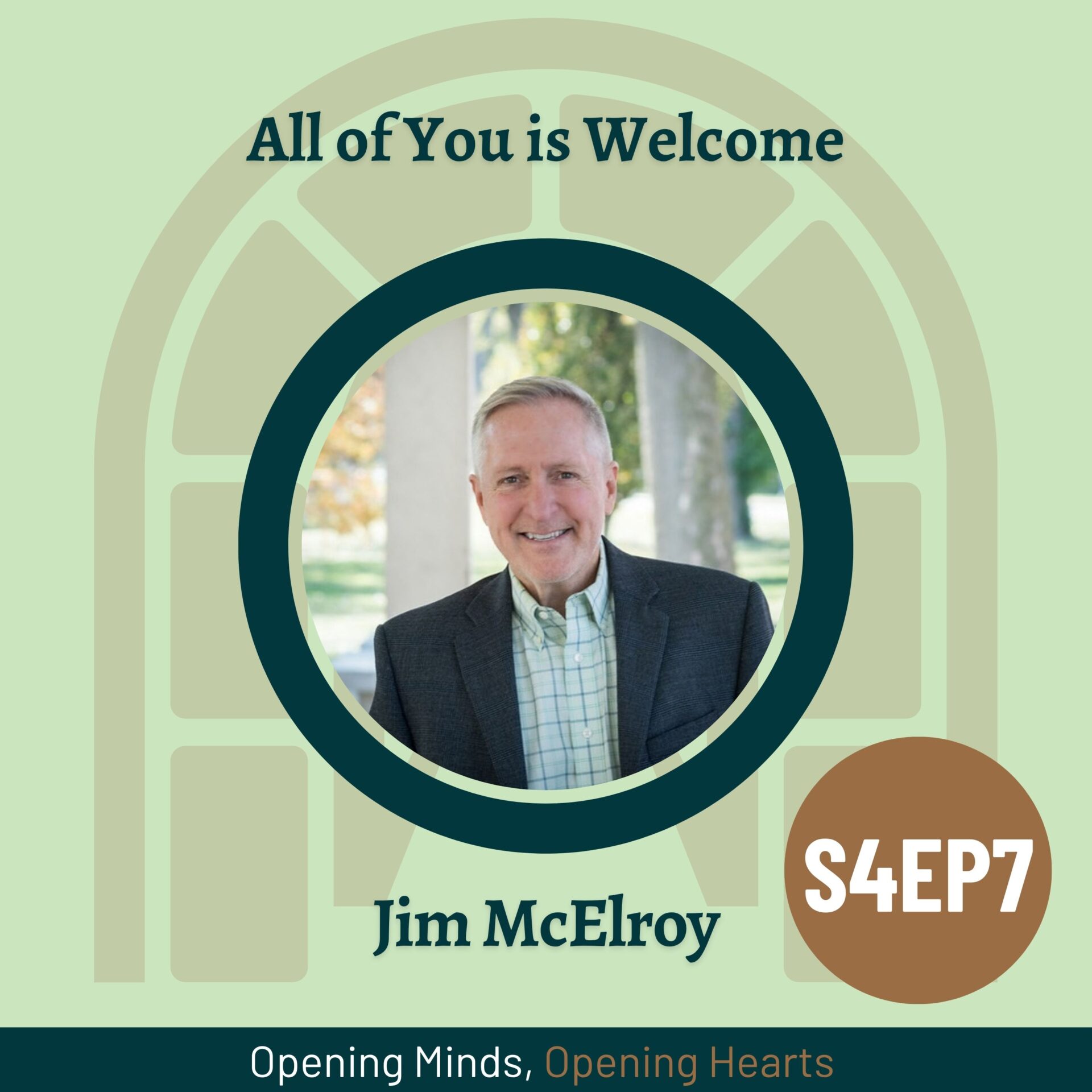
All of You is Welcome
Opening Minds, Opening Hearts Podcast Season 4 Episode 7 with Jim M
Title: All of you is welcome
"Our recovery work is not simply about stopping a behavior. Our work with Centering Prayer, the Welcoming Prayer, and other contemplative practices is about restoring connection, bringing the mind, body, and emotional life back into relationship with each other."
- Jim M
- How Jim came to Centering Prayer through the 12-Step community and found in the practice a pathway to healing that went deeper than recovery alone could offer.
- The deep physical rest that Centering Prayer offers, and how the body begins to heal from years of stress and trauma when we give it the space to truly rest.
- Healing as a transformed relationship to pain and suffering, not as a cure or elimination, where everything can be welcomed and integrated into wholeness.
- How the Welcoming Prayer offers a practical way to work with what arises in our bodies as an opportunity to consent to the divine indwelling.
"When Keating's talking about healing, he's not saying your pain is gonna disappear or your addiction is just gonna end. It's more our relationship to it. The Welcoming Prayer points to this when it says, 'I welcome everything that comes today because I know it's for my healing.' Not because it's gonna fix everything, but because it transforms how we relate to what is."
- Mark Dannenfelser
- 12 Practice for Daily Life: The Welcoming Prayer - Twelve Steps, Thomas Keating: https://youtu.be/i7VcDwgTyas?is=ga1OmV6AkbfCejnp
- Welcoming Prayer resources: https://cp12stepoutreach.org/welcoming-prayer/
- 12StepOutreach Centering Prayer resources: https://cp12stepoutreach.org/
- Visit our website: contemplativeoutreach.org
- Find us on Instagram: instagram.com/prayerofconsent/
- Like us on Facebook: facebook.com/prayerofconsent
- Check out our YouTube channel: youtube.com/@prayerofconsent
If you are a grateful and generous listener who would like to support this podcast, please visit: contemplativeoutreach.org/opening-minds-opening-hearts-podcast-donation/ to make a donation of any amount.
Listen to the Opening Minds, Opening Hearts Podcast NOW for FREE on YouTube, Apple, Google, Amazon and more!
This season of Opening Minds, Opening Hearts is produced by 🫶🏾 Rachael Sanya 🫶🏾 👉🏽 rachelsanya.com
				Opening Minds, Opening Hearts Podcast Season 4 Episode 7 with Jim M

Episode Title: All of You is Welcome

Colleen: Welcome to Opening Minds, Opening Hearts, a podcast about the transformative practice of Centering Prayer. In each episode, we will talk to friends of Contemplative Outreach about their personal practice. Listen in as our guests share insights about the teachings of Father Thomas Keating, how the practice impacts their work in the world, and their thoughts about how Centering Prayer connects to the living traditions of contemplation and meditation.

We are your hosts, Colleen Thomas

Mark: And Mark Dannenfelser.

Colleen: Centering Prayer practitioners and contemplative life seekers who love to talk a little too much about how the practice of contemplative prayer transforms our inner and outer worlds. Our hope is to open the door for you to explore more deeply this powerful practice of Centering Prayer.


Mark: Welcome everybody to season four of the Contemplative Outreach Podcast, Opening Minds, Opening Hearts. I'm Mark Dannenfelser

Colleen: And oh, I am Colleen Thomas.

Mark: Look, I thought you were gone for a moment.

Colleen: I forgot who…

Mark: I thought you left ...

Colleen: …I am. Oh my goodness.

Mark: But we're here. We're here. Yes.

Colleen: We are here. I guess maybe forgetting who I am is a part of the process of transformation, right?

Mark: Yeah. We just don't exactly want it to happen during a, a recorded podcast, but-

Colleen: Right. Good point. Good point. Well, I am present, and I am Colleen Thomas, and I should definitely know where we are and what we're doing by this point because we are more than halfway through our season now.

Jim: Yeah.

Colleen: Yeah. This one is a little shorter this season, and that's fine.

Every time, I feel like we have gotten deeper in this season than maybe I anticipated. I don't know why I didn't think that talking about healing the emotional programs wouldn't drop us into some deep waters. But it certainly has. Even the wrestling that we've been doing with just the concept of healing in general and what it means to people.

Mark: Yeah, the other part of this season that I've been really enjoying too is talking to people really who are sharing more from their own personal experience and from their experience with the practice. So we've had other seasons where we bring in people with particular expertise or whatever, and it's still, that's still here, but we're really been great talking to folks who are just steeped in the practice and them sharing their own experience of that.

Colleen: Yeah. It invites a level of reflection or even just an awareness that is more personal for me as a participant in the conversation. When there's a teaching, I can connect, but I think there is some aspect of the intellectual center being a little bit more activated when I am listening to a teacher. But when someone's sharing their experience on their journey, there are those moments of real recognition of, "I've been there."

And so I really am looking forward to introducing our guest to our audience, to our guest today, Jim M., who has been practicing Centering Prayer since 1996, and he's been a commissioned presenter since 2002. We both know Jim through our work on staff with Contemplative Outreach. Jim has been on, well, what was formerly known as the governing board, and it's how I built my relationship with him, and I believe you as well, Mark.

Jim's also been on the leadership team of 12-Step Outreach since its formation in 2005. 20 years. Wow.

Mark: Hmm.

Colleen: And is especially interested in teaching contemplative practices to the recovery community. And he's also on the Welcoming Prayer faculty, which we'll talk about in this episode today, too.

And he is based in St. Louis, and for a time he was the chapter coordinator for Contemplative Outreach of St. Louis. So talk about someone who has really just served the Contemplative Outreach community so well. We're really delighted to have Jim with us today. Welcome, Jim.

Jim: Thank you very much. I'm so glad to be here. It's a privilege to be with you guys.

Mark: It's good having you here, Jim. Yeah. You know, one thing we like to do with our guests, Jim, is hear just a little bit about how you came to Centering Prayer, and maybe even a little bit of how that's impacted you, perhaps through the lens of kinda the divine therapy.

Yep. But certainly how you came to it and what's happened for you. Yeah. 'Cause there's a lot of years there. We know it started for you when you were maybe eight years old, so it's- ... you're not that old, even though it's-

Jim: That's good, Mark.

Mark: But yeah, how did you first come to the practice itself?

Jim: Mark, I will jump there, but if you don't mind, I just wanna also say that in coming into this, I was listening to a couple of the recent podcasts, and I just wanna give a, just a little bit of a shout-out to you guys because, and I mean this really from the bottom of my heart, your questions and your quotes with your people that you interview are so moving and so inviting, and I just feel like you guys are voices that people need to hear right now.

I know there are many voices in Contemplative Outreach, I know that, but you guys have a special audience, and this is part of the transmission, this is part of the legacy that we'll be leaving, and I just think you guys do a great job. I really do. I hope it goes well today, but-

Colleen: That's what I was thinking...

Jim: i, I'm really hoping.

Mark: We should've had you on sooner, Jim.

Jim: But, but you guys really are doing... And when I say the word intelligent, I mean intelligent fused with wisdom. It's just current, and I love it. I love the fact that Centering Prayer is getting this opportunity to tell the world what it is, and I think you guys do a great job of that So I'll get back to your question a little bit, and I will warn the audience, warn you guys, probably from my 12-Step background, I'm pretty transparent.

I mean, I hope I can be transparent in a loving and kind and helpful way. But the way I came to Centering Prayer was I was about 10 years sober in my Alcoholics Anonymous program, and there was a gentleman who I was going to meetings with almost probably three or four, maybe even five days a week, by the name of Matthew F.

And Matthew had had a relationship with Thomas Keating in Snowmass, Colorado, and had moved back to St. Louis and had gotten involved in Contemplative Outreach of St. Louis, and was going to this meeting. And they set up an introductory workshop at St. Francis Xavier Church at St. Louis University, and he came and invited the entire meeting to come to that intro workshop.

And a lot of us did. It was a big meeting, and a lot of people just wanted to find out what's Centering Prayer, and Matt kind of said, "Well, this is like your 11th step." I mean, none of us knew anything really about Centering Prayer, but we came. And a woman by the name of Diane Guerra and Matt F., they led the intro workshop, and that was my first exposure to it. And I'll just say right after that, they did follow-ups. That was in 1996. We started the first, I would say one of the early 12-Step prayer groups, Centering Prayer prayer groups. And what we did was we would sit, do a 20-minute sit. We would watch one of the spiritual journey videotapes for 20 minutes, and then we would have a little discussion or like a little sharing time.

And that was my first exposure to Thomas Keating and Centering Prayer.

Mark: Hmm. Yeah, for people who might not know, you mentioned the 11th step. That's sought through prayer and meditation to improve our conscious contact with God. So that was a very intentional thing, it sounds like, on your part, to find some practice that might help you do that?

Jim: You know, Mark, that's a great question for me to say that when I was in college, I was in college in the late '70s, and when I was in college, I took a course on TM, Transcendental Meditation, and I loved it And what I felt was I was, like, 18 years old, and I really liked the transcendental experience, but I didn't know what I was doing.

I didn't know; was this yoga? Was it a prayer? I had no context for what I was doing because I was raised in a pretty traditional Christian tradition, and, I just didn't know what I was doing. And plus, I was an 18-year-old kid experiencing all facets of college life, and I just-- the idea of doing 18 minutes twice a day, I mean, it was just... I just couldn't do it.

But the mantra and the transcendental experience stayed with me. And periodically, if I ever felt like I needed it, I would go back and do it, but it just didn't stick. So all these years later, I'm 39 years old now, being introduced to Centering Prayer, and I thought, "Oh, this is like TM."

I was trying to make the connections. And but then I said, "Oh, this is also like 11 step. Oh, this is also like my religious tradition." And all of a sudden, I started making these connections that I did not have when I was younger.

Colleen: Yeah.

Mark: Yeah. That's beautiful.

Colleen: I wanna try to make the connection 'cause this is what listening to your story is making me wonder.

So you tried TM when you were younger. And whenever we hear or think about someone finding a meditation practice, it's automatically this sense of oh, we're seeking something, right? Then you come into the 12-Step community, and there's this 11-step practice that's encouraged. And I think the question that's emerging for me is, what were you searching for?

And that's interesting to me because we're talking about healing, right? And so then it also makes me think about what needs healing? What are we looking for? And I know that's a lot, but just what's coming up for you?

Jim: Boy, you touch me just by your questions. Let me just kinda explain a couple of things I am a gay man of my generation.

I'm 69 years old, and in the early 1980s, I was in my early 20s. I was born in 1957. So I came into recovery in 1986, and that was in the middle of the AIDS epidemic. And I just have to say that I don't talk about that in my everyday conversations anymore. I mean, the AIDS epidemic was– fortunately, we've made so much progress.

It's not eliminated, but those were rough years. For 15 years, the gay community was really devastated by the loss of friends, loved ones, family members, and, it was really also probably one of the reasons I was attracted to alcohol. It numbed some of that loss and pain. So I think you're right. I think even as an 18-year-old, there was a part of me that was looking for something, and I tried TM.

Back then, TM was promising all kinds of things, and I was attracted to that. Better attention, better health, better breathing, all that kind of stuff. And then 10 years after I got sober, so like 1996, am exposed to Centering Prayer, and this time I'm older, and I've experienced a lot in my life at that time.

And I know what sobriety is, and I know what the promises of sobriety is, but I knew when I went to that intro workshop that there was a lot more healing that still had to be done in me. I was still dealing with a lot of anger. I had a lot of anger about a lot of things. I was still dealing with loss. I was still dealing with some unhealed family issues in my life.

And recovery was wonderful. I was working full time. I had a wonderful education by that time, and I was making progress with my career, and there was growth. There was definitely growth. I don't know if we're ever done in this lifetime, but at 39 years old, I was not done. And the idea of a Centering Prayer practice, just the idea of it, and like you said earlier, when Thomas Keating talks about healing the wounds of a lifetime, I think I was ready.

At that point in my life, I was ready. I was open. And this time, unlike when I was 18 years old, when the monks in Snowmass said, "You meditate 20 to 30 minutes twice a day," okay, that didn't seem like that much of a sacrifice anymore. It's like, "If you're telling me I'm gonna heal my life, I'm willing to do that," and I wasn't able to do that as an 18-year-old.

Mark: Yeah. Jim, as you're talking, and thank you for sharing your story, I started thinking about, you mentioned healing the wounds of a lifetime, and often Keating said it as like healing the emotional wounds of a lifetime, but I think that's a, a broad term when he says emotional. But when you were talking about losing so many friends during the AIDS crisis, there's a lot of physical loss there, too, and the emphasis there of experiencing the body, the losses that happen, and through a disease like that, you see the destruction of it. So I'm curious how that impacts maybe even your understanding of the Centering Prayer practice and the healing of the wounds, that the body is involved in that, too, and sometimes we just talk about it as the mind or the emotions.

Jim: Well, you know, Mark, I would be remiss if I didn't also say, and I don't know why this went this direction, but I also lost my first partner to HIV.

And it was a trying time because none of us was eating right, sleeping, just taking care of physical needs, being involved in the community. And I think what happens with the gift of Centering Prayer is that deep rest that starts to happen. I remember going to my very first meetings when we had the introductory workshop and went to my very first follow-up sessions, and we'd turn on Thomas Keating's videos, and Thomas is so wonderful, relaxing, and I would sit there.

I'd last about five minutes, and I was just out. I would just be out. And then sometimes during my Centering Prayer, I would close my eyes, and I would be out. And I like, "I'm not doing this thing right. I'm falling asleep." And what I realized through the help of people who had been practicing a lot longer, they said, "Oh, Jim, don't worry about that.

That's just part of the process. Your body is getting exactly what it needs, and you're catching up from sleep deprivation for maybe many years." And my body started a process of healing. I really do believe that the deep rest that we get in Centering Prayer and we focus on the body, we let go of these habitual thoughts that are going by.

We sit quietly. We start to get comfortable in our own skin. We're not running as much. Our bodies start to heal, and that's really what I think really happened to me in the first years of Centering Prayer. And Mark, five years of really letting myself immerse into the practice.

Colleen: Mm-hmm So Jim, what I'm hearing, and we've used this term already this season, so our audience should be familiar with it.

I'm certain that you and Mark are. But I'm hearing these programs for happiness that have developed, right? And those recently I've started calling them programs for unhappiness, because some of it is like grief becomes a program or anger. These other behavior patterns and thought patterns that influence our willingness to surrender.

And so I wanted to maybe get your perspective on how when we talk about healing the emotional wounds of a lifetime and the gift of healing that is offered to us, but when we've gone through some of these tragedies of life, especially when we have come to make a substance our higher power, so to speak, which is just a symbol of this distrust or fear of this love that wants to embrace us.

So I'm curious how you have come to see the value of Centering Prayer in the 12-Step community through that lens. What is Centering Prayer offering? 'Cause when we talked, you talk about Centering Prayer in the 12-Step community. I guess the simplest question to invite you to ponder with us is why?

We understand the 11th step, but what is Centering Prayer offering a recovering addict

Jim: We know that addiction is more than just uncontrollable behavior or thoughts. It's a kind of uncoupling with the self. Think of two train cars. The intellect may know the truth, "This is hurting me. This needs to stop," but the emotional world is carrying on unresolved pain, trauma, or longing that hasn't yet been integrated.

So a person lives divided. Thinking one thing, feeling another, and acting in ways that don't align with either, and this is what we call our powerlessness. Bill Wilson wrote about the situation very clearly in his article, "The Next Frontier: Emotional Sobriety." He said our unresolved childhood and adolescent behaviors can be emotionally debilitating.

So our recovery work is not simply about stopping a behavior. Our work with Centering Prayer, the Welcoming Prayer, and other contemplative practices is about restoring connection, bringing the mind, body, and emotional life back into relationship with each other. And healing begins when a person can safely feel what was once overwhelming that was split off: grief, fear, shame can gradually, over time, be welcomed back into awareness, not all at once, but gently, often in the presence of another person or with a grounded spiritual practice like Welcoming Prayer or Centering Prayer. So recovery in this sense becomes an act of reintegration.

The intellect no longer has to override the emotions, and the emotions no longer have to hijack behavior. Instead, there's a growing coherence. A person can know, feel, and choose in alignment. There's a recoupling Centering Prayer and Welcoming Prayer nurture this recoupling. And I would say Thomas Keating calls this living in the divine presence or transforming union.

People would probably take this to another level, but for some people that's transforming union, and that alignment is not just psychological, it's deeply spiritual, like a return to wholeness, where nothing essential within us is rejected and everything can be welcomed.

Colleen: Yeah, and that's been a recurring theme this season, this idea of healing as returning to wholeness, at least returning to a sense of wholeness, this idea of becoming who we already are, our basic core of goodness. We've covered all of that. Yeah. And what you just shared summarizes all of that, but also I like the word reintegration. Mark loves that word.

Mark: Love that word. Yes.

Jim: Yeah. Yeah. Yeah.

Mark: That's hard work sometimes, and it's not even a work of, you're rebuilding all that or you're restructuring or integrating.

It's happening as a part of the relationship, right? As you deepen your relationship with God and through the practice.

Jim: Yeah. Yeah.

Mark: And so to me, you mentioned the Welcoming Prayer. There's a whole lot of consenting going on there, which that's what we understand from Centering Prayer. The sacred word represents our willingness to consent. Doesn't mean that's easy to do. But it says that we're willing, and it seems to me that the Welcoming Prayer helps to support that.

Jim: I think so too.

Mark: Yeah. How do you use the Welcoming Prayer? Maybe you could say a little bit more about that, and in that process of integration or reintegration, returning to yourself.

Jim: You know, Mark, when we start a Centering Prayer practice, I'll speak for myself. I didn't know what everything was involved here. I didn't know what was really gonna involved. I didn't know what was really happening. All I knew is I was gonna follow the directions just the four guidelines, and I was gonna do that.

But, from that little Centering Prayer group that met after that intro workshop into what we have today with 12-Step Outreach, there's a story there, and I think part of that story I'd like to share just a little bit because it keys in on what you're talking about. At the same time, in the 1990s, what was happening in St. Louis with this intro workshop, there was stuff going around all around the country. There was a gentleman by the name of Donald Masters, who was an attorney, very good friends with Thomas Keating, Matthew F., And some other people who were involved in Centering Prayer, and Donald was also a recovering person.

He was a recovering alcoholic and really struggled with his addiction. But he knew that in order to get sober, he was gonna have to enlarge his spiritual life. He knew that. So he lived in Denver and started going over to Snowmass and doing retreats, and he developed this relationship with, like, Pat Johnson.

And Donald was really struggling with his disease and would have periodic relapses. He was a Vietnam vet, and he had a chronic back problem due to an injury, and what would happen was when the back pain would flare up, his doctors would put him on opioids, which would, in turn, aggravate his alcoholism, and he would just... he was in AA for more than 30 years, but periodically, he'd have to go to treatment again. And so one time he got the opportunity to share this with Thomas Keating And he shared what I'm about to tell you at a retreat when he came to St. Louis in 2000 to lead a 12-Step Centering Prayer retreat. And he tells the story that he went to Thomas Keating and said, "Thomas, I'm still struggling with the addiction."

And Thomas said, "Hold on a second." He goes, "Describe to me what happens when you sit down in Centering Prayer." And Donald said, "I sit down, I close my eyes, I introduce the sacred word." And he said, "Then I feel pain in my back from this PTSD. I'll have sometimes visions from the past. And he says, "It's all I can do is just to sit there and return to the sacred word."

And he said, "It's really hard for me sometimes to do it for 10 minutes, 15 minutes, 20 minutes." So he's telling Thomas this, and Thomas says to Donald Masters, he says, "Donald, I hear it. It sounds really difficult." He said, "I'd like you to try something. I'd like you to use some of that pain and some of those visions that you see as your sacred word."

And Donald said in that moment when Thomas said that to him, it was like a transference. It was like something happened, and he realized that Centering Prayer or not, all he had done all his life was try to run from that pain or try to control the pain. And he realized when Thomas said, "Use it as your sacred word," he said, "For the first time in my life, I thought, 'There's another way to deal with pain.

There's another way to experience it. Your word, integrate it, be with it, welcome it.'" He said there was another way to do that. And he said it wasn't that the pain was not as intense after that, but he said, "I was able to be with it as my consent to God's presence and action within." He was able to use it as his sacred symbol.

And he said it changed everything for him. And when he told me that story, I was like, "I'm in. This is it." 'Cause I realized, like most addicts, we run from pain. We, that's just what we do.

Mark: In the Christian tradition, contemplative prayer is the opening of your mind and heart to God, who is beyond thoughts, words, and emotions. Centering Prayer is a method designed to facilitate contemplation. The method suggests four guidelines. One, choose a sacred word as the symbol of your intention to consent to God's presence and action within you.

Two, sit comfortably and relatively still. Close your eyes or leave them slightly open, and silently introduce your sacred word. Three, when you notice you have become engaged with a thought, simply return ever so gently to your sacred word. And four, at the end of the 20-minute prayer period, let go of the sacred word and remain in silence for a couple of minutes.

The additional time invites you to bring the atmosphere of silence into everyday life.

Jim: So when Donald's telling this to me, and this was in about the year 2000, I would say, at a retreat. I'm meeting him for the very first time. He gives the Friday night talk, and he's saying, "This is what Thomas Keating told me to do." And I thought, "All right, there's another way to deal with pain." And then we go into the Welcoming Prayer, and the first movement of the Welcoming Prayer is to feel and sink into what you are experiencing this moment in your body.

And as we practice the Welcoming Prayer, and we practice in little things, just like getting into that hot jacuzzi, we do it little by little. And as we know the difficult person at the Thanksgiving meal, and we know, "Boy, I'm likely to get triggered by this guy. I'm gonna visualize this, and I'm gonna welcome what comes up for me."

We start just to, like, welcome, and we practice welcoming as an opportunity to consent to the divine indwelling. So that welcoming and feeling it, feeling it in your throat, feeling it in your chest, feeling it, a pain in your shoulder or your elbow or your knee, we start to use that experience, that sensation as an opportunity to consent.

And all of a sudden it starts to mean something different. It starts to mean something different, and we're bypassing the cognitive part of the pain that we oftentimes feel. And instead of going off on splitting off or telling the same old habitual stories that we have for all these years, we're starting to experience that presence.

We know that we're not alone, and we can just kinda, like, be with it in a new way. I think that's part of the transformation. I mean, everybody's gonna experience this differently, but I think that's part of the transformation that happens. And in the moment, we might think, "Dang, I did this Welcoming Prayer."

But in my experience, if you give it a legitimate shot, if you prepare yourself and just let yourself experience it, I believe that's transforming. And then we're just kinda like open. It's like that sequence of thoughts and behaviors that happen after one of those experiences, that doesn't seem to happen.

Something has shifted. There's an openness. There's a, a willingness to see something new this time. And little by little, we start to dismantle some of that old stuff. Yeah.

Mark: Yeah. Which is very transforming. I can imagine some of our listeners saying, "Well, why would I wanna welcome pain, especially pain in my body?

Why would I wanna welcome that? That's so difficult to do." So that by itself, your willingness to even do that, even just a little bit, is transformational because this isn't about curing. When Keating's talking about healing, he's not saying, "Okay, your back pain's gonna disappear, or your addiction is just gonna end, and that's gonna be it.

You're gonna be free." Like in that sense, it's more our relationship to it, and the Welcoming Prayer kinda points to it when it says, "I welcome everything that comes today because I know it's for my healing."

Jim: Yeah.

Mark: Not because it's gonna fix everything, or I'm gonna feel better, and it's in my way of thinking of it.

So I think you're highlighting that, that your whole relationship to whatever it is, the pain, it shifts. And maybe that's still there. Maybe you still have low back pain but your relationship to it is different.

Jim: Yeah. And I think Thomas Keating would even maybe take it a step further, that the divine love, the divine therapist, the divine physician, is longing for our openness to turn it over to.

It's a different way of turning it over and wants to couple with us, wants us to be able to be with it, and allowing the higher power or the divine therapist to be with us in that process and transmute it. I don't think God wants, wants us to suffer, but I think can help us find the value, the transformation in suffering.

Certainly, God doesn't want needless suffering for anybody. Yeah. And I never want to minimize anybody else's pain or experience because I know it's hard. It's been very hard for me to sit with my own stuff, very hard, but there's an opportunity here, and I think it's like any new endeavor. Sometimes we do have to go into the deep waters, and that's what we encourage in our 12-Step Centering Prayer retreats and, with Contemplative Outreach overall.

We're inviting people to check it out. Thomas would say, "Sit down and invite God in. Let Him introduce Himself. See what happens."

Colleen: Yeah.

Jim: Try it.

Colleen: I'm seeing this connection to the 12-Step work when the work of resentments, and doing a 10-step inventory and the spirituality behind the practice of letting go of resentments, that we don't wanna hold anything that blocks the sunlight of the spirit.

And as I'm hearing you talk about, particularly I love illustrations like what you shared about Donald with the physical pain and then the invitation Father Thomas gives him to welcome it, because we call the sacred word as a symbol of our intention to consent. And if I think about physical pain or what it sounds like he was experiencing, PTSD, as a symbol of my intention to consent to the presence and action of God within, that's really deep.

What is really coming up for me that's connected with this thought that hasn't fully formed is this is from the Welcoming Prayer video series, and Father Thomas says in this, I don't remember which teaching there. It's a great series, by the way, all on YouTube. But he says, "I give up my desire for inordinate affection and approval, and finally, I give up my desire for power or control."

There's also a saying, he says, that sums up all three, but it doesn't identify them. But sometimes you don't have to go through that little menu, he calls it, of power, security, control, affection. He says, "You could just say, 'I give up my desire to change the situation.'" Then he says, "Boy, is that a hard one to say."

But that's what I hear in this invitation for Donald, for me. Just give up the desire to change the pain or the circumstance, the person, whatever it is. And that really speaks to the human condition because at any given moment, there's something I wanna change. I wanted to change the dog to be a dog that doesn't bark.

Jim: Yeah.

Colleen: It's at every moment of the day. And then he says, "It's the desire..." He says, "Now it's the desire for security or the craving for security, the unlimited character of the desire that is the problem, that is the source of the frustrating feelings and the afflictive emotions." And so as long as my desire mechanism is consumed by this intent to change things, how can my desire be consumed by ultimate reality, what is, presence?

And that's the invitation I hear underneath of it all. It's like this competition of desires. I'm either constantly desiring for something to change, or I am giving it up, accepting what is, and then I'm in a posture of receptivity or openness to being, is-ness. It's why Centering Prayer and this process is so difficult to talk about.

But I see that in Father Thomas's teachings. It's that thing that Mary Dwyer always reminds us that Father Thomas said, "What would you want more? Why would you ever want anything more than your divine birthright?"

Jim: Yeah. Yeah. Exactly. Yeah

Colleen: Jim, maybe as we start moving towards closing, I just wanted to get a little more practical insight as to why do you teach Welcoming Prayer as a companion to Centering Prayer, and maybe in particular in the 12-Step community?

Jim: Okay. You know, Colleen, I think one thing you can say is people who are already attending a 12-Step program, they're at different levels maybe of recovery, but they've all admitted they're powerless over something, whether it's an, an addiction, a relationship, that fundamental idea of powerlessness, that is pretty core to the recovery for an addict.

I mean, usually you have to really hit something hard and realize, "I'm never gonna be able to do this on my own. I have tried every way to control this, to stop this behavior, to stop this thinking, this ti- this way of being in relationship. I have done everything."

Colleen: Yeah.

Jim: "I'm done. I surrender." And in that recovery process, you're gonna have to eventually come to see or feel those emotional wounds of a lifetime.

That's just the way it is. There's step work, fourth and fifth step work we do, with face-to-face, but ultimately we have to feel our own stuff. One thing we know for sure is that purification, that healing of the unconscious that Thomas talks so beautifully about, it doesn't just happen in those 20 minutes.

We can be triggered any time of the day. We can start to minimize the effects of the emotional programs for happiness. We can start to minimize that. So we offer the Welcoming Prayer practice as people come to meditation, they usually think, "Oh, I'm gonna find serenity. This is gonna be my carpet to bliss."

And I think we all know it's more like taking the lid off the sewer sometimes. It can really bring stuff up because that's part of the healing process. But the Welcoming Prayer, in my mind, is just another way for people to start to heal those emotional wounds. Welcoming becomes like a sacred word. And the whole idea of surrender and consent and allowing their emotions to be experienced in their bodies. 'Cause I think that is fundamental to the Welcoming Prayer, is to really be open to feeling and experiencing what is happening in our bodies, and it takes a long time to get there. It's not an easy thing to do.

It's like somebody's really angry, well, feel that. It's not easy just to feel that. But we do the body scans and various mindfulness. We try to help people be aware of what is happening in their body as they experience some of these emotions.

Mark: Yeah. I'm glad, Jim, you're pointing to that connective tissue, and the words that we've been using, to me, that are staying with me is there is a powerlessness that we have to acknowledge, whether that's through a 12-Step recovery program or just the everyday challenges of our life, and that there's a, in Centering Prayer, we call consenting, recognizing this powerless.

So we consent, we give it over. Or now we're talking about welcome prayer, too. That's another word for it. And I think that's really the essence. Keating said that, too. The divine therapy is a process of inner transformation, and then he says it's a conversation initiated by God and leading, if we consent, to divine union.

Colleen: I wanna ask this. So I'm going to. I'll preface it by saying if someone asked this to me on a panel or on a podcast, I'd probably be like, "Oh my gosh, why are you asking me this?" But I'm gonna do it anyway because it's sitting with me ever since, Mark, you said that line from the welcome prayer, "I welcome everything that comes to me today because I know it's for my healing."

And we're talking about healing all season, and then we're saying we're welcoming everything for my healing. What is that? Like, how does welcoming connect to healing?

Jim: Hmm. Okay. Colleen, first of all, I wanna say this, and that is the version of the Welcoming Prayer that you just quoted is an older version.

And the second movement of the Welcoming Prayer is to welcome what I'm experiencing this moment in my body as an opportunity to consent to the divine indwelling. So let me just make a little nuance here. We're not welcoming bad experiences. We're not welcoming somebody in your face, somebody being disrespectful.

We're not welcoming a bad illness, bad news. We're not welcoming harming anybody. We're not welcoming that. We're not welcoming that. Those are circumstances beyond our control. What we are welcoming are the sensations in our bodies as an opportunity to consent to the divine indwelling. So in essence, that second movement of the prayer to welcome what we're experiencing in our body is our consent to the divine.

Mark: Well, I love the way you described it, Jim, because you're talking about inclusion, like you're welcoming all of it. And to me, that's what healing is. It's wholeness. So it's not separating out.

Colleen: Getting rid of this.

Mark: Yeah, like, "Oh, that's bad," or, "I notice this, but I don't want that, so I'm gonna..." You know.

And of course, we have to discern things and make decisions, and some things we let in and some... But overall, it's being willing to see it and let it all be there without reacting necessarily to it or having it impact your life in a negative way.

Colleen: And that's important too. That's important, Mark, but that was at the heart of that question that I asked, is that the relationship between welcoming and healing, it changes the image of healing to what we've been talking about this season as healing, not as getting rid of something, but healing as integrating.

Jim: Consenting, integrating, grounding ourselves in the present moment. Centering. When we focus on our bodies, we are focusing at the core of our being, the source of our being. That's what we're doing. We're putting our attention on our  hearts, the very most center of our being. Not the heart muscle, of course, but the center of our being. That's what we're doing. That's what we're opening up to.

Mark: Beautiful.

Colleen: Oh, it's fantastic.


Thanks for joining us on this episode of Opening Minds, Opening Hearts.

Visit our website contemplativeoutreach.org to subscribe to the show on Apple Podcasts, Spotify, and wherever else you listen to podcasts. You can also follow us on Instagram at contemplativeoutreachltd. To learn more about our guests and their work, you can find info in the show notes for each episode.

If you enjoyed this episode, you might want to check out our YouTube channel, C-O-U-T-R-E-A-C-H, COutreach. Thanks for listening, and see you next time

Season 4 of Opening Minds, Opening Hearts was made possible in part by a grant from the Trust for the Meditation Process, a charitable foundation encouraging meditation, mindfulness, and contemplative prayer. We are extremely grateful for their support and would be grateful for any additional support that you as a listener might offer.

Your donation helps Contemplative Outreach to freely offer the wisdom of the contemplative tradition and Centering Prayer to all who are interested. If you are a grateful listener and would like to support this podcast, go to contemplativeoutreach.org/podcast to make a donation of any amount.


