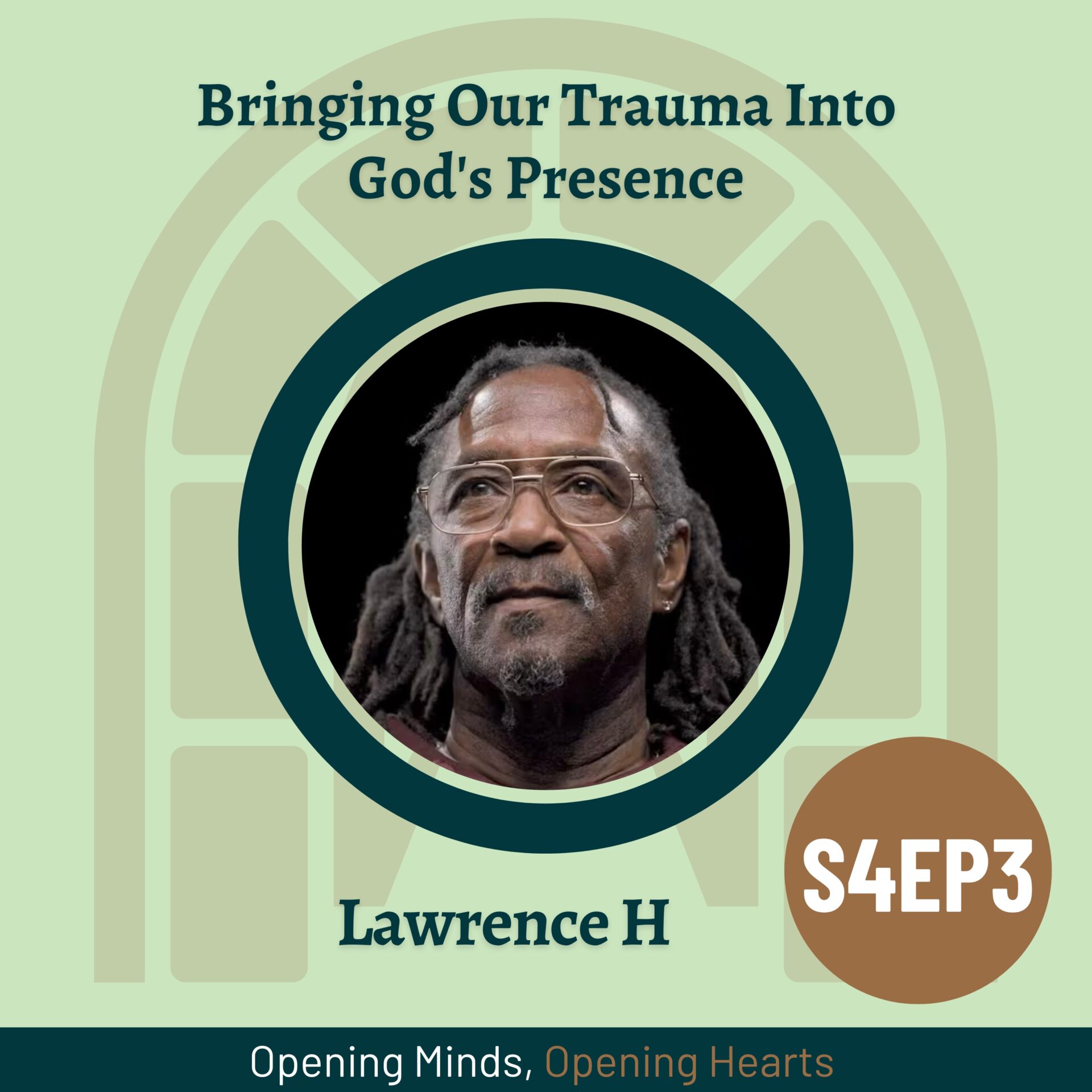
Bringing Our Trauma Into God’s Presence
Opening Minds, Opening Hearts Podcast Season 4 Episode 3
with Lawrence H
Episode Title: Bringing Our Trauma Into God's Presence
"I think for me, what it is is bringing my trauma into God's presence. And because there's light and love in everyone, when your trauma comes to the light and feels the love, it transforms it. It doesn't necessarily change it, but it transforms how you accept it."
- Lawrence H
- How Lawrence came to Centering Prayer through the devastating loss of his son, addiction, and a 20-year prison sentence, and how sitting in silence became both a refuge and a turning point in his journey toward healing and wholeness
- The dark night of the soul as understood through the teachings of John of the Cross, Gerald May, and Father Thomas Keating, and why it is not something ominous but a hidden and profoundly good work of liberation happening beneath our conscious awareness
- The sequence of thought, emotion and action, and how the practice of Centering Prayer creates a space in between that transforms our relationship to our own inner life and, ultimately, to the world around us
- Lawrence's ministry of bringing Centering Prayer into prisons, what he has witnessed in others and in himself, and why he says he goes back not to teach but to learn
- How kindness, compassion and care as lived disciplines flow naturally from a deepening contemplative practice, and why Lawrence believes healed people heal people
"The dark night is a profoundly good thing. It is an ongoing spiritual process in which we are liberated from attachments and compulsions and empowered to live and love more freely. The darkness of the night implies nothing sinister, only that the liberation takes place in hidden ways, beneath our knowledge and understanding, mysteriously in secret and beyond our conscious control and always works to our benefit."
- Gerald May
- The Prison Contemplative Fellowship/Praestolari: YouTube Channel
- Catholic Prison Ministries Coalition to view the documentary: Holding Still
To learn more about the mission of Contemplative Outreach’s Prison Outreach Service Team (COPOST), visit: contemplativeoutreach.org/prison-outreach-homepage/
- Visit our website: contemplativeoutreach.org
- Find us on Instagram: instagram.com/prayerofconsent/
- Like us on Facebook: facebook.com/prayerofconsent
- Check out our YouTube channel: youtube.com/@prayerofconsent
Listen to the Opening Minds, Opening Hearts Podcast NOW for FREE on YouTube, Apple, Google, Amazon and more!
This season of Opening Minds, Opening Hearts is produced by 🫶🏾 Rachael Sanya 🫶🏾 👉🏽 rachelsanya.com
				Opening Minds, Opening Hearts Podcast Season 4 Episode 2 with Lawrence Hamilton

Title: Bringing Our Trauma Into God's Presence


Welcome to Opening Minds Opening Hearts, a podcast about the transformative practice of Centering Prayer. In each episode, we will talk to friends of Contemplative Outreach about their personal practice. Listen in as our guests share insights about the teachings of Father Thomas Keating, how the practice impacts their work in the world, and their thoughts about how Centering Prayer connects to the living traditions of contemplation and meditation.

We are your hosts, Colleen Thomas and Mark Dannenfelser, Centering Prayer practitioners and contemplative life seekers who love to talk a little too much about how the practice of contemplative prayer transforms our inner and outer worlds. Our hope is to open the door for you to explore more deeply this powerful practice of Centering Prayer.

Mark: Welcome to season four of the Contemplative Outreach Podcast, Opening Minds Opening Hearts. I'm your host, Mark Dannenfelser,

Colleen: and I'm your other host, Colleen Thomas.

Mark: Good to see you again, Colleen.

Colleen: Always. Mark, always good to be with you.

Mark: We've had so many good conversations already, really for me, deep and inspiring conversations, and I think we're coming up on another one today.

Colleen: Yeah. Yeah. And talk about deepening, we're actually gonna take a pretty deep dive today. We've been having these conversations about healing the emotional wounds of a lifetime, and the role of the shadow in Centering Prayer. And in his teachings on Centering Prayer, Father Thomas spends a significant amount of time unpacking what is known in the Christian experience as our journey through the dark night.

And he builds on teachings of the mystic John of the Cross who coined this phrase, dark night.

Mark: Sounds ominous.

Colleen: Yeah, it does, right? It does. And, I appreciate too that Keating brings in Gerald May, who really did some seminal work around the Dark Night of the Soul, which is an amazing resource for deepening our understanding about this process.

But it's funny you use the word ominous, and that's often what we think when we hear about Dark Night, that it's something dark and ominous. And I think in the Spanish it's known as 'la noche oscura' and that's interesting because it really speaks more to mystery than like evil.

Mark: Yeah. Yeah. Yeah. It's intense language.

And of course a lot of that it's coming outta John of the Cross who's like 16th century. But one of, I think one of the many gifts that Thomas Keating left for us was that he took that, even some of the language from that, that was more 16th century type stuff and he brought it into today, and I think that's very helpful that he called the dark night really, the divine therapy, something else is going on there that's really a good thing. We're getting deeper.

Colleen: Yeah.

Mark: He understood in that sense that this was a divine work going on in us, a divine therapy, and it takes us deeper going through that process.

Colleen: Yeah. I think it's worth sharing, and there's so many resources about this topic in the Spiritual Journey series on our website, on the Contemplative Outreach website, again referencing Gerald May and Gerald May says, the dark night is a profoundly good thing.

It is an ongoing spiritual process in which we are liberated from attachments and compulsions and empowered to live and love more freely. Oh, and here we go. The darkness, he continues, of the night implies nothing sinister, only that the liberation takes place in hidden ways, beneath our knowledge and understanding, mysteriously in secret and beyond our conscious control and always works to our benefit.

Mark: It makes so much sense. It's a great quote and it's definitely where Keating was working that the whole false self thing, he thought, was not false like bad, but this identity that we built up or was built up in us for these false security and approval systems and all that. And the invitation is that we let go of that and we go to some other deeper place in our relationship with God.

Colleen: Yeah. Especially, I like this part about beyond our conscious control, that the dark night is an opportunity for us to be led somewhere beyond where we would choose to go.

 : Mm-hmm.

Colleen: And there is an aspect of this journey, the whole essence of surrender, really, that we give up control and this whole conversation about healing, I think, I'm becoming more aware that I have little to do with this healing process than to consent to it.

Mark: Yeah. I'm still learning that. I get it about giving up control. It's just that I wanna control giving up control. You start to realize that letting go sounds easy in a way, or letting God take over, but it's, for me anyway, so conditioned.

Colleen: Of course. Of course. And that's the whole practice.

That's why we keep practicing Centering Prayer so that we can just continue to practice letting go of our attachments in our 20 minutes, one thought at a time. Millions of opportunities to attach and we say, yes, I will remain here.

Mark: Yeah, and just the willingness to actually sit for 20 minutes, is the beginning of that. To sit in silence that's beyond working it all out, and then all the distractions start to fall away, and then it's just you and God and the rest of the world, I guess. But

Colleen: Yeah, absolutely.

Mark: Our guest today is somebody who can really shed a lot of light on some of what we've been talking about, so I'm anxious to introduce our listeners to Lawrence Hamilton, who was introduced to Centering Prayer while serving time at Folsom State Prison in California in 2009.

He now serves retreats with Contemplative Outreach's Prison Outreach Team, regularly volunteering in prisons where he shares the transformational practice of Centering Prayer. He's a frequent presenter at Contemplative Outreach conferences and for good reason. Lawrence was also featured in this, what I think, riveting 2021 documentary entitled Holding Still. It was a collaboration by Prison Contemplative Fellowship and Catholic Prison Ministries, and it's all about really the healing power of Centering Prayer, and in this case specifically in correctional facilities. Lawrence is also a father, a grandfather of 13 and a great-grandfather of seven. That sounds like a lot of work, and wonderful.

He's also a 12-Step sponsor and he is active right here in my hometown, here in the Atlantic community where he is been residing since 2021. So welcome, Lawrence.

Lawrence: Thank you for having me. It's a pleasure.

Mark: So good to have you and to see you again.

Colleen: Yes, it is. It is. Last time I saw you was in Atlanta, I think two years ago now for the global conference.

Lawrence: Yeah, that was great too.

Colleen: It was.

Mark: So Lawrence, as we begin today in this conversation, well, we've already begun in the conversation, but upfront we like to ask all of our guests, if you would just spend a couple minutes just telling us about how you specifically came to the practice of Centering Prayer.

And we'll say more about this as we go, but you could also say a little bit about how that practice has impacted you. Maybe even in light of this overarching theme that we have this season of the Divine Therapy, but start with telling us, how did you come to Centering Prayer?

Lawrence: Well, my life had really got frustrating.

I was addicted to drugs, alcoholic, and my oldest son got murdered in Oakland in 1995, and it sent me into the deepest, darkest depths. All I could do was think of vengeance. Luckily 'cause of God, I wasn't able to enact all the vengeance that I had in my mind to enact. But I did end up in prison with a 20 year sentence and at 55 years old, that was horrifying.

It was like, this is the end of my life. I was so depressed and as I started walking the yard and meeting people, I met a guy there, Harold, he's still incarcerated, but he had 153 years, and for the life of me, I couldn't figure out how someone with 150 years could be so peaceful, so calm, so open. As I started walking and talking with him, I actually followed him into the Grace Stone Chapel where I met a guy, Ray Leonardini, who was facilitating the Center in prayer, and he said something that I've never forgotten.

He said, An intimate relationship with God. I was like, wow. Because sometimes we always think we have a relationship with God. You know, God is a guy you pray to that you don't get caught or that you get what you need, but the intimate just being in God's presence. So when we started practicing, luckily for me, I think the way that God felt my need, I immediately started feeling that presence and that presence took over everything and whatever was going on, he was just, if I could just get here and sit in this presence, we were doing it once a week for like 20 minutes, and then we'd have a discussion. Some people it was difficult, you know, they didn't get to the immediate peace, but I guess God saw my need, and from that peace, it was able to stabilize some of the things that were going on because for me it was thoughts, and thoughts creating an emotion, and that emotion bringing forth an action.

And then through the process of Centering Prayer, which is letting thoughts go, I was able to disconnect the thoughts from the emotion. So that thought would come and the emotion would come, but there's a space in between. So now I'm letting the thought go. I'm riding the emotion and the action is just sitting still.

And there's something in that stillness. I've been trying to figure out ways to describe it. It's just indescribable, but it's something in that stillness where God's presence is definitely a grace. It's a gift from God where your presence meets his presence and your presence merges, and in that presence, it's just indescribable.

I get like, how can the world be in so much turmoil, but how can just by coming into the presence of God, it makes it okay. And I realize what it is. It's almost like that thing with the footsteps. When you're thinking, God, you left me. No, God hasn't left you. That's when God is holding. So being held in that presence, I was able to just come to myself.

That's what I think, Centering prayer is. And I always believe, from that learning Centering Prayer, and I'm committed to this, that there is light and love inside of every human being. There really is light and love. And if you connect to that light and love, your actions will start coming in line with light and love. And I think that's what was happening to me and it's still happening.

I do still struggle. When things are going on, they break through the peace, but it's just always come back to center, come back to center and God will make a way for you.

Colleen: Yeah, you said a lot there and just picking up from the last thing you said, sometimes I still struggle. I think that we can all relate to that, and in the context of this season's conversations about healing, I'm reminded always that this is an ongoing journey, healing.

It's not a one time event, and I'm curious. What do you think healing is? You said connecting to light and love, and in a way that this healing is coming to awareness of who we are, it tends to take us through a fair amount of pain and suffering, but do you have a framework? What's Lawrence's framework for healing, from your experience?

Lawrence: I think for me, I just have a kind of a active mind. My mind wants to make a story about everything, so if I'm in a negative spin, my mind will make this negative story up. But I think for me what it is is bringing my trauma into God's presence. And like I said, because there's light and love in everyone, when your trauma comes to the light and feels the love, it transforms it.

It doesn't necessarily change it, but it transforms how you accept it. Some things that happened that you looked at as being really devastating, when you look back, you see as devastating as it was, God was showing you his fidelity to you and showing you your resilience. When I first heard the saying that we have a God that protects you from nothing but walks with you through everything, I was kind like, man, I wanna be protected. I don't wanna be, you know, but I see what it is is because God made you out of himself or itself, God knows that you're resilient. So everything that happens is really just something that is happening on the lower level, where that connection is, there's the stability.

I think that's where you connect with your real eternal life. Your real life. 'cause everything we do in the world. Not everything, but for wants for needs for what we have to do, it's just life, and all life for me comes back to wellbeing. No matter what happens, it's a war, it's a tragedy, it's a death, it's a trauma.

But somehow, God's presence brings that back to wellbeing. So the wellbeing that is God's presence is the real existence, and everything else that's happening is just something to learn from, I guess, or something to grow from.

Mark: Hmm. That shifting, when you said that you bring your trauma into God's presence and then it transforms and then I think you said it doesn't necessarily mean it changes the externals about it, but something else changes.

Something else is transformed once we not even be in the presence of God. 'cause we're already there, but we start to recognize it. But I don't know in my experience that's tough at times. In Open Mind, Open Heart, Keating says the chief thing that Centering Prayer does is to unload the unconscious. That sounds good, but it also sounds challenging that this purification process, he sometimes called it, and you're saying this transformation.

What's helped you with being able to continue sitting when all that stuff starts emerging? The traumas and the hang up still, and the aspects that are not easy, at least from my perspective, to let go of. What's helped you to continue sitting?

Lawrence: Sitting becomes like a refuge, but it's more than that. When I'm able to just look and see with trust that God actually does have it, it doesn't feel like it.

I know we were gonna talk about the dark night. To me, it's one of the most devast— You know, you have connection with God, you almost don't have connection with anything. Life seems futile. Life seems useless. And it's almost like in that thing about the footprints where God says, well, why would you leave me?

And when you find out that God hasn't left you, God is carrying you. 'cause like you said, you're always in God's presence because God never goes anywhere. He says he'll never believe you or forsake you, but you can let some situations overwhelm you. This has been my thing. No matter what has happened to me, ever since I've come in contact with the Centering Prayer, and a lot of things have happened, but I always know God has got me. And there's something about that assurance if you just know that God's got you. For me, it was like thinking of a chrysalis, how the caterpillar crawls on the ground and before you know it, he's wrapped up in whatever he's wrapped up in and then he is inside this cocoon and he's dissolving inside this cocoon. It's probably horrible, but the thing about it is, while that Caterpillar is in that cocoon, you cannot break in there. If you try to break in and help him, all you're gonna do is make it. It's something about the stro that pushes that fluid into the wings, and when he's able to tear out that cocoon, he's able to fly. So he's become a whole new creature. Instead of a creature that crawled on the ground, now he's a creature that's flying above.

And sometimes when you're talking about the unloading, you're sitting there and you feel like you're in that chrysalis and you're just melting inside. You wanna wiggle, you wanna wobble, you wanna sigh, but you just maintain, look, all I'm gonna do is sit here and be still.

Hmm. And from the strength of sitting and being still, it actually pushes that fluid into your, whatever it is, your wings. And when you come out, you are flying above it. And you're not realizing how, but that's just the process that life is taking you to the next level.

Colleen: Yeah.

Lawrence: Yeah.

Colleen: I feel like I wanna back up a little bit, even though I'm sitting with that. I don't know why I've never had or heard that image before of the experience of sitting in Centering Prayer as like being in cocoon where you wanna wriggle and move around, but you just hold still.

Because that's so true and it really debunks this idea that I think is often associated with Centering Prayer and meditation practice, that we are sitting in this very peaceful, blissful experience, and it is so often not that, especially when our prayer life deepens. But something you said earlier too, Lawrence, when you talked about how you came to Centering Prayer and how you came to Folsom and saw the chapel, but just before that you said life had become so frustrating.

That stood out to me, and then it's like, oh, and that's how Thomas Keating also talks about the frustrations of the emotional programs. He uses that word frustration. And it's really difficult to talk about the dark night as a stage of our spiritual journey, because there's background teaching to this.

Part of the process of arriving to this dark night is through this frustrations of the emotional programs for happiness, because when Keating describes the spiritual journey, we get to the frustrations of the emotional programs for happiness first. And I feel like before we continue and really open up this conversation about the dark night, can you share a little bit about life before Centering Prayer that gives some story to life had become so frustrating?

What was happening?

Lawrence: I think I was just wrapped up into the circumstances of my life. I grew up in Oakland in the ghetto, and you know this alcoholic, drugs, you're involved in that environment and next thing you know your criminal behavior. So it's like the thought will come, the emotion will come, and then here comes the action.

And while we were sitting in prison, I always tell everybody, you know, we're not in here because of our thoughts and our emotions. We're in here because of our actions. And it's something about that last part, holding still, if you can withhold your actions long enough. I don't wanna say— I do wanna say it's almost magical. God fixes it. And he doesn't fix it according to our emotional program for happiness, we want safety and security. We want power and control. And it's almost like we've said, I need these things to be happy. I need these things to be fulfilled. But when Jesus said the kingdom oh heaven is within, when you go in that place, you get that fulfillment right there, and that's where the fulfillment is.

So then when you're out into the world, you're already happy, you're already okay, and you don't really need anything to make you okay. God's got you and God will take care of you through everything that happens in your life.

Mark: You know, when I was watching Holding Still, you were talking in that documentary, it's kind of this thing that you would just mention now about thoughts come and emotions, and then actions come from that.

But it doesn't always have to be that way, that sequence either. And the thing you said in the documentary was that thoughts are always taking you away, but you just sit there and pretty soon, you're able to not have to react to them. The thing you said that really touched me was that between the thought and the next thought, there is that silence. And in that silence you can hear God's voice.

Whereas if you're just caught up in all of it, then it's, there's a lot of noise going. It's hard to hear God's voice. And then you said that God is the silence between thoughts. That sounds challenging. I think maybe that's why Keating said return ever so gently to the sacred word, 'cause all that stuff is coming up. So I just wonder if you might say more about that.

Lawrence: To me, that's where it's at. 'cause I'm still subject to my own criticisms and recriminations about, you know, look at you, you used to be a hardcore person. Now you're a big old teddy bear and a big old softie. You know?

And I know some people are big teddy bears or big softies, but I actually enjoy it. But it's just that when you're sitting in silence, there's no judgements. There's no right or wrong. You're just there. And for me, life is naturally buoyant. It's like the cork analogy. There's a cork, and those thoughts, those emotions are holding that cork down.

You don't have to do anything except let those thoughts go, and when you let those thoughts go, life just automatically [unintelligible] you. I think that's what a lot of times that people don't understand about Centering Prayer practitioners is that we're just being lifted by life. It's not that we're over ah, happy about this, happy about that.

It's just that life is just buoyant. I keep thinking about this thing my father used to tell me, it was a joke that he would always tell me. He would say, son, I saw this guy and he was beating his head against the wall. Bam. Bam. Bam. He said Blood was come outta his head.

And I went over, I grabbed him. I said, "Hey, what are you doing? Why are you doing that?" And he said, "Because it feels so good when I stop." And I think that's what Centering Prayer offers us. When those thoughts stop and all those things that start making you think different stuff and feel different ways, when you can escape from that, you'll find that you're naturally buoyant and life is okay.

If you can have just one grain of gratitude about anything, that gratitude will lead you to appreciation. And to me, joy always follows appreciation. It's just like it comes. So that's what Centering Prayer does for me. It allows me to be grateful for the presence and I appreciate the presence. And then the presence brings me so much joy. It reminds me of the ultimate sacrifice that Jesus made.

Could you imagine God being God's son and God saying, I want you to teach the world a lesson. The lesson is that you can love and you can help and you can heal and you can hold, and it don't make any difference what the world does to you. Watch how I bring you through, and that's what happened.

I saw a picture of Jesus one time that really made me see. It was so horrible. Just looking at this picture, brought tears to my eyes and I said, someone that suffers as God's son, that suffers that much to prove to you that the world has no power over you, that you can get through anything, and that you will get through it.

Colleen: Which is such a huge shift from what it sounds like you were describing. It's just a totally different way of seeing the world from life before you met Centering Prayer, i'll put it that way, in the sense that we're grasping at these things that seem like they're going to be the source of our contentment or happiness. And I wanna share this quote, Father Thomas, we were talking about silence, says the best way We seem to have to deal with that stuff - and that stuff he's talking about is the material that's conditioned by our growing up process and the idea of others, which is the gift of the dark night, is that it starts to unload and dismantle this stuff.

But he says that in the resting in God, as it becomes more habitual, we move into this profound healing that enables us to not only with our emotional programs, but with our cultural conditioning. Because during that time on a regular basis, we're not thinking. Those stories that you were saying, you're able to make a story out of anything, we're taking a break from that story and we're not thinking, but then in that pause, in that opening, all of this other stuff comes up.

So I'm curious, you get to Folsom, you meet Harold, you walk into the chapel, you meet Ray Leonardini, you start Centering Prayer practice. But then what happens? Because I imagine you've had all these ways of thinking, seeing the world, and yes, Centering Prayer allows for there to be some kind of settling in this connection, like you said, connecting to light and love. But haven't you lost your tools for managing your thoughts and holding back your thoughts? So like after you start Centering Prayer, you're still in prison, what comes up?

Lawrence: For some reason, I keep thinking of that saying,, this peace that passes all understanding.

Because with my regular mind, there is just no reason to be happy to be locked in a cave all day. You got long lines all day. There's violence, there's all kind of games being played by the guards and the incarcerated people with you, and it's like your mind is just going all the time. All the time, all the time.

So what it reminds me of is like, let's say you've had like a hard day and you say, man, I can't wait. When I get to that bed tonight, I'm just gonna lay my head on that pillow and I'm letting it go. And you get there and you say, ah. I think that's part of that habituation of the Centering Prayer. You know, it's not always a ah space because like you said, there's stuff unloading inside of it. But what happens is that the change that comes, where before the stuff used to just grip you and toss you and turn you, now you're more of an observer of it, so you're not a hostage to it. Hmm.

Colleen: Okay.

Lawrence: My main disciplines are kindness, compassion, and care. And it's not easy all the time. For me, kindness is just recognizing that there's so many differences in this world and just accept people for being different. And compassion, it's just part of knowing that I don't care who you're, you can be a billionaire. Everybody's gonna go through frustration, heartbreak, disappointment. Everybody is going through something. And then that third level of that story is care. Care when you can. Sometimes the person might need money, sometimes they might need encouragement, sometimes they might just need your presence.

But this kindness, compassion, and care, I believe, as a discipline would change the world.

Mark: Those disciplines of kindness, compassion, and care, I know that's in evidence in your life 'cause you're still supporting others in the practice of Centering Prayer. You still go into prisons and work with men and introduce them to the practice.

And I imagine too, that practicing in environments like that, all that stuff's gonna come up. It happens everywhere, really. But I mean, that's a particular environment where the dark night kind of issues, the unloading of the unconscious and the dismantling and all that is going on. That happens in every Centering Prayer circle, I guess.

But I'd love to hear more about that ministry of you teaching Centering Prayer and sitting in circles in prisons with there's a lot of unloading going on. Can you share a little bit about that experience and what had you go back into prisons to teach men who were wanting to practice Centering Prayer?

Lawrence: I'm more in there to learn because when you see people and you see their stories, and you see their lives, people are the products of their environment. Nobody grows up and says, I wanna be in an alcoholic family. I wanna be beat up and abused, and then I wanna go out into the world and harm people.

That comes from your experience of what life is. The biggest thing about the Centering Prayer practice, I call it coming to yourself. Everyone that I've seen that came to their self, there was a transformation in their life because all the things that used to hold you hostage, once you, like you say, dismantle those programs and you're able to sit and breathe, everything is okay, even when it's not okay.

To be able to experience that is transformative.

Mark: It is, and it seems to be the way that we're invited to whatever it is in our own particular lives or even within the life of society and all the things that really get us down or much worse than get us down. It's not a departure. It's not a detour on the path to that, like you said, coming to yourself where you find God there. It seems that is the path and it's a deepening of that. When we're, when we go there, when we deal with all the stuff, the programs for happiness and our histories and our traumas and all that. That just seems to be part of the deal. It's not like we run from that and we take refuge in a church in some pious prayer or something.

Colleen: Yeah, and I think that's what Father Thomas is teaching us about the dark night in general, is that it's a gift that allows us to face that which we don't want to face. That we are being taken, in that quote that we talked about earlier, that beyond our conscious control, we are gifted this opportunity to see what we don't wanna see. See what's in the shadows of ourselves in a way.

And I'm struck too that, and I don't want to give the impression that, and maybe you can help us with this too, Lawrence, that the dark night is not just a hard time. Prison isn't a dark night per se. It's a hard time. It's a place where no one wants to go, and I don't want anyone I love or even don't love to be, but in and of itself having an experience of incarceration isn't the dark night. So how do you see the relationship between prison incarceration and the dark night? Are those different for you?

Lawrence: You know, sometimes you wake up and you actually could feel God, and this is, you just feel so good.

Colleen: Yeah.

Lawrence: But then there's times when you can't feel God.

Mm-hmm.

Colleen: Yes.

Lawrence: That's why's it's a learning experience because God isn't based on your feelings or your emotional program for happiness if you're getting your knees mad or not, no matter what you feel God's got you. So the other side of that is even when I didn't know that God had me, God had me, and God has my best in store.

Colleen: Yeah. Yeah. You know, Lawrence, for as many people as have found Centering Prayer in prison through these ministries, and I don't wanna just leave this about Centering Prayer in prison, who have found Centering Prayer, who have come from experiences in life, like you described, alcoholic families, people who've experienced childhood abuse, like people who've had hard times. Often trauma can make entering into silence really difficult and people resist it. You are going into the prisons, I'm sure as many people show up to do Centering Prayer, there are even more that are like, I don't wanna have anything to do with this. What challenges are you seeing in integrating and bringing Centering Prayer into marginalized communities? What's the barrier for some?

Lawrence: I think the barrier is a lot of people really thinks that it'll make you passive, too passive. You'll be like a sheep, and it's almost like with Jesus and Barabus. Jesus preaching love and he keeps in kindness, but the people were desperate because of the times.

They wanted somebody to get these people's fear off your neck. They wanted that revolutionary guy. And I think that's what a lot of folks want is that change, that upheaval. But I don't think it comes from necessarily the violent change in upheaval. It's the gentle, underneath that rises to the surface. The kindness and compassion.

That love that overcomes all the hate that rises up and takes control.

Colleen: Yeah, there is. There's such an appeal to the ways of the world, and this path is just so counter to so much that it isn't always attractive in times of divisiveness. The easier way seems like, oh, just pick a side because everybody else is picking a side.

But the contemplative in me is like, I can't pick a side when I'm on both sides because there are no sides, and I don't mean I'm on both sides in the sense that I agree or disagree or hold same beliefs, but in the context of this awareness of being one, there isn't a choice to make. But that is such a mystical mindset that offering people who have been hardened by the world's misery and misfortune, offering this soft way of kindness and compassion. I could see how there would be some skepticism there. You know, how is this gonna protect me? How is this going to get me? How am I gonna be able to acquire all the things I feel like I haven't had? Power, control. Why would I go the path of surrender or dissent?

Lawrence: Mm-hmm. For me, it was a shift and it was a hard shift because remember they had this term which called speaking truth to power or something like that, I think. Mm-hmm. And so what we see is that power does not care about truth. We've got a lying pedophile running the country, so they don't care about, power doesn't care. But speak truth to goodness.

There's some goodness in that person. When you speak truth to goodness, goodness responds. The reason why we have such hope for the world is because there's been so much trauma in the world because you know, they got this thing that hurt people hurt people. Well, healed people heal people. That's why you see a lot of guys that go back to those environments to turn the lights on.

When people go back into prisons, they had guys in there that had life without the possibility of parole. It seems like, wow, that's the end of the world. But what happens? The spirit comes in them, it changes them on the inside. It becomes undeniable just by what's inside of them is ready to go out into the world.

Not only just to go out into the world, but go out in the world and do some things that make some changes. When you see people that doing what you used to do that didn't work, and you can get 'em to listen to you and let you know that you know what, what you think is really important right now is maybe not that as important.

What might be more important is the family that you have, the community that you have, the relationships that you have, and that's what life really is. It's not your car, your clothes, your money, your your wealth, it's your relationships and when you build your relationships, Oh man! The love and the light that's inside of you, it just makes for a much better environment, a much better world.

Mark: As you're speaking, you're talking about speaking truth to power and speaking truth, you know, I feel in that a lot of hope also because we talk about Centering Prayer as this spiritual practice, but it's actually very practical too, isn't it? It can impact our own lives and the people around us and society itself.

If we're gonna make those changes, if we're gonna allow that kind of purification process, or that dark night, or that dismantling, whatever we want to call that, it's gonna translate into something very practical in the world, not just something out in the cloud somewhere.

And I think that's really important. I mean, it's one of the things that got me interested in Centering Prayer as I was also becoming a psychotherapist. I wanted to know, can these deep spiritual traditions also impact people's lives in a way that actually does show up in healing trauma is supporting people in active addiction so that they can become free of that.

And I think that's important. It's one of the things we're looking at during this season is how Centering Prayer is part of the overall healing landscape and it does interact with these other kind of modalities of psychotherapy or trauma work or addiction work. And you're speaking to that Lawrence, it's like a very practical thing as well as this spiritual kind of thing. They're related. And that's very, to me, that's very hopeful, that real healing, not just this theoretical thing can happen.

Lawrence: And it does work, 'cause when I got to Folsom, Folsom had been one of the most notorious prisons in California. Level four is the highest level, unless you go to supermax level five, that's what Bin Laden most guys.

But level four is just the highest. But when I got to folks, it was a level three. The way I described the levels on the prison is; level four level is everybody trying to kill everybody. You know? Level three, everybody's trying to beat everybody up. Level two, everybody trying to cuss everybody out.

And level one, everybody just thinking bad about each other.

So you go down in levels, you go from low four down to low, and then you're ready to get out. But, I'm thinking of, it's like we were able to transform a level three, a hard level three to a nice soft level two.

Colleen: Wow.

Lawrence: Centering Prayer practice has something to do with it because it's like light. When you at that peace and enveloped in peace, you can go into areas where it's chaos, but the chaos won't come around you because it's peace.

So it was almost like a mustard seed. You just plant that and then it grows. So from the peace that start coming, the prison start getting more cohesive, people start getting around, they start dropping a lot of old concepts, the racism, the phobias and all that. You know, there's stuff that's just useless, like riding a horse on the freeway or something.

No value in any of that stuff. Treat people how they are. I mean, who knows when the aliens get here, it's gonna be green people, them blue people walking around.

But just the fact that it grows, that kindness, that light comes out and it makes more light. So despite what we're doing, even though, you know, I don't know how long this goes back, I guess like to the Desert Fathers Centuries or whatever, we looking at, I guess, million of years of life on the planet or whatever, we're still in the formative stages.

What we're doing is like that mustard seed that's gonna turn to that great giant tree and still envelop the world in love just from what we are doing promoting this practice. And practices like this increase the cohesiveness, increases the unity of the world. You know, of course everybody's gonna do different things, but that's okay.

But just approaching with kindness and compassion. Sometimes it's hard. It's like the turn the other cheeks type thing. But you're not turning other cheek 'cause you're afraid, you're turning to see because you're wise.


Lawrence: I might have global aspirations though. I don't know. I just want this planet to come to- Man, it's just too many people and there's too much things that we could be doing to help each other. Nobody has to be poor or homeless or illegal or whatever on this world. We live on earth. Let's live on earth and thrive and help each other.

Colleen: Yeah. It's our earth. Yeah.

Mark: Oh, we could talk for a lot longer.

I could, anyway. I'm so moved by the conversation and I just really want to thank you, Lawrence, for being here with us today. And not just for your insights and your honesty, but just who you're, that just comes through.

Colleen: Yes.

Mark: Uh, so much, and I think hopefully our listeners can recognize a bit of themselves in some of that, both the struggles and also the possibilities for healing and transformation.

For me, there's something very powerful about being in conversation around Centering Prayer and reflecting on the practice, and not just as a theory, but as this, the lived experience and what that really means to us.

Lawrence: Yeah.

Mark: And you've really shed light on that for me today, so I'm really grateful for your presence here with us.

Thank you.

Lawrence: And I'm always so honored to be with you and Colleen, every time I see you guys, I just glow. World Conference, and I appreciate what you guys are doing for this world. I'm telling you this is what's needed. So just keep doing what you're doing and anytime you need me for anything, i'll be there.

I just try to speak from my heart and say what's on my mind.

Mark: Yeah. Yeah.

Lawrence: And I always say, love, love, love is what I always try to do. Love, love, love.

Colleen: Yes. It seeps through. It seeps through. And we feel that same love in your presence. I was listening too at one point and just like, gosh, our, our another modern mystic in Lawrence. Yes.

Mark: I wanna remind our listeners too, or let them know at least, if you wanna learn more about Centering Prayer and prisons, go to the Catholic Prison Ministries Coalition, where you can also find that beautiful and inspiring 2021 documentary Holding Still. It's also on YouTube. And I wanna say thanks to all of you who are listening.

 We'll see you next time on Opening Minds Opening Hearts.

Thanks for joining us on this episode of Opening Minds Opening Hearts. Visit our website, oontemplativeoutreach.org, to subscribe to the show on Apple Podcasts, Spotify, and wherever else you listen to podcasts. You can also follow us on Instagram at Contemplative Outreach LTD. To learn more about our guests and their work, you can find info in the show notes for each episode. If you enjoyed this episode, you might want to check out our YouTube channel, C-O-U-T-R-E-A-C-H. coutreach. Thanks for listening, and see you next time.

Season four of Opening Minds Opening Hearts was made possible in part by a grant from the Trust for the Meditation process, a charitable foundation encouraging meditation, mindfulness, and contemplative prayer. We are extremely grateful for their support and would be grateful for any additional support that you, as a listener, might offer.

Your donation helps Contemplative Outreach to freely offer the wisdom of the contemplative tradition and Centering Prayer to all who are interested. If you are a grateful listener and would like to support this podcast, go to. contemplativeoutreach.org/podcast to make a donation of any amount.


