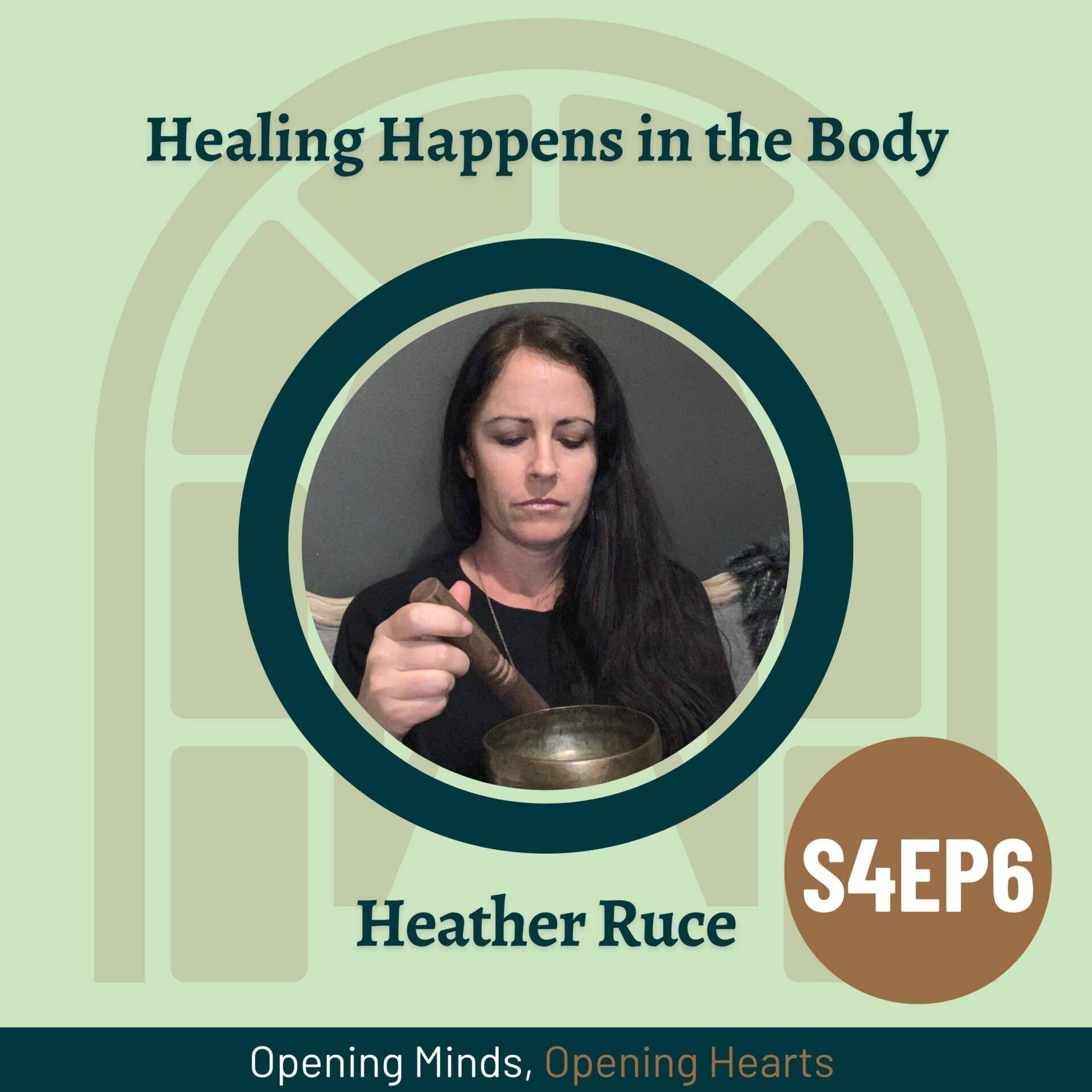
Healing Happens in the Body
Opening Minds, Opening Hearts Podcast Season 4 Episode 6 with Heather Ruce
Title: Healing Happens in the Body
"My whole self is included in this process of transformation and of divine therapy. I can't grow spiritually without also growing emotionally, without also growing and changing my mind and how I perceive the world and think. And then also, I can't do that outside of my body."
- Heather Ruce
"The divine therapy has to empty out the emotional junk of a lifetime that is stored in the body like a meal that has never been digested. And it's very healthy because you're getting rid of something that shouldn't be in our psyche."
- Father Thomas Keating
- How Heather came to understand that her whole self needed to be included in her spiritual transformation, and why integrating somatic practices and therapy alongside Centering Prayer deepened rather than detracted from the divine therapy
- The concept of unintegrated resources and how small, seemingly insignificant experiences from childhood become stored in the body and the nervous system, waiting to be processed and integrated
- How the nervous system is designed to oscillate between activation and deactivation, and what happens when we either suppress our responses or allow them to overwhelm us rather than move through us
- Practical somatic tools for staying present with what arises in Centering Prayer, including orienting to the environment through the senses and engaging in simple embodied practices that help the nervous system regulate
- The often-overlooked role of pleasure and beauty in spiritual practice, and why orienting to simple enjoyment strengthens the nervous system to hold space for the difficult material that surfaces in divine therapy
"Transformation really implies something much deeper and maybe at times even terrifying. In the practice of sitting, we open ourselves to the presence and action of God within us. But we've learned through this season that this openness is only possible when we perceive that presence as loving and safe."
- Colleen Thomas
- Her website: heatherruce.com
- Her Substack: https://substack.com/@heatherruce
- Her Facebook: https://www.facebook.com/heatherruce/
- Visit our website: contemplativeoutreach.org
- Find us on Instagram: instagram.com/prayerofconsent/
- Like us on Facebook: facebook.com/prayerofconsent
- Check out our YouTube channel: youtube.com/@prayerofconsent
If you are a grateful and generous listener who would like to support this podcast, please visit: contemplativeoutreach.org/opening-minds-opening-hearts-podcast-donation/ to make a donation of any amount.
Listen to the Opening Minds, Opening Hearts Podcast NOW for FREE on YouTube, Apple, Google, Amazon and more!
This season of Opening Minds, Opening Hearts is produced by 🫶🏾 Rachael Sanya 🫶🏾 👉🏽 rachelsanya.com
				Opening Minds, Opening Hearts Podcast Season 4 Episode 6 with Heather Ruce
Episode Title: Healing Happens in the Body


Colleen: Welcome to Opening Minds, Opening Hearts, a podcast about the transformative practice of Centering Prayer. In each episode, we will talk to friends of Contemplative Outreach about their personal practice. Listen in as our guests share insights about the teachings of Father Thomas Keating, how the practice impacts their work in the world, and their thoughts about how Centering Prayer connects to the living traditions of contemplation and meditation.

We are your hosts, Colleen Thomas

Mark: And Mark Dannenfelser.

Colleen: Centering Prayer practitioners and contemplative life seekers who love to talk a little too much about how the practice of contemplative prayer transforms our inner and outer worlds. Our hope is to open the door for you to explore more deeply this powerful practice of Centering Prayer


Mark: Welcome to season four of the Contemplative Outreach Podcast, Opening Minds, Opening Hearts. I'm Mark Dannenfelser

Colleen: And I'm Colleen Thomas

Mark: Hello, Colleen

Colleen: Hello, Mark

Mark: We're here again for another stimulating conversation

Colleen: Yes, we are. We are in the business of having really engaging conversations. What a fun job

Mark: Yes, it is a fun job.

Colleen: That's such a strange word to use.

Mark: I feel like I should be paying for this.

Colleen: I know, I know.

Mark: Yeah.

Colleen: Yeah, all of this work that we do, I cringed when I said the word job, because this work doesn't feel like work at all.

Mark: It's a capital J job.

Colleen: Yeah. No, no. You've never actually really been in a job job.

You've always been working in ministry.

Mark: Yeah, I've tried to avoid work as much as I possibly can.

Colleen: Yeah. Yeah. Look, that's a great, that's a great approach. I'm seeing that trend too, like more and more of my generation, especially in the contemplative outreach community. That's one of the things we're finding is that younger contemplatives don't have traditional jobs.

They're professionally in ministry, even if they're not connected to a church, and it's great. I mean, we need people who can serve others.

Mark: Yeah, it's great.

Colleen: Yeah.

Mark: I go to parties sometimes, people say, "What do you do?" And I- it's, "Well, I find myself staying at monasteries and giving talks and retreats."

They're like, "What? How old are you?"

Colleen: I know. Yeah. Yeah. That question when people ask, what do I do, there's always like a pause. I'm like, "I have no idea how." It's like, I don't even know what to write when I do my taxes when it says occupation. I'm like, I draw a blank every year, and then I come up with something.

But what do you write on your taxes for your occupation?

Mark: I write teacher and psychotherapist.

Colleen: Okay.

Mark: Yeah.

Colleen: So you at le- you have that psychotherapist.

Mark: I do. Yeah. Though I'm doing less and less of that work, but I'm still-

Colleen: Yeah ...

Mark: doing it.

Colleen: I've found I write spiritual director, and I feel like I can just imagine the IRS being like, "What in the world?"

But I don't know what else-

Mark: Flags, flags your return right away.

Colleen: It does. Or they just say, "Oh, no wonder she hasn't made any money this year."

Mark: Right. Now it makes sense. Yeah. Yeah. Yeah. Well, yeah, I'm just glad that what we are doing, whatever it is we're doing, brings us to this conversation come and having this podcast.

Colleen: Yeah.

Mark: We've been having some great conversations this season

Colleen: Especially this season, and who knew that we'd be having conversations about healing in the context of so much social and global unrest And when Thomas Keating says Centering Prayer is the divine therapy that heals the emotional wounds of a lifetime, I'm even thinking about it today as not just the personal emotional wounds, but emotional wounds of society.

And maybe we'll weave that in a little bit. It was not really scripted that we would approach it that way, but anyway, that's on my mind this morning. What we do plan to talk about today is healing as a somatic experience, one in which the body is engaged in this process of transformation, and how we can develop a deeper understanding of the body's role in the work of divine therapy, and also maybe get some insight around some somatic practices that might be useful to accompany our Centering Prayer practice.

Mark: Yeah, and I think that's such an important conversation for us to be having. I still run into it myself. I think of Centering Prayer as it's in my head in a way, you know, thinking about it. Or even when we talk about consciousness or awareness, I think of that as a mental thing.

Colleen: Mm-hmm.

Mark: But really, it is. And Keating does point to this in his teaching: it's not just happening in the head. It's a full-bodied experience, and it's about the whole person. And when Keating's talking about these emotional programs for happiness, security, affection, control, and all that, that they're not just concepts or ideas.

They're lived out somehow in our embodied experience and throughout our life. So it's really important to understand it that way and speak from that broader place where it's not just a mental practice. And I think that's why he called it divine therapy. It's touching all parts of us. We perhaps have maybe our perfect guest to help us dig into this Centering Prayer and the embodied somatic aspect of the prayer and how healing takes place. So I'm anxious to introduce our listeners to Heather Roos. We're happy to have you here today, Heather, as a guest. Heather is a wisdom spiritual director, writer, and teacher working within the Christian contemplative wisdom tradition.

She's been a longtime student of Cynthia Bourgeault and has focused her work on integrating Benedictine spirituality with the Gurdjieff work, which is a system of spiritual and psychological development. Her work also emphasizes a kind of embodied spiritual practice as a pathway to awakening the heart and deepening presence in daily life.

Grounded in her training in psychology as well, and the nervous system and regulation of the nervous system, she has a master's degree in marital and family therapy and a certificate in trauma-informed organic intelligence approach to somatic experiencing, and she supports others in meeting both inner and outer life with greater awareness of the sacred steadiness, compassion, and conscious participation.

She understands spiritual awakening not as separate from life, but as a deepening relationship with all that is in God, an invitation into intimacy with self, others, and the living Earth In addition to all this tremendous skill set and expertise, Heather is a returning guest, actually, and a friend. And so we're delighted she agreed to come back to the podcast for more conversation.

So we welcome you, Heather.

Heather: Welcome, Heather. Oh, thank you. It's such a delight to get to be back and to be in conversation with both of you in such an interesting topic close to my heart.

Colleen: Yeah, when you know someone and then hear their bio, it just expands my knowing of you. It's like we don't walk around wearing our bio on our T-shirt or anything.

But I'm just like, "Oh, yes, this is Heather," so much of who she is. And it was real delight to get to spend time with you not too long ago in New York and see how you embody this awareness of a living field of creation. Just one of the things that stands out to me that I didn't share with you, but I've thought about, is just your interaction with the ticket takers at the train station.

You know? And you're just so kind, and I just left you feeling like, oh, there's such an embodied kindness and an appreciation of every aspect of God's creation. It just really is who you are. And so I really appreciate you as a friend.

Heather: Well, thank you for that. I very much appreciate you, both of you, as a friend, and feel that you both really embody also, I think, this more integrated, holistic path that we're on in the way that you think and the way that you show up in the world, and it's such a gift

Colleen: Yeah.

Well, I'm eager to invite others into this conversation, conversations that we may have one-on-one or at times together that I know is of interest to us, but wanting to share with a larger audience, too, about Centering Prayer and how we might expand our awareness of Centering Prayer to be more inclusive of these experiences of the body.

And so, so far in this season, we've had wonderful conversations about Centering Prayer as divine therapy and healing of the emotional wounds of a lifetime, the false self, and experiences of the dark night. And typically, we start our conversations with our guests asking how you came to Centering Prayer.

But since we've already had that conversation with you in season two, and I encourage everyone, if you're just meeting Heather here today, to go back and check out that season two conversation. But maybe this time we can invite you to fast-forward your journey a little bit and share about how or when you begin to sense an invitation to another level of awareness, what in your work we know is called Three Centered Awareness.

And how this path and this three-centered practice came to deepen your experience of, or even reframe your relationship to Centering Prayer as divine therapy.

Heather: Yeah. What I came to understand is maybe outside of Centering Prayer, just really discovering, okay, if I'm going to live out this path of Jesus, which I really wanted to live out, it has to touch every aspect of my being.

I can't grow spiritually without also growing emotionally, without also growing and changing my mind and how I perceive the world and think. And then also, I can't do that outside of my body. And just even noticing what arises within my body in trying to live out this path. So when I had come across some of Cynthia Bourgeault's work through Centering Prayer and her writings on Centering Prayer, that also led me to another book of hers, The Wisdom Way of Knowing, that really speaks about these three centers that our tradition, our Christian tradition, has worked with in different ways.

There's something about that that really struck me, like my whole self is included in this process of transformation and of divine therapy that takes place, as you said, in Centering Prayer. And what I started really to discover is, although Thomas Keating wasn't using that language of three centered awareness, he was basically saying when we sit down to engage this prayer, what we're doing really is we are entrusting our entire being to the divine indwelling, and we are letting go of our attachment to the contents of our three centers, right?

So he uses this umbrella term, thoughts, but that really includes, as you both know, it includes not only the contents of my intellectual center, which we would refer to as thoughts, but also the contents of my emotional center, so all the emotions that arise. And then also the contents of what we might call our moving center or our body.

All that is also coming up and being released in Centering Prayer- And the other thing that I really realized was that every time we come to the practice of Centering Prayer and we're coming with that desire to consent to the divine dwelling, that's actually an inner posture. Like, it's an inner embodied posture of consent, of surrender, of entrustment.

And so my hands are moving, because naturally it's like it's not just an intellectual idea that I do this. It's like my whole being wants to offer, entrust, surrender to God within and all around. And when I started to realize that it's not that in the period of 20 minutes or longer that we're doing Centering Prayer, it's not that I'm bringing attention to this embodied posture, but what ends up happening is anytime I am caught in the contents that are flowing by the thinking or the emotion or what's taking place in my body, and I return to my sacred word or sacred glance or breath, there is an actual release that takes place in the body, right?

So again, it's not that I'm bringing my attention to that because of course in Centering Prayer, we're letting go of anything that brings our attention to a focal point. But it is happening in the body. I'm imprinting this posture, this gesture of surrender, of letting go, and it does take place in the body because we're not separate, right?

Our heads are not separate from our body. Our hearts are not separate from our body. It's all taking place in this body. And so there was something that just opened up for me in that around okay, my whole self is, engaged is probably not the right word, but you know what I mean. My whole self is engaged in this process of letting go, of interesting, of surrendering.

Yeah.

Mark: I'm glad you say that in that way, that it's the whole self. 'Cause it's pretty important that we even recognize that there's a mental thing going on, an emotional thing, and a physical body kind of thing going on. But to me, the other part of that is it's not just about seeing these different parts there, but understanding that the practice is a lot about integrating, too.

Colleen: Yeah.

Mark: And as I read your bio, you've been doing a lot of integrating in this work by bringing different parts of your own experience and your own expertise to it. The somatic work of course, but family systems therapy, depth psychology. You mentioned Cynthia Bourgeault. We mentioned Gurdjieff in the intro.

There's a lot that kind of connects up and we do see that at least the research and mindfulness practice that's like looking at it from a research perspective. There's a lot of connecting and integrating going on. I wonder if you could speak to that, especially from these different disciplines that you've cultivated your own skill set in and bring to this work, the value of integration and connection.

Heather: Absolutely. Because I think for myself, especially early on when I got into Centering Prayer and really heard about this notion of divine therapy, I was coming from a probably a fairly immature place inwardly going, "Okay, great. God is gonna totally heal me in Centering Prayer." Zap. "And all I have to do is sit for 20 minutes and let go, and I'm gonna become the person that I would like to be."

Which you both are laughing, so I don't know if you experienced that or if you've just heard that before, but I def-

Mark: I'm still waiting. Still waiting for it.

Heather: Yeah. So interesting in terms of what you're talking about, the integration there is part of the reason I actually even went into studying marriage and family therapy was because I was realizing in terms of trying to walk this path that Jesus talked about and to really experience the abundant life that he was speaking of, it just, it felt so far from my experience.

And so much of what I was recognizing in my own therapy was really, okay, I have so many tendencies, qualities of manifesting, nervous system states, parts of myself, personality features, patterns of thinking, of emotion, of somatic configurations, gestures, postures, all these automatic conditioned ways of being that maybe our spiritual ancestors, the Desert Mothers and Fathers might even call the passions.

So many things that were outside of my conscious awareness or were in my conscious awareness, but I didn't wanna accept as part of my experience or part of my manifestation. So I just was trying early on in my early 20s and teens, trying to ignore those or keep them under control or manage them or exile them or disown them.

And really, I was just trying to be this transformed person rather than actually being a transformed person. Yeah. My spiritual superego was like, "This is how you're supposed to be a good Christian and live the path? Okay, that's what I'm gonna do." But of course, it doesn't really work that way.

And so what I found was, like, therapy for me was really a spiritual practice. It wasn't just about trying to shore up my ego and be a better version of Heather as a human. It was like, I want transformation, and I wanna see these things that are hard to see. And, in Centering Prayer, we're resting and trusting ourselves to the divine indwelling, and it's opening up a deeper spiritual awareness that really, over time, helps us see, okay, I'm not my thoughts, I'm not my emotions, I'm not my sensations.

I'm not my ordinary view of myself, my personality, but, like, who am I? And then how do I operate in the world from there? And then there also, I think, in Centering Prayer, because as we rest and in trust, more and more comes up in our awareness, as you have spoken about, like the unloading of the unconscious.

But it's like, for me anyways, it was like, "What do I do with all this?" It was almost overwhelming actually to see I'm not who I thought I was.

Colleen: Mm-hmm.

Heather: And then it was overwhelming to notice, okay, I am watching. I can see all this, these tendencies and all these ways of being that are not helpful, but I can't do anything different.

And that gap is so uncomfortable. And this is where I think a lot of other modalities can come in and really be helpful because at least in my experience, on my own with Centering Prayer, I couldn't stay grounded in my own goodness, and I couldn't stay grounded in a deep self-acceptance. It was too hard.

And so things like the practice of therapy, which as I mentioned, became a spiritual practice, was really helpful in normalizing that and contextualizing that and understanding and almost giving me new tools until a different impulse arose. But then there was also just everything that's happening.

For so long, I was working with, let's say, I was targeting more the intellectual center, thoughts and thought habits and those, or trying to make space for the emotions and presence, those and all that. But my body was still carrying, and I would say, at a cellular level, these patterns and these unintegrated resources, and I needed something more.

And so that was really what took me into somatic experiencing and organic intelligence, and coming to understand all of that stuff, again, is happening in the body. It's just really not separate. And so learning, in many ways, how our different emotions and thoughts and what's taking place in the body are connected, it really is happening in our physiology.

And so we can't necessarily address that from what they often say, the top down, right? I can't just tell myself, "Okay, God loves me. I'm okay. I'm good," or even try to experience emotionally a connection with being able to rest in that divine indwelling. It's like my body was not there in that same way. And so for many years, I just thought there was something wrong with me. I can't seem to get my body to settle in this. And so I think that really coming to understand how our physiology works and how our nervous system works was such a great support in being able to have some maybe realistic expectations of myself throughout the process of divine therapy.

So both the therapy as a spiritual practice and then the somatic experiencing and organic intelligence also as a spiritual practice, they didn't take away from the divine therapy. They just helped me enter into it even more.

Colleen: Hmm. Mm-hmm. Wow. Okay. There's so much in what you said. I wanna see if maybe we can unpack some of it for those who are listening.

But one of the things that I might bring us back to first is the importance of integration that you're talking about that arose out of this idea that Centering Prayer will heal everything. All I have to do is just sit here for 20 minutes. And although we know, those of us who have gone through the Spiritual Journey series, there's so much involved in this process of transformation.

I mean, and Father Thomas really does a wonderful job of laying out all the stages of transformation. But this area right where you said, "I want to see the things that are hard to see," makes me think about this idea that we've been exploring this season, where Thomas Keating says in Consenting to God as God Is, a very important aspect of contemplative prayer is that it does not fully do its job unless we are also working on our shadow side And so it's in there, right?

That contemplative prayer does its work, but there needs to be some accompanying work. And so I'm curious if you could maybe help us to understand better the practice of somatic experiencing. But if you could also give us insight about that practice in connection to the shadow side. Like, does somatic experiencing, how does it support our encounter with our shadow side?

Heather: Yeah. So when I was saying I wanted to see all that within me that I didn't really wanna see. I mean, in some ways, we say we wanna see until we start seeing, and then it's like, "Woo. Okay." Yeah. "I don't wanna keep seeing." Right?

Colleen: Well, I like how you said, "I wanna see things that are hard to see," 'cause they are hard to see.

Even if we want to see them, they're hard to see.

Heather: They are hard to see. Yeah. That's right. And there's a way that we can, again, we can on the surface maybe look a certain way or behave a certain way, but are we inwardly free, right? So there's being able to allow anything that we have put into the shadows, whether consciously or unconsciously, to be reintegrated, right?

So speaking of integration, it's like anything that is in our shadow, and it's not all what we would call negative either. There's this notion of the golden shadow. It's like maybe ways that our essence or our true self would manifest that wasn't either appropriate in our culture or, maybe appropriate's not the right word but- That maybe wasn't accepted or encouraged

Colleen: welcomed, yeah

Heather: welcomed, that also gets tucked away in the shadow. And from a somatic experiencing or organic intelligence experience or organic intelligence understanding, what can happen then is that we can almost, like, shut that down, or it almost becomes frozen inside. It can become frozen inside of us.

And so in Centering Prayer, oftentimes what will happen is that that stuff starts to begin unfreezing, right? So let's say, just to use a very simple example, part of what goes into the shadows also is, as I mentioned, an unintegrated resource. So let's say when I'm young, I fall off of my bike, and I'm sitting on the ground and maybe my friends come over and they're like, "Ah, get up," you know, "Stand up."

And I get up and I just, okay, I just have to go on anyways, right? Get back on the bike and keep going Pretty benign experience there. But it's possible that that fall was pretty disorienting inwardly. Could have been maybe emotionally, like feeling like, "Ooh, I just experienced something hard, and I didn't necessarily feel like it was okay to express what was coming up for me emotionally, or my body didn't have a chance to put my foot out before I fell, and so my body didn't get a chance to try and protect me from that fall," or any number of things.

And so something like that, though it seems very small, might be still incomplete in the sense that I didn't necessarily have the resource that I needed in that moment. And so we have lots of these, I'm gonna call them states, which could be mental, could be memory or an image, or could be some kind of meaning, could be the affective experience.

But that's looking for its resource so that it can integrate and move through. Because what we understand now from the nervous system is that it wants to oscillate. It wants to activate and deactivate, activate and deactivate. But so often what happens is either it just starts activating, activating, activating, activating.

It goes way over its threshold, which can be really intense, and that's where we can get into a lot of the disoriented responses. We're bringing a state from a previous experience into the moment and reacting out of that, or we're pushing it down, right? So it starts to activate, and we don't think that's okay, so we suppress it.

So it's like we have these patterns of either inhibiting something that doesn't feel okay or almost going way over, not inhibiting. And all that is gonna come out as we're in this process of divine therapy. So learning how to work with that in a way that can support that oscillation coming back into kind of a self-organizing, so that our system can digest or get the resource that it is looking for, is a really essential thing.

So people will talk sometimes about in Centering Prayer, they'll start shaking, right? Their body will physically start shaking. And that can be a little disorienting, but oftentimes it's because you're in this space where you're entrusting yourself to the divine indwelling. It's safe now for some of that undigested, to use Thomas' language, or that state that's looking for its resource to arise.

And so sometimes what will happen is it's like, okay, that bicycle crash, now the state that was connected to that is now emerging and may or may not in that moment be receiving its resource. Thomas sometimes talks about if that arises in a Centering Prayer period, sometimes if you're trying to let it go and it's not, like, you just stay with it, right?

You presence it for a minute or two. And if we presence it without judgment, with an awareness of our connection to ourself and God and everything, then what will happen is it might hit its threshold and then deactivate. And that deactivation can sometimes involve an actual shaking. We see this in animals all the time, right?

When they get away from a predator that they've been running from and they stop. Oftentimes they'll go into the forest or something like that, and their body will shake. It's like it's shaking off that activation, and then it will start looking around and mapping its environment, and then it will return back to that regulation and move on.

And so that same thing sometimes happens for us.

Mark: Yeah, we come back to a set point so that we can function. And I think so much of what you're saying is so important, especially when it comes to what you were saying, that some of those things we do need. Right. Those programs for happiness.

So we do need to ensure that we're secure. And maybe at a different time in our life when that was threatened or may have been threatened, then we use it in a particular way now that's not appropriate. But they're really designed to help us and protect us. And if you saw an animal shaking in the forest, you wouldn't necessarily see that as an adaptive thing.

But Keating, he warns us. He says, the purpose of the divine therapy is to bring the unconscious motivations maybe when they're out of place or no longer needed, it's not just all about our own security or whatever, they're gonna come up in the practice, these unconscious motivations, and that we have to become aware of them in order to heal the wounds of a lifetime, he says.

Heather: Right.

In the Christian tradition, contemplative prayer is the opening of your mind and heart to God, who is beyond thoughts, words, and emotions. Centering Prayer is a method designed to facilitate contemplation. The method suggests four guidelines. One, choose a sacred word as the symbol of your intention to consent to God's presence and action within you.

Two, sit comfortably and relatively still. Close your eyes or leave them slightly open, and silently introduce your sacred word. Three, when you notice you have become engaged with a thought, simply return ever so gently to your sacred word. And four, at the end of the 20-minute prayer period, let go of the sacred word and remain in silence for a couple of minutes.

The additional time invites you to bring the atmosphere of silence into everyday life

Mark: So I wonder if you could say a little more about it, 'cause I think it's such an important part. So then what happens when all that comes up? What helps us to create enough safety in the body and in the nervous system so that we can continue on in that divine therapy, healing of the wounds as they're coming forward?

It's so, as you said before, it's not about suppressing that or running from it or covering it up or something. No, it's about turning towards it But in a way where it doesn't just totally shut us down or overwhelm us. So how do you support people in staying present especially when that kind of junk arises without becoming too overwhelmed or shutting down from it?

Heather: Yeah. So first I wanna comment on what you said in terms of there's some level of need for safety for the, what Thomas calls the programs, right? For happiness. Some level of need of safety, security, affection, esteem, power, control, or influence. One of the things that I think I missed early on, but I've more recently recognized, is he really talks about that as the exaggerated need, right?

To your point, it's not that he's saying don't have that need. He's saying it's the exaggerated, it's like the demand, right? Or the attachment to that, that in some ways we can get caught up in looking to be more important than God in a way, right? So, we do have to tend to ourselves, but as we know, life doesn't always give us that, and can we still be okay even if we don't have those things that we think we must have?

But in terms of the way that our nervous systems are working, and that's where I say oftentimes these states are looking for their resource, so, a lot can happen with just a simple, "This is arising." Let's just say it's some fear related to that bike accident or something. If I am then met, either from myself, a deeper place inside, God, someone else, in that fear, it's like I'm being seen, that space is made, and that resource is then integrated, then it loses a lot of its juice anyways, right?

So often we almost think because of this idea of the emotional programs for happiness, that we shouldn't have any safety, security, affection, esteem, influence, power, control. It's almost like we shove that away rather than saying there are times when that's there, and can we take it in? Can we enjoy it?

Can we enjoy these moments of really being met in something that is arising? And so part of, in terms of working with our physiology with all of that is saying it's okay to enjoy when something is arising looking for a resource that that is being met instead of having to just push it away, and really enjoying that in the body, like allowing that to be there.

And I also think Cynthia Bourgeault talks about how because Centering Prayer isn't a practice where we're working with anchoring or growing our attention, we're letting it go, right? Outside of Centering Prayer, it's so important to continue to develop that capacity for witnessing presence. When we begin to notice that separation between our ordinary awareness and our spiritual awareness, and all that content is coming up and can be very overwhelming, it's really important that we are able to find or access some place within that can make space for that with both self-acceptance or compassion and even some neutrality.

And that also has to be experienced in our bodies. I need to be able to find within my own body where I experience a sense of grounding, a sense of being anchored or rooted inwardly deeper than my ordinary egoic operating self. Because if

that is who I think I am, and then that is what is being broken up in Centering Prayer, if I don't have a way of anchoring deeper inside, I might have a psychotic break, or I might completely deteriorate.

I don't have any other structure to fall back into. And so, so much of our somatic work is both finding a place that we can access, not just in thinking, but actually physically inside that is grounded and rooted and can bear that discomfort and maybe even offer something. But the other thing is so much of the stuff that is coming up, that is arising in this unloading of the unconscious can often be confusing in life because, say, somebody says something unkind to us.

If all that material is there but it hasn't quite been integrated, then I might have an inner reaction to that encounter that is way bigger than that moment is calling for. And if I buy into that, then I just reinforce that egoic operating system. But if I can, from that inner place of observing and witnessing, see, okay, that was a lot of energy that is probably not oriented to the here and now, and I can say, "Okay, yeah, that's here.

I don't need to push it away, but I also don't need to react from there." Even Thomas talked about this. Sometimes when that stuff comes up, we can, I think he says, cast it into the lap of God. That's one thing. I think that sometimes can be helpful, but usually it is not quite so simple Another one is to come back to the here and now.

And so, so much of somatic experiencing and organic intelligence is getting our biology, our physiology grounded in the here and now, which this sounds so simple and unspiritual because we're engaging our ordinary awareness in this. But even just connecting with the environment through our senses is so essential, I would say.

Because in a lot of ways, as we have become more modern, we're not even really fully engaged in our senses, and so we're not really connected to our environment. We're oftentimes in that default mode of reflecting on something or planning for something. So even the simple practice that's called orienting, where I'm letting my senses connect with my environment, I'm seeing what I see.

I'm not thinking about what I'm seeing, 'cause that's the other thing. We're so self-referential and associative, it's like if I let my eyes just look around, I might see something, and then immediately I go, "Oh, well, that reminds me of this," or, "Oh, that makes me think of this." It's like we almost can't even relate to our environment without association, right?

And association isn't presence. So really learning how to be grounded in, "Okay, this is what I'm seeing. This is what I'm hearing. This is what I'm smelling. This is what I'm noticing with my skin. This is what I'm tasting. I'm not thinking about it. I'm not having it take me into the future or the past. I'm just here," is actually so helpful for our physiology because then it registers from what we would call the bottom up.

It's going straight to the amygdala, which is where a lot of our fight and flight and freeze and fawning and all that stuff is coming from. It's like it's a direct communication going, "That thing that happened to you when you were seven is not happening right now." It's like it resets your physiology to go, "Oh, okay.

Actually I'm safe. Right. I'm here now, I'm safe. And that one practice, which is a part of, I think, any somatic modality now, is transformational because it brings us back to the here and now, and we can, in that way, practice presence. And then one of the other things Thomas Keating talked about is redirecting our attention, like if there's a big something coming up.

And he would talk about redirecting our attention to doing something else. So that could be, I would say even just doing something that will get you into your body. So Cynthia, you probably heard her say this recently, Colleen, when you have an emotional upset, don't go journal. She says, "Go chop wood."

True. Well, most of us probably don't chop wood anymore, but maybe you do if you live in a part of the world where you can. But even, like, go do the dishes. Go- I was gonna say, does go clean the bathroom count? No. Yeah. Go vacuum. Go sweep. That's a stretch. Yeah. Go, you know, something like that because it's like your body can engage that, and it can be moving some of that energy.

Colleen: Moving through the body.

Heather: And yeah. And in many ways, it also stops our nervous system, our physiology's tendency to go towards the negativity bias. So it's like our attention often wants to go to what's wrong and fix it, and that can just get us more activated.

Colleen: Which is so connected to the self-reflective consciousness, right?

It just gravitates towards negativity. And this is a, a new practice for me that I'm in the practice, but I find even just this morning, I'm aware how little I'm journaling these days because it was such a foundational practice for me, but it's so reflective that I have stopped, and I kind of miss it a bit, but I'm going with the flow of this letting things move through, you know?

And I can't really articulate it well. And even listening to you, Heather, I'm just smiling inside because your work with Cynthia is really bearing so much fruit. I'm like, "Oh my gosh, Heather's almost like Cynthia in that I almost can only understand half of what she's saying."

And I mean that in the most complimentary way, and I think folks who listen to Cynthia will understand. But at the same time, I am getting it. I am because what I'm hearing you say, and I keep thinking about the image of falling off the bike because it's such a common experience that happens in childhood, we can almost completely overlook what occurs in our body in that moment where our safety and security are threatened because it's scary. And yet our friends say, "Get up, get up," or even our parents say, "Get up, get up, go at it again," overlooking this moment that we need to allow the nervous system to deactivate in a healthy way- Yeah

which involves not disassociating with those feelings of fear or that my security and safety has been threatened, that everything I thought I knew that I could stay up on this bike, that the ground is hard as though that didn't happen. But we need a moment to allow ourselves to connect with those feelings.

And so then that goes on, that happens at 5, it happens at 10, it happens at- Yeah ... 14. Some people it happens even later in life you fall off your bike, and then all of a sudden we're adults and we don't connect anymore with those moments of tiny losses of safety and security, and it all adds up, and then it all comes up in this practice.

I do wanna share this one quote with you 'cause I love this so much, that Thomas Keating says, "The divine therapy has to empty out the emotional junk of a lifetime that is stored in the body like a meal that has never been digested." So it's a little uncomfortable coming to consciousness when you're blasted by unloading of the unconscious or this psychic vomiting Which is very healthy because you're getting rid of something that shouldn't be in our psyche.

And I love this because he says psychic vomiting, which is such a visual- Yeah ... and physical illustration of what's happening. And then he just, as he always says so gently and kindly, which is very healthy. You know? What we don't think about vomiting as healthy.

Heather: Right.

Colleen: And the illustration of psychic vomiting surely doesn't seem healthy to me, but I hear that in what you're describing.

Heather: Yeah. That is such an interesting picture that he has given, and I think maybe I would say it feels like that kind of vomiting, right? Because it's like, it's so much that is arising and moving through us, right? To, is what you were saying. And it's like, another word I would use for undigested is really unintegrated.

It's this unintegrated stuff, right, that's arising. And a lot of times it is looking for that threshold so that it can deactivate and move through, and I do think that that deactivation can sometimes be experienced as vomiting, right?

Colleen: Vomiting, yeah.

Heather: It's letting something move through that I'm not used to letting move through or whatever.

Because all of this, all emotion, is energy, and it doesn't wanna go on forever and ever, right? So it does wanna move through, like vomit. Yeah. Move through, right?

Colleen: Or even cry. Just cry, right? Because so many times in childhood we can't even cry because when your friends say, "Get up," they don't say, "Cry" and "Come on, let's keep on going," you know?

Right. They just say, "Come on."

Heather: Yeah. Yeah, absolutely. And there's something else, and if I'm taking us off topic here, you can bring me back. But I'm coming back to something actually in being with you, Colleen, in our most recent time together, you were talking about a practice of pleasure.

Colleen: Mm-hmm.

Heather: And I wanna bring that up because this is another piece that is so key to working with our physiology, working with our biology, our body, everything

from a somatic experiencing or organic intelligence perspective. And we think so often pleasure, it's like, "What? Christians can't have pleasure," or whatever your... If you're spiritual, you can't have pleasure. Aren't we trying to get away from pleasure? And in some ways we are. We are moving beyond the attraction aversion principle

or the likes and dislikes. But int- especially when all this unloading is taking place and we are experiencing that gap between how we want to be and what's actually coming up and how we're actually operating in the world, it's so important not only to have that self-acceptance or that neutrality or that inner observer, but also to find the basic non-addictive, non-substantive pleasures that life can offer us.

Colleen: Mm-hmm.

Heather: So not just orienting ourselves to our environment, which is so key, but also because of this negativity bias and this what's wrong attention that we have, which when all that stuff that we view as wrong is coming up, right, all that stuff out of the unconscious, all that stuff in the shadow is coming up, the attention can wanna keep going there, and then almost to an unhelpful degree.

Having a practice of orienting to pleasure so that I'm not only looking at what's wrong, but I'm also taking in beauty. I'm taking in that which is good. I'm taking in the simple enjoyment of looking at this plant right here or a sunset. Everybody talks about a sunset. Something happens when we as humans encounter beauty, but not only to orient to that, but then to take it inside and go, "What happens in my body?"

While I'm enjoying that. Simple. What happens in my body when my two friends are sitting across from me and we're having an amazing conversation? Oh my gosh, my stomach totally releases. I feel this warmth in my chest. There's this experience of just ease. There's a feeling of connection, right?

So if I'm connecting in with, like, what's happening in my three centers, for example. But in particular, the one we miss so often is in the body.

Colleen: Mm-hmm.

Heather: When we can keep coming back to what's taking place when we're having these simple moments of enjoyment, and we can ground that back in our body, it really does help digest the other stuff that's coming up.

Mark: Mm-hmm.

Heather: And in that way, we're also, might we say, enjoying God in that moment. So it's not separate. It's like, okay, God is in this. Can I experience that enjoyment as well? Because that strengthens my nervous system to be able to hold more space for the uncomfortable stuff, right? It's like an equal measure.

Mark: Yeah. I'm so glad you're talking about this, Heather. Because with talking about the body with regard to spiritual practice or pleasure with regard to spiritual pra- When I was growing up, they did not go near the body when talking about the spiritual life. And I think along those lines of it being a practice of integration, Centering Prayer and connecting, I think it's so important to acknowledge.

You've said it a couple times, that we sometimes think of that part of it, the body part or whatever, as unspiritual. But it is probably the height of spirituality in the sense that it's connecting. It's not excluding stuff.

Heather: Yeah.

Mark: And I think that's really important right now in the Christian contemplative tradition, that we're bringing in some of these other discoveries.

Right. And it was clear that Thomas was doing that. He drew from all these different disciplines, so he knew that there was different ways to talk about it and that these things all kind of synced up. And I really appreciate that that's what you've dedicated your life to.

Heather: Yeah.

Mark: To bringing in these other practices that can support that unloading of the unconscious and that basically what is the divine therapy. But there's challenges to that, I think in contemplative circles sometimes.

Colleen: Mm-hmm.

Mark: So I'm glad we're talking about it and that you're advocating for that

Heather: Yeah. And it's interesting too, as a tradition that is based on the incarnation, that we should be so averse to our incarnate bodies, right?

Colleen: Yeah. Right.

Heather: And yet, it's also so fascinating, one of the things I've discovered is that it goes back so far. We've been doing these things. We just maybe haven't recognized that's what it is. Like chanting, for example. Chanting is such an embodied practice. You're working with the breath, and you're sensing your vibration of voice coming through you, and you're giving your mind something to focus on while you're sensing this vibration.

And usually the tone and the words will bring a feeling to it. It's a very holistic practice, and now we know that chanting also stimulates the vagus nerve, which helps us be more present in the here and now. So it's just fascinating to me that these monks who've spent so much time chanting, also in silent prayer.

But also, like if you look at the Benedictine rhythm, and really any monastic lifestyle, this element of conscious work. Yeah. We're engaging the work that needs to be done consciously. Most of the time that involves the body, tending to the bees or pulling weeds or cleaning or something like that.

I think that's another thing that we've outsourced so much in our modern society.

We outsource our manual labor, and one of the things that I've consciously tried to do is actually do a lot of that cooking or cleaning as I'm able to stay grounded in that practice, which also connects me to not only my body, but also the whole collective.

Because as humans, we all have to do that. We all have to tend to ourselves, and it keeps me connected to the wider system, right? Like if I'm preparing my food, then I might even have a chance to recognize, if I'm fully present, like all that it took to get this carrot into my kitchen. Wow, the amount of people and earth and rain and water that it took to bring this into existence and then to get it on my plate.

The vast interconnectedness of that, that's a moment of enjoyment and pleasure to be had. Oh, yeah.

Mark: Yeah, and discovery. I mean, consciousness is a collective kind of thing, and then so that includes even the non-human world and the natural world and ecological kind of consciousness too, that we're part of the whole thing.

It's all connected.

Colleen: Yeah. This is where your work and Mark's work in mindfulness really intersect because they both invite a practice of attention which for our Centering Prayer community is a different practice because Centering Prayer is an intention practice.

Heather: Mm-hmm.

Colleen: And maybe it would be helpful, and maybe as a way of wrapping up our conversation in some way, we tend to invite our guests to share their thoughts about how Centering Prayer can continue to be in conversation with this growing landscape of contemplation and the healing arts and modalities and what Thomas Keating's teachings can contribute to these ongoing conversations.

But one area that might feel relevant to this conversation is what do you notice about the Centering Prayer community and practitioners that you work with, maybe some challenges, but also where you see openness to inviting attention practices to companion this intention practice?

Heather: That's such a great question, and it is interesting that Thomas Keating, when he talks about how do we continue this in life, one of the things he talks about is the guard of the heart.

And in that, he speaks specifically about mindfulness. And I think mindfulness, even that word, I think you said something about this, Mark, it's like it can be a little misleading 'cause it's not my mind thinking, right? Mindfulness is actually embodiedness. Being here now in my whole self.

But I would say in working with people with Centering Prayer, there's almost this deep desire maybe for the body to be re-included. So often, again, I'm using the language as if the body is separate from us. It's not, but I think since probably the Enlightenment, we've really almost started to live from our neck up, and it's almost like I think our bodies are going, "Yes, please.

I also am part of this path. I also am engaged in this transformation. I also am engaged in living this life of love." And so I do think that a lot of the practices outside of Centering Prayer that can also accompany Centering Prayer are a drink of fresh water. I also work with some movements practices, some Gurdjieff movements practices, and oftentimes when people have had a taste of that, they're like, "Oh my gosh, my body has been wanting this, to be included in this way."

Even chanting can be that way. Where it's like There's this deep desire, I think, to be a whole human and to have practices that acknowledge all parts of ourselves, engage all parts of ourselves. And that is sort of the balance. Like in Centering Prayer, this, as you said, this practice of intention where we're actually letting go of attention, that's one thing.

But although we wanna surrender in life, when we're going about our life, we do actually have to have some agency over our attention and place our attention, otherwise our attention's getting pulled this way and that. And so they're like two wings of a bird, right? We have that surrender and intention, and then the hopefully surrendered attention.

And so I do see an openness and a deep, I guess, maybe gratitude for more and more integration and practices, even sacred gesture, even just like a body prayer or coming to be aware of gestures. People often just feel like, "Oh, okay, more of me is included here

Colleen: I wanna say just as someone who is embracing this invitation to attention practices, in part working with you, Heather, in your wisdom circle, for anyone else who might be resistant, because I feel like I'm one of those.

I don't want to be, but I just notice some resistance to it, that there's some part of me in having spent so many years with my Centering Prayer practice and letting go of thoughts, that all I wanna do is not do not be engaged. I don't think that I consciously have that intention, and I don't think that is the intention of Centering Prayer is to not engage.

Heather: Right.

Colleen: But some part of me has taken this practice to mean no engagement even with my body, and I'm working around that, that there's a, maybe because I have experienced trauma and disassociation is just what is familiar for me, Centering Prayer gives me an out almost. Yeah. And so I have to set a very conscious intention to be with my body be with the sensations, even be with my thoughts in a guided meditation. Yeah. Which to be honest, I don't like. Yeah. I don't. Yeah. Because I like the silence. I like, "Don't bother me."

Heather: Right.

Colleen: But I'm seeing some of the limitations of this, and I'm working through it. Right.

Mark: I'm glad you're saying that, Colleen, 'cause I've struggled with that, too.

And even those two words, I started looking into them. The Latin root for both of them is they share the same root, intention and attention. Yeah. And it's actually very active, both of them.

Heather: Yeah.

Mark: It means to stretch toward. Or one is maybe stretching. Intention is more of a stretching within, and attention is stretching outward. But as you said, the two wings of the bird There's a relationship there

Heather: Mm-hmm

Mark: And so what is that? And how does that show up in actual practice in Centering Prayer? Yeah And it does show up. It's important to show where there's distinctions, but there's definitely a relationship there, and it's complementary

Heather: Yeah

Mark: And I'm glad we've been talking about this because I'm sure a lot of our listeners, that there's that same, at least on that part, attention and intention, but so much of this, too.

I mean, we've all been sitting in Centering Prayer and had some kind of physical reaction to it at some point. Maybe not dramatic or anything, but something. We know that's there.

Heather: Right

Mark: So such an important conversation to have and also to bring to our retreats and to our Centering Prayer groups to at least consider it

Heather: Yes

Mark: Yeah.

So thank you, Heather, for helping us to reflect on that and talk about that.

Heather: Mm-hmm.

Mark: Yeah.

Heather: Thank you both for such a rich conversation and for bringing this into a wider audience and awareness of this.

Colleen: Mm-hmm Yeah. So what would you like to share with people, Heather, about how they might be able to engage with you in your work and offerings?

I know that you do these wisdom circles, and you're still doing your Centering Prayer, but you also have other practice circles. So share just where can people find you. We'll include it in our show notes, but just- Yeah ... anything on your mind that you might sense an invitation to the wider community.

Heather: Sure. Yeah. So I think the best way to find out what I'm up to is just my website, which is my name, heatherruth.com. I have a daily Centering Prayer sit at 8:00 Monday through Sunday. 365 days a year. Christmas-

Colleen: Yes, I don't know how you do it. It's 8:00 AM Pacific Time, FYI.

Heather: 8:00 AM Pacific Time, yes, for about a half an hour, and people can join for any part of that.

There's usually a chant or a body prayer or something, and a reading, and then a sit. And that you don't have to commit to. You can just come in and out of. And then on my website, there are a few offerings that I have that are... You can do on your own, and then if you sign up for my email, then you'll get some reflections and the quotes or whatever's been done in the daily meditations that comes out, and then any offerings like wisdom circles or movements or different things like that.

Another place you can find some of my work is on Wisdom Waypoints and on the Contemplative Society. So there are other places there.

Colleen: Wonderful. So good to have you join us for this conversation, and it was a really, really rich one. And so I'm grateful that you shared your wisdom with us, and we'll hopefully look forward to having you back again as our podcast themes and seasons unfold.

You're always welcome here.

Heather: Mm-hmm.

Colleen: Thank you.

Mark: Yes, thank you, Heather. Thank

Heather: you

Colleen: Thanks for joining us on this episode of Opening Minds, Opening Hearts. Visit our website contemplativeoutreach.org to subscribe to the show on Apple Podcasts, Spotify, and wherever else you listen to podcasts. You can also follow us on

Instagram at contemplativeoutreachltd. To learn more about our guests and their work, you can find info in the show notes for each episode. If you enjoyed this episode, you might want to check out our YouTube channel, C-O-U-T-R-E-A-C-H, COUTreach. Thanks for listening, and see you next time

Season 4 of Opening Minds, Opening Hearts was made possible in part by a grant from the Trust for the Meditation Process, a charitable foundation encouraging meditation, mindfulness, and contemplative prayer. We are extremely grateful for their support and would be grateful for any additional support that you as a listener might offer.

Your donation helps Contemplative Outreach to freely offer the wisdom of the contemplative tradition and Centering Prayer to all who are interested. If you are a grateful listener and would like to support this podcast, go to contemplativeoutreach.org/podcast to make a donation of any amount.


