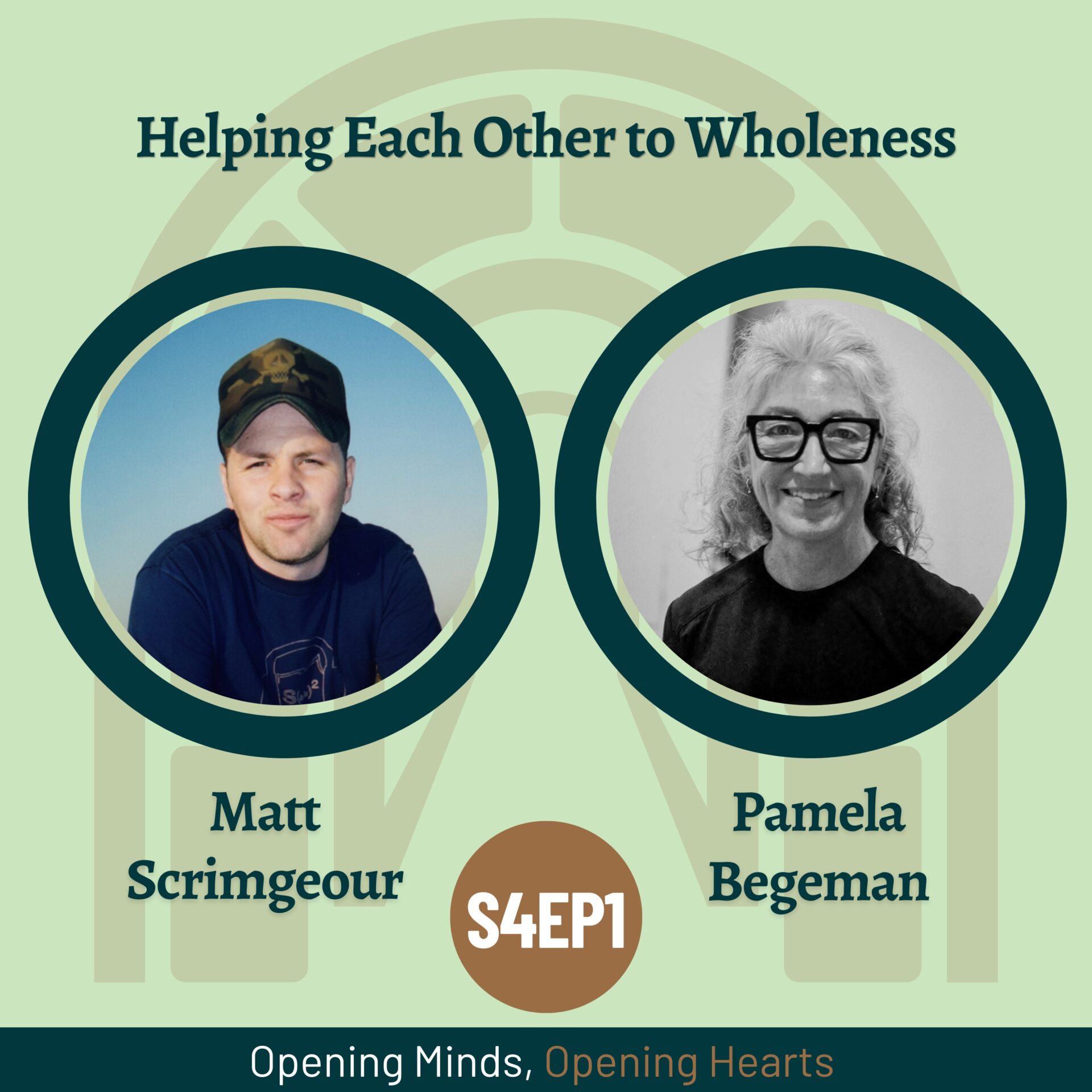
Helping Each Other to Wholeness
Opening Minds, Opening Hearts Podcast Season 4 Episode 1
with Pamela Begeman and Matt Scrimgeour
Episode Title: Helping Each Other to Wholeness
"A question was asked of me at this time of crisis, and the question was, ' Who are you? Who are you, beyond all your roles?’ And I could list 10 or 15 different roles I had at the time, but when I had to answer the question without the roles, I couldn't answer it. And so part of what I was looking for was, ‘Who am I beyond all of this programming?’ And Thomas says that one of the purposes of divine therapy is to help you figure out who you really are."
- Pamela Begeman
Welcome back, everyone! We are so glad you are joining us for what feels like a dinner table conversation with dear friends. In this episode, we are joined by two beloved members of the Contemplative Outreach family, Pamela Begeman and Matt Scrimgeour, for a warm, honest, and deeply personal exploration of Centering Prayer as divine therapy.
Pamela Begeman is a longtime Contemplative Outreach staff member, commissioned presenter of Centering Prayer and the Welcoming Prayer, and a former board member of the Church of Conscious Harmony in Texas, where she serves as a retreat leader and class facilitator.
Matt Scrimgeour is also part of the Contemplative Outreach staff team, who says he accidentally discovered Centering Prayer more than a decade ago, and whose favourite cathedrals are found in nature.
Together, we explore what it truly means to experience Centering Prayer as divine therapy, the role of community and supportive practices alongside the prayer, and what it means to be restored, not fixed, to our fundamental core of goodness. We also reflect on what is needed to carry this tradition forward into a world that is hungry for exactly this kind of healing.
"Being faithful to the [Centering Prayer] practice and then showing up in daily life and noticing what we notice; what comes up there, what I am able to see, what is brought to my attention in daily life, that is what helps me work through what I need to let go of. When we have that awareness, that is actually when some of that healing is happening."
- Matt Scrimgeour
- How Pamela, Matt, Mark, and Colleen each came to Centering Prayer, and how the practice became the foundation of their healing journeys, leading each of them to the central question at the heart of divine therapy: who am I beyond all my roles?
- The two threads of divine therapy as described by Father Thomas: the affirmation of our basic core of goodness and the process of purification, and why community, spiritual direction and supportive practices are essential companions to both
- The distinction between fixing and restoring, and how the dismantling of our emotional programs for happiness is not about eradicating what is there but freeing what was always good in us to arise
- How inner awareness is itself a form of healing, and the role of practices like the Welcoming Prayer and the act of prayer in helping us notice, on the go, what is running in us beneath the surface.
- Visit our website: www.contemplativeoutreach.org
- Find us on Instagram: https://www.instagram.com/prayerofconsent/
- Like us on Facebook: https://www.facebook.com/prayerofconsent
- Check out our YouTube channel: https://www.youtube.com/@prayerofconsent
Listen to the Opening Minds, Opening Hearts Podcast NOW for FREE on YouTube, Apple, Google, Amazon and more!
This episode of Opening Minds, Opening Hearts is produced by 🫶🏾 Rachael Sanya 🫶🏾 👉🏽 www.rachelsanya.com
				Opening Minds, Opening Hearts Podcast Season 4 Episode 1 with Pamela Begeman and Matt Scrimgeour
Title: Helping Each Other to Wholeness

Welcome to Opening Minds Opening Hearts, a podcast about the transformative practice of Centering Prayer. In each episode, we will talk to friends of Contemplative Outreach about their personal practice. Listen in as our guests share insights about the teachings of Father Thomas Keating, how the practice impacts their work in the world, and their thoughts about how Centering Prayer connects to the living traditions of contemplation and meditation.
We are your hosts, Colleen Thomas and Mark Dannenfelser, Centering Prayer practitioners and contemplative life seekers who love to talk a little too much about how the practice of contemplative prayer transforms our inner and outer worlds. Our hope is to open the door for you to explore more deeply this powerful practice of Centering Prayer.
Colleen: Welcome to season four of the Contemplative Outreach Podcast, Opening Minds Opening Hearts. I'm Colleen Thomas.
Mark: And I'm Mark Dannenfelser. Hello again. I'm glad to be back Season four.
Colleen: I know. Season four, a whole new season. New conversations, new guests. New friends.
Mark: I can't believe this. This is the fourth season.
Colleen: I know. And we had a really long pause between season three.
We really didn't record episodes much of 2025 at all.
Mark: No, I almost forgot that we were doing a podcast.
Colleen: Yeah, yeah.
Mark: But that was good too. A little break to absorb so much from those first three seasons.
Colleen: Yes, absolutely. Especially that last season, there were some really deep conversations.
You know, it's strange to have a podcast about Centering Prayer and talk about Centering Prayer because it is a method and there are guidelines, and it's something that we do for 20 minutes twice a day. But what happens in Centering Prayer is really hard to talk about the experience.
Mark: It is, and it's such a deep practice, and a lot of the talk about it runs pretty deep too, so it's easy to get caught up.
I think you and I have talked about this for this season, too, where we don't want to get too technical about it, all of it, because in the end it's an experience and it's a relationship, but there are some very, I think, intriguing kinds of concepts and things that are at work during the practice. So that's our challenge, isn't it, to strike a balance and explore some of these terms that Thomas used.
(Yeah.) And still always come back to the practice and the direct relationship.
Colleen: Yeah, and he's a good teacher for that too, because his whole life's work essentially was putting language around an experience of intimacy with the Divine through contemplative prayer. And he did it. I mean, loads and loads of words and videos and teachings and audio recordings and sounds true podcasts and dialogues with Richard Rohr, and that's what he did.
He committed his life to helping us understand what happens that really can only be understood by having a personal experience, but he gave us language for it.
Mark: Gave us language. Yeah, and that's such a major, major contribution to the Christian contemplative tradition. He had such a keen mind that he was able to look at other disciplines outside of contemplative practice or Christian spirituality.
And that's a little bit of what we are gonna be looking at this season. What's happening when we sit like that in Centering Prayer, 20 minutes twice a day, or whatever the timeframe is, too. What that leads to.
Colleen: Yeah. Which, in a nutshell, leads to healing.
Mark: Yeah.
Colleen: Which in itself is a bit of a loaded word in our current times because everybody's talking about healing.
I mean, were people talking about healing like this 20 years ago?
Mark: No, nobody was healed 20 years ago. No, I dunno about that. No. I guess it was different language. I like to think of healing, even the root of that word. It means wholeness, really health, and if you think of overall health, you think of wellness or wholeness, which relates to holy.
So to be whole is to be holy in that sense. You could see it from both angles in terms of the language. And Keating did. He combined a lot of those kinds of terms, like he has this term, divine therapy.
Colleen: Yeah.
Mark: It sounds like psychology, but it sounds like spirituality. It's divine therapy.
Colleen: Right? Yeah. That's key for us this season. We're holding this theme for this season, The Divine Therapy: Healing the Emotional Wounds of a Lifetime. I mean, that's a classic Keating— two classic Keating phrases there, this way of calling God The Divine Therapist and the practice of Centering Prayer he calls the divine therapy and he says that the fruit of this practice of this divine therapy is to heal the emotional wounds of a lifetime.
Mark: That's a lot of work.
Colleen: Yeah.
Mark: Thankfully, we don't do it on our own.
I'm especially excited to kick off the season with these guests who are really old friends.
I mean, they're not really old, but they're old friends and colleagues of Contemplative Outreach. Pamela Begeman is here, and Matt Scrimgeour is here.
Colleen: Yeah. We're gonna talk to them about healing and exploring Centering Prayer as the divine therapy, which Thomas Keating says, heals the emotional wounds of a lifetime, and I think there isn't a better way to start off than with these guys who we were just with not too long ago at your house, Mark?
Mark: Yeah. Only a few weeks ago, we were in Atlanta. You guys were all in for a staff meeting, and we thankfully were able to carve out a little relaxing time. We had a wonderful conversation just around the dinner table. So we thought, well, this should be a podcast episode.
Colleen: Yeah, exactly.
So we're gonna just have that dinner table conversation here, but let's introduce them first so everyone knows who we are having dinner with, so to speak, tonight.
Mark: Yeah. So I wanna first introduce Pamela Begeman, who's a Contemplative Outreach staff person who's been on staff for a long time. She's also a long-time Centering Prayer practitioner, commissioned presenter of Centering Prayer and the Welcoming Prayer.
Pamela's also a longtime member and former board member of the Church of Conscious Harmony, a contemplative community in Texas, where she serves as a retreat leader and a class facilitator. And she's also a talented artist.
Colleen: Yes, she is.
Pamela: I'm trying.
Mark: Welcome, Pamela.
Pamela: Trying to live into that. Thank you, Mark.
Colleen: Welcome, Pamela. Yeah, and we also have Matt Scrimgeour here, our brother from the Islands of Britain and Ireland. And Matt's also a part of the CO staff team and grew up and feels most at home in Britain and Ireland. He says he accidentally discovered Centering Prayer more than a decade ago, and his experience with the practice is integral to his rhythm of being human, and his favorite cathedrals are found in nature.
We love talking to Matt, and we're really excited to have both Matt and Pamela here to talk with us and talk with you all. Welcome, Matt and Pamela.
Pamela: Thank you. So good to be here with friends.
Matt: Thank you for having us.
Colleen: It's hard to really recapture a conversation, and so, as much as I wanna try to do that, we can't. And so I'm gonna just try to start us off in a way that we will be inviting everyone in this season to begin our conversations, and that's with just sharing a bit about how you came to the practice of Centering Prayer. And also for this season in particular, since we're talking about Centering Prayer as divine therapy.
Is there a way that you can share with us a little bit about your practice and how you came to Centering Prayer, and also how you've come to experience Centering Prayer as divine therapy?
Pamela: Yeah, I can start because divine therapy happened almost immediately when I started the practice. I really came to it on my knees.
My life was broken. All the scripts that had been handed to me were not working. Get a job, get married, have kids, live a responsible life, none of that was working. And I wasn't religious or spiritual at all. I was highly invested in life and was introduced by a friend, and almost immediately, first of all, I took to it like a lifeline.
A friend of mine says that when we're in crisis, we go from buoy to buoy, and Centering Prayer was definitely a buoy for me to turn my life around and hold onto something trustworthy. And almost immediately starting Centering Prayer, I started with two sits a day. I was connected to a community who practices Centering Prayer, so that was really critical in the beginning.
And Centering Prayer really became the foundation. That is, everything was dropping away, and that relationship with God was deepening.
And honestly, I wanted it to happen because I was so clear that life wasn't working.
Colleen: Yeah. It's so interesting because whenever I'm facilitating a group, or even in this, I'm experiencing in this moment, I will offer a prompt for the group, and then whatever question or prompt I don't have an answer for, but I just have the prompt, and so I'm like, oh, shoot. I don't even know how I would answer this question, but as you were talking about your experience of Centering Prayer's divine therapy, I realized that I also came to Centering Prayer in crisis, and I don't think I've ever thought about that before, but I was in seminary and everything was falling apart.
My worldview and my belief system. Having grown up, unlike you, Pamela, very religious and then going to seminary, which for me didn't reinforce my beliefs. It began to deconstruct them, and I felt lost, and like, I didn't know who God is. So thanks for bringing that to my attention. Yeah. Matt, do you have an experience?
Matt: I mean, I think my experience of the practice it's like one of those stories that is maybe so old you've forgotten exactly how it began. But I think it was, I was reading a lot, a Monk by the name of Sebastian Muir who had spent some time teaching in the States, but was really a kind of posh English monk from an Abbey in England.
And he was a little bit like Thomas Keating, maybe, very well read, very interested in the emergence of the new sciences and psychology, particularly. And I'm pretty sure that in some of his material, he referenced Centering Prayer and Thomas Keating, and I think just as I was doing at the time, was just following these threads that you bump into in a book somewhere or in a conversation, and you make the connection.
And I think that that was how I discovered Thomas, and then maybe connected with some stuff online, but then probably it was the app, actually, that was then an entry point for me in terms of that was definitely a place I went in terms of practice and the place that I worked at the time. You're maybe familiar with the Irish poet, Pádraig Ó Tuama, who does some stuff with  Krista Tippett.
And so  Pádraig had just become part of the leadership of the community that I was part of where I worked here in Northern Ireland at the time. So as part of our daily rhythm, we'd always had this space, which was called the  Croí, which is the Irish word for heart. And so partly with  Pádraig's influence, we started using silence in that space.
And so very naturally, I had a space where this was a place I worked for 10 years from 2007 to about 2018. And so we had a natural rhythm of silence every morning. And so that really supported my leaning into and experiencing the practice of Centering Prayer.
Mark: Thanks, man. It's funny listening to you and reflecting on my own trajectory or journey to Centering Prayer; there's a theme of what I was looking for. That's what emerges for me. What I'm looking to get from that. And then you hear things like an introduction into silence, which doesn't seem to be like a whole lot of getting stuff, like I want information, and Centering Prayer, it turns out, is not a lot about getting in that kind of sense of it.
Keating says that, too. The discipline is designed to reduce the obstacles, not give you a bunch of stuff, but actually get rid of some stuff. And those are the obstacles to what he says is free-flowing grace. No need to earn it, just get the things that block it out of the way.
Pamela: You're reminding me, actually, that a question was asked of me at this time of crisis, which the question was, " Who are you? Who are you, beyond all your roles?”
And I could list 10 or 15 different roles I had at the time, but when I had to answer the question without the roles, I couldn't answer it. And so part of what I was looking for is, who am I beyond all of this programming? And Thomas says that one of the purposes of divine therapy is to help you figure out who you really are.
Colleen: One of the central quotes that we'll be referring back to throughout this season is from his book, Consenting to God as God Is, and he says, " A very important aspect of contemplative prayer is that it does not fully do its job unless we are also working on our shadow side.” And there's a lot in there; we have a whole season to unpack that. But I am gonna ask you, as our resident therapist here, what stands out to you from hearing that?
Mark: Yeah. Well, that term shadow side, I think, was popularized by Carl Jung, and I think Thomas was reading Jung and he was engaging in all this, but it's pointing to the same thing.
It's like, what's that early stuff that emerged for us that we still carry? 'Cause a lot of it is very survival-based, security, safety, the desire for power or control was meant to really protect us.
Colleen: Which he calls emotional programs for happiness.
Mark: Right. And he says, we all develop these early on and need to. If you don't have some kind of self-agency or power or whatever, then you're at risk.
But that can get out of control in the sense that we get attached to that, or we don't have the same needs as when we were younger. And so can we work on that part? And that's the shadow work is dealing with all that stuff that's down there. The dark emotions. The anger, the shame, the fear, all that stuff. And see if we cannot let The Divine Therapist just take care of that.
It's not about eradicating it either. We should still have a little bit of concern about security or whatever when we're walking down a dark street. It's not like you don't wanna have that, but the shadow work is just, okay, can we tone that down a little bit so that's not (Yeah) every interaction is just based on me having power.
Colleen: I love somewhere Father Thomas says, we don't want to eliminate them, but we don't want to be limited by them.
Mark: Yeah. Yeah. Yeah.
Colleen: And I love that expression, the idea of, oh, this can limit me from my potential to be just fully taken over by love, essentially.
Mark: Yeah. Yeah.
Colleen: When I think about the word shadow in this context, I think about things that don't wanna be seen, things that are hiding or lurking in the shadows.
And then this relationship between the shadow and contemplative prayer is that in contemplative prayer, as we've discussed, I think, but we definitely will discuss in this season, what happens as we sit and let go of our thoughts. Father Thomas says, there's this unloading of the unconscious that happens when we stop trying to direct our thoughts and control them.
And what arises there when we are in this posture of consent and trust is this stuff, this gunk from the shadows. When we are not intent on controlling the narrative, we're gifted this experience of maybe an unpleasant memory from childhood. Or maybe an unpleasant awareness of my insatiable need for control and affection.
Mark: Right?
Pamela: If I were to step into this about how healing is related to the question of who am I, in Manifesting God, Thomas has a chapter on the divine therapy, and he said there are two purposes to it or two threads to it. The first one is to affirm our basic core of goodness. And I have to say that was so important to me in the beginning because I had such a deep sense of unworthiness and deep shame that had been in the dark. So to really begin to experience that basic core of goodness and being loved by God changed everything for me.
So in my own experience, I can say that the divine therapy really did bring forth, along with a lot of other Thomas's teachings that I was reading at the time, that I was good and that I was made to be good and made to participate in the divine life. So that was a big key to stepping courageously into this journey.
And then the second part of the Divine therapy is purification, and I experienced that in spades. And that's when it's important to have the support of a community or a spiritual director, because otherwise, you think you're going crazy.
Mark: Yeah.
Pamela: You're being shown a lot of stuff, and you're working through resentments and memories and maybe trauma in some cases, and it's important to be stabilized during that time of purification so that you can both feel God's love as well as feel the love of community to stabilize that healing process. So then what happened to me over time is the question changed. It went from Who am I? (now I don't even care) to what am I?
Colleen: Hmm.
Pamela: To what am I?
Colleen: Mm-hmm.
Mark: I'm glad you mentioned community, because all of us here, the four of us here, I'm no longer on staff at Contemplative Outreach International, but in Keating's wisdom, he formed that organization mostly to support small communities. Small prayer communities, Centering Prayer communities.
Which is genius, and certainly if we're gonna practice Centering Prayer and we're gonna do it consistently, we're gonna find ourselves alone a lot of the time doing it. Getting up before work and sitting or at lunch break or whatever it is, but then to have a community that is part of that healing.
Pamela: Yeah. It's part of the genius also of technology, where even now, like Matt in a rural area, can have community online.
Colleen: Yeah. I wanna say something about what you just said, too, Mark, about community, because it made me think of the most fundamental teaching of Father Thomas that I always go back to, which is that prayer is relationship.
Mark: Mm-hmm
Colleen: Prayer is relationship. And that also is resonating to me as a foundation of his teaching about what healing is. Healing is restoring that relationship.
Pamela: Yeah.
Colleen: And that can't happen without what Pamela's talking about, the fundamental core, our basic human goodness. And that this healing process has a lot to do with reorienting ourselves, our who am I rightly to this original relationship, which he also talks about our divine birthright is to be in this relationship in such a way that what more could we want? All of what our programs for happiness seek, the thing to be most desired is to be restored to this relationship of real intimacy and oneness.
And I think that's what most of you know when I think about healing from just a cultural perspective, because healing is a thing everyone's trying to heal out there. And not just the body, although that's connected, but something in the soul, and people are seeking healing. But it is really a desire, even if it can't be named, the desire is to know truly, who am I, and am I alone?
Who am I in relationship with? When I think about the darkest periods of my life, those are the questions that root me, are the sense of I don't know who I am, and I feel all alone.
Mark: It's an important distinction, too, to say that it's about a kind of restoration, not like fixing. We're not broken in that sense, that need to be fixed.
It's more about moving the obstacles out of the way so that we can be returned to that original core of goodness that's still there. Just screened out by Keating's term programs for happiness, which are really survival mechanisms, desire for security and esteem, and power and control, and all that. That's like when we're feeling like we've gotta protect ourselves, that we're isolated.
Colleen: Yeah. Let me share this quote because this came out of our conversation together in Atlanta, but it was after we'd parted ways there.
Mark: You mean you're gonna quote one of us?
Colleen: No. [Laughter].
Mark: Okay, good.
Colleen: I'm gonna—
Mark: That wouldn't be good.
Colleen: I'm gonna read this quote about Father Thomas, and maybe we can continue that conversation, not quote from him.
It's from the Spiritual Journey series, Contemplation: The Divine Therapy, and he's talking about the beatitudes and how we can understand healing the emotional programs through the lens of the beatitudes. He says this, the physician doesn't heal people by killing them. And I think this connects to what you're saying, Mark, that it's, we're not fixing.
So the physician doesn't heal people by killing them. We do not heal the wounds of childhood or the emotional programs for happiness by destroying the instinct itself, but rather we free what was good in this instinctual need. The biological need for survival is essential to keep going in this world when things are tough. It's only the limitations, the distortions, the malformation that the grace of the Spirit is healing in order to enable that level of consciousness. Once it's healed and brought into reasonable proportions, it can be integrated and contribute to the ongoing health and wholeness of the human organism with all its potentialities.
Pamela: Yeah, I like that word, wholeness.
Colleen: Mm-hmm.
Pamela: To me, after decades in this journey, it feels like a journey of wholeness and freedom, and there's so much more energy that I have now that's just free and not constricted and restricted by programming. I mean, I literally feel like a different person, like there's been some sort of inner resurrection into a new kind of wholeness to be lived into, like a new great experiment. And I also think it's important to know that God never gives us more than we can handle.
God never gives us more than we can handle in this journey. So even though I've talked about scripts falling away and my life changing, there was never more than I could handle in all of that letting go.
Matt: I really love in terms of the teaching, this idea of being faithful to the practice and then showing up in daily life and notice what we notice because it's what comes up there and what I'm able to see, or what I'm aware of or what's brought to my attention, I think, in daily life, that maybe then helps me work through, actually, is this something that I need to let go of, like a conversation I have with myself is, will I just drive at the speed limit today.
Just because I can. I like to get there earlier. I do. I do like that. I quite like speed in terms of velocity, but also I could just put the car in a gear where it'll just cruise, and we might get there 10 minutes later, but actually, everything might be a little bit more chilled, and I'll be at ease.
And so whatever those things are that help us be aware of ourselves, and what's running in us, I think being mindful of that or getting insight into that is super important because that's the stuff that if we're really getting into our practice, I think we're developing a capacity to notice or see that in ourselves.
And it's when we have that awareness, I think, that actually some of that healing stuff is happening.
Colleen: Yeah.
Pamela: Yeah, that's the light heals when there's that inner awareness, that's the light of The Spirit, and the awareness is everything. And so it's back to not fixing, but becoming aware, and then the subtle changes take place.
Like I'm not gonna say the thing I always say when my husband's loading the dishwasher. I don't have to do that today.
Mark: Yeah.
That's another form of wholeness, isn't it? That it enters every part of our daily life.

In the Christian tradition, contemplative prayer is the opening of your mind and heart to God who is beyond thoughts, words, and emotions. Centering Prayer is a method designed to facilitate contemplation. The method suggests four guidelines. One, choose a sacred word as the symbol of your intention to consent to God's presence and action within you.
Two, sit comfortably and relatively still, close your eyes or leave them slightly open and silently introduce your sacred word. Three, when you notice you have become engaged with a thought, simply return ever so gently to your sacred word. And four, at the end of the 20 minute prayer period, let go of the sacred word and remain in silence for a couple of minutes.
The additional time invites you to bring the atmosphere of silence into everyday life.

By the way, Matt, I'm thinking if I ever visit the Emerald Isle there, I'm gonna be certain to remember not to get in the car with you.
Colleen: I see. And I was thinking the opposite. I'm like, yeah, let's go.
Mark: You know, Keating seems to have, as we're talking about this too, it's so wonderful because there's so much there in his teaching, and there's such a beauty to it that it touches all these things that we're talking about. And he had such a keen intellect, he was talking across traditions, too. Because of that, it's a variation on the wholeness.
It's touching everything, and it's not just exclusive to Christianity. He was also very interested in what the sciences are saying about that.
He became very friendly with Ken Wilbur. They discussed all of this, who was looking at consciousness, and Wilbur said meditation alone will not dismantle split-off parts of the psyche.
And Keating was interested in that. Like, is it healing the whole enchilada? Is it touching all parts of our life?
Colleen: Yeah, and that's so important, Mark, because when you both were just sharing about the healing and awareness, I think you said Matt, it brought to mind that healing doesn't feel good all the time, and that's a cultural myth too, like, oh, I need some time for healing, so I'm gonna go to the spa, or I'm gonna go on this lovely wellness retreat. But it's like coming to awareness of my need to manage how my husband, my partner, puts things in the dishwasher, or what's motivating my need to drive fast. That awareness brings up a lot of icky, uncomfortable feelings, hence the need, like Mark, you were leading to, what is the role of these other supportive modalities and practices in our healing journey?
It's important, as we are talking about the relationship between contemplative prayer and our shadow side, that we also talk about supportive practices that we really actually need to engage in as we are in our practice of Centering Prayer. One of those being psychotherapy. It helps to have somebody help us unpack this stuff.
What is the intention of psychotherapy?
Mark: To heal the emotional wounds of a lifetime? [Laughter]
Really, I mean, it's very similar work. The psyche part of the psychotherapy means soul. You could look at it as soul work. And I think Thomas saw this. It resonated with what at the time was modern psychology and has continued on these different modalities that are not opposed; they actually work together. And that sounds like a lot of work, too. And it is at times, if we're gonna add work around, say trauma, which is one of the things that may be creating problems for me today. But he also kept it very simple. He's like, just sit in a certain way, in silence, and have a sacred work that you return to.
Colleen: Oh yeah.
Mark: That is the basis of the whole work.
Yes, we need these other supportive modalities that work hand in glove with the practice, but the practice, as Keating was fond of saying, really what it's about is, when you see yourself engaged in all that stuff because of thoughts coming in or emotions whatever, he says, the response is return to the sacred word, and then he always added, ever so gently.
Colleen: Ever so gently.
Mark: Yeah.
Colleen: Return ever so gently without shame, judgment, blame, just
Mark: Right. Yeah
Colleen: Come back.
Mark: It turns out that's extremely powerful, and that's also what we find in other modalities like this, like mindfulness and other meditative traditions where they just, because those are based on a practice of letting go or letting be, however you're comfortable saying, something comes up and rather than reacting to it, a memory, you could practice just letting it go downstream.
Yeah. And that by itself starts to shift us in dramatic ways. I've certainly experienced that in my own practice. I didn't think I could get past that jealousy or that anger or whatever it is that was coming up. And then I practice letting whatever comes up, letting it go, and it starts to generalize.
Colleen: Yeah,
Mark: And that's what neuroscience might call integration. You're not split apart, like now I'm this raging maniac over here, and then I'm this contemplative sitting over here. It smooths out all those edges.
Pamela: Because I was connected with a contemplative community, we had lots of structures. If I hadn't had that, I probably would've been seeing a psychotherapist.
But we had, for example, we would do small group work. We would have daily conversations with people to help process what was happening on the journey, and a practice of going on annual retreats and lots of body practice. Every day is part of our rule of life, and I still live a rule of life.
There's body practice to help move the energy. Definitely, there have been times when there's so much energy. If you just call it Energy Colleen, for example, and just keep it neutral. There's just a lot of energy that's moving with these practices. And then the Welcoming Prayer really became an adjunct practice for feeling the energies in the bodies and learning how to surrender on the go.
I can't recommend that enough in the Centering Prayer community as a really embodied, incarnational practice of letting go. And again, that really involves the light of inner awareness being awake during the day to notice what's happening, to notice the gut clenching or my jaw clenching, or the sensation of when I think I'm right, when the energy is starting to rise up to reply.
Becoming aware of those kinds of things in a really neutral way. Non-judgmental, loving, gentle way. Especially that gentle part for me because I was raised in a perfectionist family, so just to learn to be gentle, that's a teaching in itself for me. What about you, Matt?
Matt: Yeah. A thing that I always appreciate in Thomas's writing is that if there's a need for professional psychological help, Thomas is absolutely saying, get that help.
But alongside that, there are things I think that all of us can do. In a newsletter from 2006, he mentions that there are hallowed practices for addressing the exaggerations of the emotional programs for happiness. I wonder where they are. He doesn't list them, but I'd be really curious to know where they were.
But certainly for me, the Welcoming Prayer that Pamela's already mentioned would be something that I come in and out in terms of my intention to practice it. But a thing that I really worked with last year was the idea of the active prayer. And so this would be like a little phrase. I think the teaching originally was like six to 12 syllables, maybe, or words I can't remember exactly.
I didn't follow that really strictly, but I had phrases that I would turn over, and the idea was that where there might be, what we might know as negative self-talk in other self-help material, these little phrases might be rewriting that with another phrase. So one of mine was, I am becoming a lover of God.
And so whatever would be showing up for me, that was the thing that I would turn over in my head. Whether it was trash-talking myself or just stuff that I just wanted to let go of, I would just come back to that as a thing to just be with and just let it go. And so, at one level, there's not a lot of effort about that, but it's just little practices that help us attune to what we're setting ourselves up for.
Colleen: Yeah.
Pamela: I have a question. I know you guys are the questioners, but I have a question for you two guys, because you both have- Colleen, you're a spiritual director, Mark, you do spiritual direction, and you also have a background in psychotherapy. What practices or how do you navigate your own process, especially because you also have skill sets where you're also assisting other people in navigating?
Colleen: Yeah, I would say spiritual direction has been a support for me for sure on the journey. I can navigate a dark night 'cause I can recognize it, but I still need to talk to my spiritual director. And that's been the case for at least 20 years now. But in general, and I notice this more when I am sitting with a directee, that the simplest practice for me, like my go-to, is just accepting the human condition.
And that's been the greatest growth and healing I've experienced over the years, is that this human condition thing is real. I'm not getting out of this body until it's time. And as long as I'm in it, I am gonna be reacting. I react less in one area, and then there's another area. But I don't experience the shame from my reactions like I did five years ago, 10 years ago, and this is what I love about Father Thomas: every Saturday when we're watching those videos in the Young Contemplative Spiritual Journey series, it's just part of who we are. And there's so much grace, and after spending the first half of my life from childhood to my mid-twenties and really probably into my early thirties, trying to fix everything.
Pamela: Right.
Colleen: Grace is the best practice.
Pamela: Amen.
Matt: I think we may have talked about this before when we were at Mark's house, but I think connected to that, there's the idea of sin that I think for people, especially if they've had this churched experience, either through their family or however that happened for them, sometimes sin is really like it's a barrier for us.
It's something that can get in the way. And then, especially, I think today I hear about people who really, maybe because of their identity, there are all sorts of other complications about how we think about sin, and one of the lovely things I think that Father Thomas sets up is this idea that God is in no way offended by human sin.
He made these creatures. He knows the millions of them that are and ever have been intimately, and there's nothing about them that he feels anything other than love towards. Love that we can hardly fathom or understand. I'm a parent, and so increasingly I marvel at my kids, and then I think, what is it like to be a being who loves everybody more than I love these other creatures? It blows my mind.
And I read earlier today, God likes our weaknesses. This is from Father Thomas because it enables God to exercise infinite mercy. And I think there's something about that that just totally deconstructs some of the weird ways we've thought about what it is to behave in the right ways to be faithful to some sort of religious group.
And I think absolutely those are not things that should be tripping us up as we discover our birthright. But it is this fundamental goodness that Thomas emphasized is the starting point for practice.
Colleen: Yeah.
Matt: You are deeply loved just as you are. However you come to sit today, you are deeply loved, and everything else I've got.
I believe the Divine Person is saying to me and to us, and so that's a great way to start every day with that kind of security and stability.
Mark: I'm glad you named that, Matt, because when I first came to Centering Prayer, I was fairly young. I was just getting into ministry. I was 18 years old, and I had discovered Keating's work and started practicing, and then, like you, Pamela, I found myself in psychotherapy, psychoanalysis. Because I recognized, well, this was all being offered to me, but there was something about me that was not able to accept it or integrate it or live it out, really.
And so what's that work? And I think I've always seen it that way, and it's probably what got me interested in becoming a psychotherapist, that kind of psyche part, which is in soul. I always saw the two works somehow touching each other. And that's also what drew me to mindfulness was that it was a healing modality for what Keating called the human condition, and it was holy. And when we talked about wholeness, the root of that word, the same word, is holy. And I don't see a real difference there. In fact, I don't really even frame it as sin. I just frame it as our own stuff getting in the way that makes us do things that are hurtful to people and bad things and whatever, but not in that traditional sense of sin.
So it's, to me, it seems like a very integrated approach to God and to our relationship with God and by extension to one another and even to the world.
Colleen: In the language of one of the practices, we are gonna talk to some folks about this season of the Welcome Prayer, I can welcome everything.
Mark: Right? Yeah.
Colleen: That's that first line of the Welcome Prayer is, I welcome everything that happens to me as a part of my healing.
Mark: Yeah.
Colleen: I welcome every emotion. Every sensation. It reminds me of that Rumi poem, too, The Guest House.
Mark: Yeah.
Colleen: I love that. It's just like we're all here. Yeah, we're all here.
Mark: Welcome and entertain them all.
Colleen: Yeah. Welcome and entertain them all. Don't let them drive your decision-making and choices in the world. There's so much we're learning as healing of the emotions becomes more common language in our culture, that's so valuable to us in terms of embracing our inner child that needs tender love and affection and attention, and to be heard.
But also that inner child can't drive the car. You don't want your little girl to drive. She doesn't have a license yet.
Mark: Right, right. Sometimes you don't want your 20-something child to drive either, but...
Colleen: Yeah. We're also gonna hopefully talk to some folks who are more practiced in these somatic practices like the Welcome Prayer, talk about the role of integrating the body in all of this work, because a lot of this trauma we've learned is held in the body. And so some of this unloading that Father Thomas talks about can be experienced also in the body. He talks about and likens it to a psychic vomiting. That's a really illustrative expression for a physical response to a psychic experience, and I'm looking forward to that because so much of what I think I know, that I think I know I've inherited from trauma in my own family dynamic, is a disassociation with the body, that at this stage in my spiritual life and practice, I'm challenging myself. I'm inviting more practice of noticing what's happening in my body, and I know you're really accustomed to this 'cause so much of that is in mindfulness practice, right?
Mark: It is, yeah. And in trauma therapy, we have a saying, the issues are in the tissues.
Whatever's happened to us in our emotional life or in our everyday life or whatever, it gets recorded there somehow in the body. It's a warehouse for all those emotions, but it's also a processing center. And Christianity has both done really well with that, addressing the body and also not. Or addressing it in a more negative way. The body was minimized in a way, but it also has a wonderful tradition, say of pilgrimage or things like that, where you're fully engaging the body in prayer. It's like a walking prayer.
And so I'm really looking forward to that conversation on the somatic modalities that are helping to support these practices.
I'm curious, as we're coming to the end of our time, unfortunately, what you guys might say, too, about all of us really have been involved in not only working personally with the Centering Prayer practice, but also helping to pass it on to others. What do you think is needed today and into the future?
Colleen: And I would add, especially in relation to how Centering Prayer and Thomas Keating's teaching contribute to conversations now, because trauma and recovery, these are hot topics, and we're always thinking with the podcast how to be in conversation with other practices that are supporting people's healing journeys, what's our place in all of this? What was Keating's place in all of this?
Pamela: Well, as the community diversifies, the way people are learning about it, the way they're taking it on is diversifying, and there's just so many more tools available now than there was when the practice first came out, and so many more resources, so many more ways, for example, just to connect with a Centering Prayer group, which is so helpful. And the emphasis on the body has to heal along with all the other parts of the psyche and the self, I think, is happening naturally because of the awareness of trauma. And so there's more somatic support, more incarnational awareness of the practice, or how to incarnate the practice more in the body. And the Welcoming Prayer, again, is a great way of doing that.
One of the things that Cynthia Bourgeault says is the next level for Centering Prayer practitioners is to develop that inner awareness, that inner observer or the witnessing presence, and I just did a little mini workshop for a Contemplative Outreach chapter on that very practice of cultivating a non-judgmental, accepting inner awareness that's just witnessing, in the presence of God, the human condition as it arises. And that inner awareness, that light of the Spirit, assists that healing process, and it starts to move away from the psychological reflection and the focus of psychology, just into embodied presence. So I think that's one of the places that I hope to see some skillful means arise in the community.
Mark: You've certainly assisted in that, Pamela, with the meditation chapel and making so many prayer groups available to people around the world.
Pamela: Yeah, that's really an amazing interspiritual, interdenominational community and where that diversity is really flowering and people are sharing their own journeys and modalities. So yeah, it's a great resource.
Colleen: What about you, Matt? Any thoughts about Centering Prayer's place in this landscape?
Matt: I think the thing that comes up for me is probably for all of us, we would associate with the practice, the idea of letting go.
And I think it's also true that there's a level at which people will be invited to let go of the practice. I think Thomas speaks to that explicitly as they go deeper into experiences of contemplative being and practice. Thomas, I think, talks about this as the contemplative dimension of the gospel. of that goon news. Of what it's to be human. So I think for Centering Prayer, I imagine that what is required really for the future is the stewarding of what we've received, but being open to what is to come to the evolution of things. I mean, Thomas was massive for experiments, trying things out, and I think that that should still be something that I would expect to see in the future.
At one level, it's not about Centering Prayer. This was just the way that Thomas, Basil, and William just received this together in the community that they were part of at the time, with the understanding that they had at the time.
In a world that's struggling to find goodness in the day to day, I think one of the big things is how is it that we can be vessels that carry and share loving goodness, or what Thomas might call is utmost charity into the store that you're in, the workplace that you're in, the places that you socialize, the families that we're part of, maybe especially where there's lots of different views or divisive things that are all over our media.
I come from a post-conflict place here in Northern Ireland, where there were decades of physical violence.
And one of the big lessons of this place is that peace begins with me and the relationships that I have with my neighbor. And so wherever we are in the world, wherever our communities are dealing with, we can choose to be people of peace and people of charity towards our neighbor, as well as to our friends and families.
And I think practices like Centering Prayer help us to be resourced, to be these kinds of human beings living this kind of way with one another, even when that means living with people who see the world very differently than we do.
Pamela: Yeah. And Father Thomas's focus on utmost charity, just this radical capacity and willingness to love no matter what.
Colleen: Mm-hmm. Yeah.
Pamela: No matter what.
Colleen: Yeah.
Pamela: That's what I wish for.
Colleen: Hmm. Yeah.
Pamela: That's why I'm in this.
Colleen: Yeah. Love ourselves no matter what. Love each other no matter what. Love the enemy, no matter what.
Pamela: Love the enemy. That's right.
Colleen: Yeah. Yeah.
Mark: Thank you both for being here and for sharing so deeply, and I feel so grateful to be companions on the journey.
Colleen: Mm-hmm.
Mark: That true sense of the word companion, one who shares their bread.
Colleen: Yeah. I wish we could all have dinner together more often and more regularly.
Mark: Well, I'm serving tonight, so if, whenever you're in the area, like my kids, they just drop in, for food.
Pamela: You better tell Tammy, Mark.
Colleen: Give her a heads up.
Mark: She rolls with it, too. Yeah.
Colleen: Thank you so much. Really, really lovely to share our conversation with an audience, and I hope folks will be inspired to maybe have a conversation of their own, that they start with three or four of their friends on the way.
Pamela: And help each other to wholeness.
Colleen: Yes. Yes, yes. Amen.
Thanks for joining us on this episode of Opening Minds Opening Hearts. Visit our website, oontemplativeoutreach.org, to subscribe to the show on Apple Podcasts, Spotify, and wherever else you listen to podcasts. You can also follow us on Instagram at Contemplative Outreach LTD. To learn more about our guests and their work, you can find info in the show notes for each episode. If you enjoyed this episode, you might want to check out our YouTube channel, C-O-U-T-R-E-A-C-H. coutreach. Thanks for listening, and see you next time.
Season four of Opening Minds Opening Hearts was made possible in part by a grant from the Trust for the Meditation process, a charitable foundation encouraging meditation, mindfulness, and contemplative prayer. We are extremely grateful for their support and would be grateful for any additional support that you, as a listener, might offer.
Your donation helps Contemplative Outreach to freely offer the wisdom of the contemplative tradition and Centering Prayer to all who are interested. If you are a grateful listener and would like to support this podcast, go to. contemplativeoutreach.org/podcast to make a donation of any amount.


