The Psychology of Centering Prayer
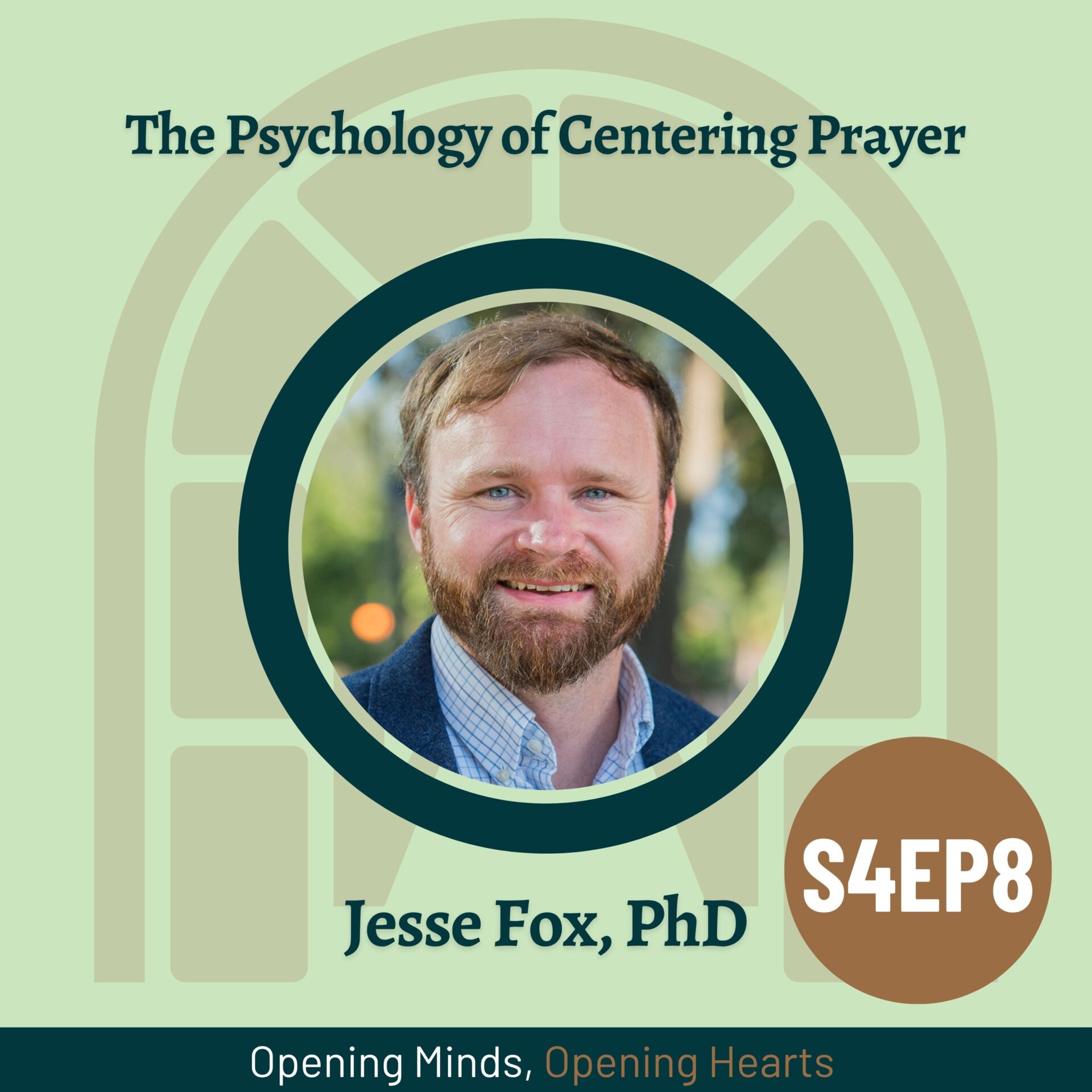
Opening Minds, Opening Hearts Podcast Season 4 Episode 8 with Jesse Fox, PhD
Title: The Psychology of Centering Prayer
"It really is a both/and with our psychology and our spirituality, that both are one great whole. And when we adopt something like Centering Prayer as a practice, it is our part in the whole process, but it isn’t the whole of the process. The whole is a gift that’s already there and already happening. But we are simply consenting to it."
- Jesse Fox, PhD
- Jesse’s journey from growing up surrounded by silence in the Arizona desert, to finding words for his spiritual longing in Thomas Merton’s writings, to discovering in Thomas Keating’s Centering Prayer a practice that gave form to his deepest search. And his growing understanding that psychology and spirituality are not separate but deeply intertwined.
- Origen of Alexandria’s three-layer framework: the body (the exterior or literal), the psychic layer (our responses and thinking), and the spiritual sense. How this ancient understanding of scripture applies to therapy and healing, and why Jesse believes we cannot stop at addressing the psychological dimension alone, but must also attend to the spiritual.
- What Jesse calls the great mystery of suffering, that we are healed at a deep level by God’s presence, and yet continue to live with anxiety, depression, and suffering we cannot escape. And how this connects to St. Paul’s “thorn in the flesh” and the invitation of Centering Prayer to enter into our pain rather than turn away from it.
- How the unloading of the unconscious is a normal, adaptive quality of our psychology rather than a pathology, and how it forms part of the purgation process. Why healing happens when we stop trying to control the unloading and simply allow it to unfold while held in God’s presence.
- How marketing and commodifying contemplation cuts against its very foundation, turning a freely given gift into something we try to achieve and control. And how this exaggerates our programs for happiness, rather than inviting us into the suffering that genuine transformation requires.
- Visit our website: contemplativeoutreach.org
- Find us on Instagram: instagram.com/prayerofconsent/
- Like us on Facebook: facebook.com/prayerofconsent
- Check out our YouTube channel: youtube.com/@prayerofconsent
If you are a grateful and generous listener who would like to support this podcast, please visit: contemplativeoutreach.org/opening-minds-opening-hearts-podcast-donation/ to make a donation of any amount.
Listen to the Opening Minds, Opening Hearts Podcast NOW for FREE on YouTube, Apple, Google, Amazon and more!
This season of Opening Minds, Opening Hearts is produced by 🫶🏾 Rachael Sanya 🫶🏾 👉🏽 rachelsanya.com
				Opening Minds, Opening Hearts Podcast Season 4 Episode 8 with Dr Jesse Fox
Episode Title: The Psychology of Centering Prayer


Colleen: Welcome to Opening Minds, Opening Hearts, a podcast about the transformative practice of Centering Prayer. In each episode, we will talk to friends of Contemplative Outreach about their personal practice. Listen in as our guests share insights about the teachings of Father Thomas Keating, how the practice impacts their work in the world, and their thoughts about how Centering Prayer connects to the living traditions of contemplation and meditation.

We are your hosts, Colleen Thomas

Mark: And Mark Dannenfelser.

Colleen: Centering Prayer practitioners and contemplative life seekers who love to talk a little too much about how the practice of contemplative prayer transforms our inner and outer worlds. Our hope is to open the door for you to explore more deeply this powerful practice of Centering Prayer.

Mark: Welcome everyone to season four of the Contemplative Outreach podcast, Opening Minds, Opening Hearts. I'm Mark Dannenfelser

Colleen: And I'm Colleen Thomas.

Mark: Hi, Colleen. It feels like it's been a while. We've taken a little bit of a break during the season here.

Colleen: Yeah. I think we've had a more leisurely rhythm of conversations with our guests, at least in the way we've approached recording it.

For you listeners, you'll still be getting an episode from us every two weeks, but it's been longer than that between our conversations, and it's been nice. I think it's given us time to let the conversation settle and to live with the wisdom that I feel like we've been exposed to in this season.

Mark: Yeah.

I've appreciated the amount of time we've spread out our own recording of the sessions 'cause it's so much good information, but also, there's a lot to take in, so it's been nice to sit with it, and suddenly we're here at the final episode for the season.

Colleen: Yeah. The final conversation with a guest.

Mark: With a guest, yeah. We're gonna do an episode together.

Colleen: That's the heart of the podcast. Not that I don't enjoy talking to you, Mark. What people don't know is that Mark and I, of course, talk more often than when we're recording these episodes, and the conversations are always just really rich and long, and, we could talk about Centering Prayer and contemplative prayer and meditation and especially this season about healing and transformation all day long.

All day long. But yeah, we are here, and it's November when you're listening to this, which means our summer has passed. Did you have a good summer?

Mark: I did. Yeah. It's been a little busy. But I spent a little time just relaxing as well, so it was a nice dynamic there. Yeah.

Colleen: Yeah

Mark: I like the fall too, and I like winter, all the seasons, so I'll be traveling north for Christmas, so hopefully there'll be snow.

Colleen: I know. Well, we got snow last year, which was nice 'cause it hadn't been in... I love fall too. I mean, I love when the temperature drops. I know there are summer lovers out there, and their summer is special, but I'm a fall girl. So I'm looking forward to the crisper air and just the holiday season, all the things.

And I hope that you all who are listening have been listening to us. If you've been doing road trips, then we're really grateful to have your audience here. As Mark and I like to say, we hope we are not just talking to ourselves. Yeah.

Mark: I do too much of that already, so.

Colleen: Right. Right. Right. Well, like we said, this is our final conversation this season with a guest.

You will have to hear just Mark and I talk again, unfortunately. But it's incredible. Our fourth season is already coming to a close, and there may be no better way to be closing out our dialogue about healing than by looking at this concept of Centering Prayer as the divine therapy with a clinical psychologist and psychotherapist.

And the word therapy in Father Thomas' description of divine therapy implies a direct connection to this clinical practice. And one of the unique things about Father Thomas' life and his work is that the teaching that he developed to support the practice of Centering Prayer and to explain what's happening to us in Centering Prayer was really cutting edge, and it was deeply rooted in psychology.

He's really known for being a pioneer in marrying spirituality and psychology.

Mark: Yeah, and true to his real genius in laying out all of this and exploring these ancient practices and then, connecting that up to modern psychology. I mean, after all, the word psychology, it's fitting because it means soul work, really, essentially, the study of the soul, which then later became the mind, and that's how we think of it now, but it's really this deep soul work too.

So digging into psychology and the psychology of Centering Prayer as Jesse is looking at our guest today, but it's what Keating invited us to do by his own approach to it And I'm excited about this today because our guest is very well-suited for having this conversation around this intersection between spirituality, Centering Prayer specifically, and psychology, and how they do have a place to be in conversation for sure.

So would you wanna introduce our guest for us?

Colleen: Yes. It's gonna be me and the two professionals, so I'm excited. I'm gonna learn a lot from you guys. And I am happy to introduce Jesse Fox. Jesse is a PhD and Associate Professor of Counselor Education at Stetson University. He earned his doctorate from the University of Central Florida and served on the faculty of Loyola University, Maryland, in the Department of Pastoral Counseling before joining Stetson in 2017.

Jesse has extensive clinical experience, which we're really looking forward to gleaning from, in college counseling and outpatient addiction treatment, community mental health, and private practice. He's done a lot of clinical research and published a lot of academic research papers that have been of particular interest to us and how we actually first were introduced to Jesse at Contemplative Outreach, and his scholarship focuses on the integration of spirituality, religion, and mental health.

And so we are really excited to just explore this topic with you, Jesse, and can't wait to introduce you to our audience and have them learn from you. And one last little plug, I met Jesse in person in Atlanta at the global conference. I guess that was now two years ago. And so good to see you now on camera, Jesse.

Welcome.

Jesse: Yeah. Thank you, Colleen, and thank you, Mark. I've been a longtime listener of the podcast and really enjoyed hearing your conversations with prior guests and learning from them. And so I'm looking forward to having a conversation with y'all today about something that has been really close to my mind and heart for many many years, and I would say brings me some of my greatest sense of fulfillment in the work that I get to do.

So looking forward to unpacking that with y'all.

Colleen: Yes. Well, and Jesse, maybe that's a good place to start for our audiences. This has been close to your heart for many, many years. Can you share a little bit about how you arrived on this path? Maybe first, the path of Centering Prayer, and then if it connects naturally how that led you into clinical psychology.

Jesse: Yeah. So when I began this journey, and I've been asked this question before, I tie it back to my earliest experiences of God. So I grew up the son of a minister and a missionary in the mountains of Mexico, and so my earliest memories are growing up, just deep in the wilderness in Mexico as well as the Southeast United States, in Arizona in particular.

I was born and raised in California, but we spent a good part of my formative years literally in the middle of nowhere in the desert. And so I could drive or walk for two hundred miles and not see a living soul. So when I say rural, you have to picture rolling grassland. One of the things about where I grew up in southern Arizona is that many people tend to think it's just one big desert.

There's actually quite a bit of diversity to the topography. And so I grew up roughly five thousand feet above sea level, where you can grow grapes for wine, so there's a lot of wineries in the region. But beyond that, it's simply mountains and cattle and what seems like an infinite horizon, and the sound of sheer silence And so when I grew up, I was surrounded by silence.

Colleen: Hmm.

Jesse: And it's probably not surprising to you to also learn that there was a Carmelite monastery right down the road from- ... where I lived. And so the idea of contemplation was in the air, but I didn't have a word for it.

Colleen: Yeah.

Jesse: Many of my days were spent walking in the fields and just becoming very acquainted with silence at a very young age.

So the idea of longing for God, longing for the divine as this kind of core spiritual experience was right there from my very earliest memories growing up. I didn't have the word contemplation, though. I think that's important to mention, because much of this was, for me, an intuition. It wasn't something that I could put into words.

It wasn't something that even a prayer could fully capture. So verbal prayer always felt a little empty to me when I would try to pray, or when I would go to church and I would hear prayers. There was always something left that went beyond, that I had no ability to really explain or to be able to put into concepts and words.

So I spent a good part of my growing up being somewhat aware of that, what I now call contemplation. But it's this kind of infinite horizon that has no end, and has no word to really be able to signify fully. So I went through my growing up years, went through my high school years, went through then college.

And it was in college that I began to really develop a desire to understand people at a deeper level. And it was in part because of actually a New Testament professor who became my spiritual friend, spiritual mentor, guide, I would say, through those really formative emerging adult years of my life, where I was beginning to try to understand people in a more refined sense or, so our psychology, but also continued this search of spirituality.

So I couldn't tell if I was gonna go into theology, philosophy, psychology. They were all, to me, very, very tied together. I didn't really see a really hard boundary between them. And during those really formative emerging adult years when I was really starting to look into this more deeply was when I discovered Thomas Merton.

I first started reading Thomas Merton in high school, his work, The New Seeds of Contemplation. And what Thomas Merton was saying was something that I felt, but I didn't have the words for it.

Colleen: Mm-hmm.

Jesse: And as I began to really look more deeply into what Merton was talking about, he gave me the words to explain my experience, what was going on internally.

But what was so compelling to me about Merton was that he was so articulate about our psychology simultaneously. And so for him, I realized that there was a very developed, nuanced psychology to his spirituality that I still to this day find incredibly compelling. And he was able to talk about things at a psychological level that led to a spiritual realization that I think is still hard to match.

But when I started to then move into my training in counseling psychology, what I would do is I would read my standard textbooks in counseling psychology, et cetera, and then I would again find them somewhat lacking. There was something missing from many of the profound early theorists of the Western psychotherapy movement and tradition that emerged over the last roughly 100 years.

And so I would put down Carl Rogers and Irvin Yalom and other formative theorists, but then I would pick up Teresa of Ávila right after that. And I would spend the rest of my afternoons in graduate school in the library reading something like The Interior Castle. And I realized in going through those kinds of really profound spiritual texts that have gained these individuals the title, for instance, of Doctor of the Church, was again a very profound psychology to their spirituality. And I found that in reading something like Teresa of Ávila and her work on The Interior Castle, you could see her perceptive insight into the way our psychological mind works, but then how that's a jumping-off point to our sense of union with God.

Mark: It's wonderful to hear your background and particularly your growing up. To me, in listening to that, it kind of parallels the whole Christian contemplative tradition, which started in the desert, as did you, and then progress... Well, maybe progressing isn't right, but it just moves through this trajectory that eventually has like, okay, so what's happening here?

And implying different points of view about that, including the psychology of it. When you start reading Merton and you see what he's saying when he's talking about contemplation, and that's led you to actually, sounds like most of your career, that's what you've been exploring.

Jesse: Absolutely. Absolutely.

Mark: I'm curious if you could talk a little bit about some of how you approached continuing this exploration of applying, especially psychology, to these ancient contemplative practices.

I was especially interested in that study you did that was published in twenty sixteen about the therapeutic aspects of Centering Prayer. Can you say more about that, like how, as you continued to do your own research and what you discovered?

Jesse: Absolutely. So when I think about where the story evolves from there, I think the next critical juncture was coming across Thomas Keating's work.

And I first came across Thomas Keating's work during my doctoral work at the University of Central Florida, and I was trying to figure out a pathway of how to tie all of this together. Interestingly enough, one of my professors, who is also a profoundly spiritual person, comes from an Eastern tradition, played us a video of Thomas Keating in one of our classes about the therapeutic effects of meditation.

And I remember the video very distinctly because I remember how it made me feel.

Colleen: Hmm.

Jesse: It was the first time I heard Thomas Keating speak. And what I heard in his voice was this profound invitation to come home, is how I would describe it.

Colleen: Mm.

Jesse: He was talking about Centering Prayer. He was actually just talking about the process of praying Centering Prayer.

But it was his presence that convinced me that this was the same voice that I had heard early on. It's again, as Martin said, it's a voice without a voice.

The presence is something that you recognize intuitively, and we have this analogy of senses to try to describe this psychologically. That's the only way we can.

But it's touching, it's being felt. But that's what I experienced when I just heard him start to talk about it. And that set me on a pathway of dialogue with not only my professor, but other students who were also asking many of the same questions about our spiritual life and how does that connect with our psychological health and wellbeing.

And I just started to read anything I could get my hands on that he wrote. And what I then realized was that Thomas Keating put into a form, a method that people like Martin were describing. And what I realized was that my deepest longings, I would say, had a way to be practiced on a routine basis.

And that I could adopt a practice that would leave me open to this presence of God on a more consistent basis. And that's not to confuse contemplation as a thing, right? It isn't something that when you practice, you somehow acquire it. That can be confusing for us psychologically, because psychologically, we wanna have control over something and much of understanding about our psychology has to focus more on what's within our power, what's within our control to do.

And so there's an aspect of learning about Centering Prayer and our psychological wellbeing and mechanisms of growth that led me back to this... what I had learned really early on was that it really is a both/and with our psychology and our spirituality. That both are one great whole, but there are certain modalities to it.

Yeah. And when we adopt something like Centering Prayer as a practice, it is our part in the whole process, but it isn't the whole of the process. And the whole is a gift that it's already there and already happening. But we are simply, and this is Thomas Keating's, I think, brilliance, we are consenting to it.

Colleen: Mm-hmm.

Jesse: And that is our psychological contribution, is our consent that we give to the presence of God within us.

Colleen: What would you say, then, is the object of therapy that can be confusing or challenging for those who are thinking of Centering Prayer as a healing practice?

Jesse: Yeah, I think that there's a couple things to lay out as a bit of context.

Colleen: Mm-hmm.

Jesse: So there can be therapeutic goals that are not spiritual in nature, if I can put it that way. So therapeutic goals can focus on how our thoughts are functioning, how our emotions are functioning, and there are many pathways in which people have developed to put those into, let's say, a better working order so that they don't feel out of joint or disjointed or disintegrated.

But there's a deeper part to who we are as people that if we don't address many of these psychological disjointedness, challenges, barriers, what it can do, I think, is that it can prevent us from experiencing the fullness of this sense of God's presence within our life. And so there is a, I think, a genuine therapeutic end to going and seeing a counselor, doing therapeutic work.

But at the same time, there's a part of our self that I would say lies deeper than that psychological layer.

Colleen: Mm.

Jesse: And that deeper layer is, I think, what Thomas Merton and Thomas Keating are talking about is our true self.

Colleen: Mm-hmm.

Jesse: And that true self is hidden in God. It lies beyond Merton's phrase, "The brutalities of our own will," that it is our deepest self, and it also happens to be the presence of God simultaneously. So that vision of moving from the exterior to the interior goes through this pathway, though I think of what we call the psychological.

Colleen: Mm-hmm.

Jesse: And if I could maybe tie this back to even a more ancient notion within our tradition Origin of Alexandria, who was a profoundly influential philosopher theologian. When you do read some of our, Thomas Keating among them, some of our leading lights of our tradition, they were profoundly influenced by the Origin of Alexandria and the people who came after him.

And he wrote a really influential treatise called On First Principles, and it's in that treatise that he develops this whole idea of the layers of scripture. And when you read holy scripture, you're not just reading it at a literal level, that when you are reading sacred scripture isn't just about reading a story or taking on information, but it is meant to be a transformative encounter with living Christ in the text itself.

This is the whole idea that is lying behind the ancient practice of Lectio Divina.

Colleen: Mm-hmm.

Jesse: And if you know how Centering Prayer developed when Thomas Keating held the Lama conferences, this was his starting point that it was through the practice of Lectio Divina that Centering Prayer grew out from.

And in that treatise, what he says you have to understand about reading our sacred scripture is that it's actually composed of the same parts of the human person.

Colleen: Hmm.

Jesse: So when you read the sacred scripture, it's not just words on the page. It's like a person. So that person has an outer layer, and he called that the body.

So that's the physical body of the human person. That's the words on the text. But he said, "You can't stop there. You have to go deeper." And that deeper layer is what he called the psychic layer And that's where we get our word psychology from. And the psychological layer is our response to what we are reading, and that includes our conscious thinking through the text and thinking through our response to what we're seeing in the text.

But he said you can't stop there. You have to go one layer deeper, and that's what he called the spiritual sense. He said a person is composed of a body, a psychology, as well as a spirit. And it's the same way I think you can understand the whole movement of a therapeutic relationship and encounter, is that you move from the exterior, from the body to the mind, but you can stop there.

And a lot of psychotherapy, I think, does actually stop there at that point.

Colleen: Yeah.

Jesse: For, I think, good reason. Not every counselor or psychotherapist really has the ability to move into spiritual dialogue, and so I completely understand that. But when it does stop there, where do you go next?

And I think there is a reason why when people go to see a counselor or psychotherapist, what they will talk about will often be overlaid with spiritual themes about finding not just a sense of wellbeing, but a sense that my life matters, that my life does have a purpose to it, that when I think about the trajectory of my life, I want it to actually have a meaningful impact on other people.

So those deeper questions are routinely there, but they're not always necessarily addressed at a psychological level. And sometimes that is where people do need to develop spiritual friendships with guides who do have that capacity to meet them at that level.

Colleen: Yeah. And maybe why we're seeing such a boom in the practice of spiritual direction perhaps to bridge that gap.

Jesse: Absolutely. Yep

Mid-point meditation: In the Christian tradition, contemplative prayer is the opening of your mind and heart to God, who is beyond thoughts, words, and emotions. Centering Prayer is a method designed to facilitate contemplation. The method suggests four guidelines. One, choose a sacred word as the symbol of your intention to consent to God's presence and action within you.

Two, sit comfortably and relatively still. Close your eyes or leave them slightly open, and silently introduce your sacred word. Three, when you notice you have become engaged with a thought, simply return ever so gently to your sacred word. And four, at the end of the 20-minute prayer period, let go of the sacred word and remain in silence for a couple of minutes.

The additional time invites you to bring the atmosphere of silence into everyday life


Mark: And Jesse, you mentioned the part in Centering Prayer where we're consenting, which is an ongoing thing. We consent, we consent, we consent, right, each time. And coming back to the sacred word is one way that we do that, and you said that was our psychological contribution to that. I'd rather that God just took care of all of it?

But you're pointing to something that's important, I think, is this, we're part of it, too, and we're in communion with God. But that process, and Keating talked a lot about that. Some of his language for that was the unloading of the unconscious and how we actually allow for that to happen. But from the psych perspective, I think that can also be challenging when things start to unload.

And Keating talked about it because of that, that it's a really challenging time for some people. Absolutely. I wonder, from your perspective, what is that dynamic of this unloading that happens that can feel like a negative thing, but yet it's also where we're going in the practice?

Jesse: He was very good. He had a very developed psychology to his work as well because what I think he was picking up on was that journey, again, from the exterior to the interior.

And when you do that psychologically, what can happen for some people is, and Keating called them these internal monologue or our narrative script that is functioning at an unconscious level And what happens when we move from the exterior to the interior is that outward focus to our attention and the distractions that prevent us from being able to make it a deeper journey through the interior of our life and ultimately into God, is that we realize that there are many things that we maybe took for granted or had been pushing off to the peripheral that were just too much for us to be able to handle.

And this is a normal adaptive quality to our psychology. This is not a pathology. There's a part of our adaptive capacity in our neurology, I think, that prevents us from feeling the full brunt of our overwhelm in our lives, and we have a lot to manage. One of the great gifts I think of being human is that we do have this capacity to see our lives on an infinite time spectrum, that we can look out into the future and we can imagine what a world can look like and then create that world, actively create that world, and this is where we get technological advancements that we so greatly benefit from.

But the shadow side to this gift, I think, is this capacity to also be aware of all of the challenges, the pain, the ultimate sense of our mortality also that we see on the horizon of our life. And so I do think there is an adaptive psychological capacity that we developed to navigate that sense of overwhelm of information that our brain is capable of taking in.

But what happens, I do think, is that those things that we haven't been able to find a sense of resolution for remain active somewhere in our mind And through our daily activities can distract us from that. And this can look like very, I think, healthy goals, like having good work and keeping ourselves active in work and earning a living.

But they also become problematic when we start to over-exaggerate them. And I think that this was Keating's kind of idea that each one of us reflects the image of God in our desire for control, for security, for self-esteem. These are not pathological longings. These are actually a reflection of God's glory within us.

The problem is that we overextend them. We over-exaggerate our sense of control over them. And this is where the programs for happiness take control of our life, and we no longer are pursuing God as God is, but we're pursuing our own projection of what God is through our own programs of happiness And so those become kind of our narrative scripts on a daily basis.

And again, they're not pathological, only when they become obstructive through their over-exaggeration or overextendedness because they can't ultimately fulfill that infinite longing.

Mark: Yeah. And then from a psychological perspective, some of those aspects are meant to protect us. And it's funny 'cause Keating right up front in "Open Mind, Open Heart," he lets us know, kind of a warning label.

He says that if we finally stop actively building these protections and whatever else, and we just simply stop and rest, he says that the depth of rest means that an unloading of the unconscious is certain to occur. We're putting down all of our other ways of dealing with that. And so he says you're gonna start unloading.

And he goes on, "The body loses its defense mechanisms due to the deep rest and diminished thought, so the psyche's no longer able to prevent painful experiences from the unconscious from coming to consciousness." So that whole idea of the unloading of the unconscious is just critical to the practice, and it's generally described as a good thing by Keating, that this is where it's supposed to go.

Colleen: Yeah. But not necessarily then received or experienced as a good thing. No. And we've talked a lot about, in this season, this myth of meditation, contemplative prayer, Centering Prayer, as you've written about, because it's often, at least in the meditation mindfulness community, practiced with the exclusion of its spiritual origin and presented in such a way that this is just like a pause for, stress relief or maybe even more dangerously packaged as a pathway to bliss.

And then it ignores this- Necessary but somewhat terrifying journey through this awareness of these pathologies that at a mature age or stage in life, as Keating talks about, but certainly a mature stage on our spiritual journey, we are invited to also consent to these deeper realities. And in your research, you talked about how this was observed in some of these pilot studies that you've done, that participants experience a tension in their relationship with God and a religious crisis.

And I understand how, like, how can you market meditation that says one of the known effects of this practice will be that you'll experience tension and crisis? Who would buy that?

Jesse: That's right. That's right. The whole idea of marketing spirituality that you're bringing up here, one of my favorite contemporary writers in the Christian contemplative tradition is Father Martin Laird.

And if you read his books, Into the Silent Land, the last one in that trilogy, Ocean of Light, he talks really explicitly about this danger, that the marketing, consumeristic approach to spirituality can commodify contemplation so that it becomes something that sells well on a shelf. And part of the danger, particularly in that, is because it cuts against the whole foundation of what contemplation is.

And contemplation is not a thing you can buy or commodify or put a price tag on, or, like, for instance, a certificate that you earn after you go to however many silent retreats. You cut against the very assumptive base of what contemplation is, and that is that it's a gift.

Colleen: Mm-hmm.

Jesse: It is given freely. It is not something that you work at in order to achieve. And so why is that so psychologically damaging? I think what it does is it over again exaggerates our programs for happiness, to go back to Keating's phrasing. That contemplation itself becomes another thing that I control, that I achieve through my 20-minute sit, right? The tradition is very explicit about this, I think, that the whole process of transformation does actually involve suffering. That it isn't simply going from one blissful sit to the next.

And I think most people's experience probably when they sit down in silence is that they are immediately aware of all of those internal scripts that run in the background, like a treadmill that never turns off. And the internal experience of Centering Prayer goes through or recapitulates that spiritual journey each time, from moving from realization to a deeper sense of purgation And that, that purgation psychologically is , I think, experienced as a rehearsal of those internal scripts that we carry with us.

I think one of the great healing benefits of Centering Prayer in particular is that it doesn't buy into that marketing scheme, if that makes sense.

Colleen: Yeah.

Jesse: Is that each moment that you have of unloading, you don't even need to worry about trying to control that.

Colleen: Mm.

Jesse: You simply allow that unloading to unfold and return back to that experience of God's presence that's always holding you in the midst of your own transformation.

So it really is a practice of, one, unveiling. It's an unveiling, an apocalyptic practice. It's a realization, a revealing of who you truly are grounded in, and it is also the process of consent and kenosis simultaneously. It's in your sense of letting go, of consenting, that you realize and reveal who you truly are, and you don't actually have to obey those scripts that have been in the background of your mind for who knows how long.

Mark: In addition to the Centering Prayer world that I'm in, I'm also in the mindfulness world, specifically my training, mindfulness-based stress reduction. So it definitely went there. When mindfulness practice came West, it got commodified like everything else we do in the West. And my teacher, Jon Kabat-Zinn, calls it McMindfulness, that part of the teaching.

And it's an easy trap to step into 'cause you wanna bring these practices to people, so then you talk about the benefits all the time. But some of your work looked at what happens when somebody is practicing, in the case of Centering Prayer, and there is that unloading that happens that can be very destabilizing.

And I'm curious about how you think about that and how you talk about that and even maybe work with people around that. Like, when is it the unloading of the unconscious, which you just keep consenting to and going through? And when do people maybe need some support in that so it's not going into more of a destabilizing or psychological distress or dissociation or whatever?

And I don't know if you've been finding much of that in your research where people could use additional supports that we can borrow from psychology or other disciplines as well. I'm interested in that question about that term spiritual bypassing, where we can just say, "Well then, God is just having God's way with you," and just tough it out, and when we can actually support people.

Especially on intensive Centering Prayer retreats, it can get pretty heavy for people

Jesse: Well, I think there's a couple things that this question brings to mind. One is actually my own experience of going through counseling and psychotherapy myself as a client. So one thing that I didn't mention earlier was that when I was first discovering Centering Prayer, I was also engaged in my own personal therapy, and that was incredibly helpful because what I realized when I really got into practicing Centering Prayer was that those same scripts that I encountered right after the bell rang, after the first moments of silence began, and my mind got distracted by all sorts of thoughts, all sorts of painful things in life, and the healing practice of returning to the word was incredibly helpful for that reason.

And when I talked with my counselor, I realized those same scripts that I was learning how to hold in Centering Prayer and release in Centering Prayer were the same internal scripts that I was talking about with my counselor. And so I think that's illustrative of what the process is like, is that when you go into silence and you first start to experience silence, it can be unnerving when you hear what's going on in your own mind.

That's why having someone to walk alongside of you is so helpful, because when you're able to share at a human level with someone else about what's going on internally for you, you feel an added layer of healing Because when you're able to express that to another person who truly cares for you, who truly cares for your wellbeing, and has the skills to be able to listen at a deep level, it's a simultaneous process of unloading for that reason.

And I think what's helpful about seeing a counselor too while you're going through this transformative process is that, as Sigmund Freud said, it's very difficult to do this by yourself. Because when you're with yourself, all you tend to hear is an echo of your own voice. But when you say it out loud to someone, again, who has been trained to work through these types of issues, what they can help you to do is start to see what you don't notice, and they can help you to untangle some of the knots that you tend to get wrapped up in.

And so when does it become relevant? I think it becomes relevant anytime people start to feel like it's blocking them. If it starts to feel like you cannot get into that sense of letting go, that you feel constantly entangled in your own thoughts and the overwhelm of your own emotions And it starts to filter into your practice of prayer and meditation, and it becomes its own distraction.

I think that's when having someone come alongside to help you unburden a lot of that is really helpful to your own practice and transformation process.

Mark: Totally. And it'd be great for people to take advantage of that. Colleen, you mentioned spiritual direction or psychotherapy. Some of our listeners may be involved even in being Centering Prayer group facilitators leaders in a Centering Prayer group, or some people facilitate the intensive retreats and all.

I'm wondering if practitioners of Centering Prayer can also at least recognize when there's some sense of overwhelm, or it's going into something else than just that, I don't wanna say everyday unloading of the unconscious 'cause it's not. But, yeah, I wonder if you had some tips for our listeners. Some time ago, I was facilitating a Centering Prayer retreat, and a woman came up to me about midway through, and she said, "Why do we close the door to the room, our practice room?"

And I could see just on her face that she was in some level of distress. And so I asked her about it, and she said, " I have anxiety, and I just feel like it would be such a big disturbance if I had to get up and go out of the room." So she was getting overwhelmed. She's on an intensive eight-day or ten-day retreat, and so I'm wondering, are there some things that you've discovered in the work that you've been doing that could help people to stay with it, but not just riding the wave of anxiety or panic or whatever else might come up for some people?

Colleen: And can I comment on that question before you answer it, Jesse? 'Cause what that story raises for me, Mark, and I don't want to be insensitive, I mean, I also have my experience of anxiety, and I take an antidepressant, but it raises for me this question that I think is underneath the surface of some of what you're talking about, Mark, and you and I for sure have been talking about, is this really elementary question of, "Why doesn't Centering Prayer take away my anxiety?

Why do we even still suffer from anxiety or depression?" And Father Thomas says this is the divine therapy. Why isn't it fixing everything?

Jesse: Yeah, good question. I think if you could bottle the answer to this and market it- You would, um-

Mark: We're back to marketing again.

Colleen: I could live in France for the rest of my life.

Jesse: That's right. That's right. You would, uh... You'd break 2 trillion on the stock market. Yeah. Because I say that partly in jest because this is the great mystery of suffering that, yes, we are geared to experience the flourishing of the benevolent presence of God, and simultaneously, we still experience the great suffering of being human in this life.

And part of that suffering is that we will encounter things like diseases, and we will also encounter the pathologies of the mind simultaneously. And I think he's getting at, when he uses that phrase of divine therapy, I think what he is getting at is that we are healed at a deep level by the very presence and gratuitous gift of God.

At the same time, we have to go on living in the condition of this world, and the condition of this world has things like anxiety. It has things like depression. It has times where people break down with psychosis and, you know, meaning itself loses all sense of meaning. That is a part of living, and we don't get to escape that.

We have to go through that. And so I tend to think of things like the suffering of our mind, much like the suffering in our bodies when we go through the aging process. And for a variety of hereditary reasons, environmental experiences, nurturing experiences growing up, leaves us vulnerable to carry a certain psychological weight to our life. Those who are familiar with St. Paul's phrase, the thorn in the flesh, I always thought that was really telling that it was left so vague.

Colleen: Yeah.

Jesse: That there's actually something about living that kind of implies that we will carry some type of pain with us. And for some of us, it takes the form of these, what we call now psychological disorders.

I have obsessive compulsive disorder, and that is something that we carry with us. There's not necessarily a cure. There's only a way to continue to manage these things, like anxiety, like depression. They tend to be with us. Now, there are periods in which we feel like we have some relief from them But as we continue to go through life, there are flare-ups, just like with other forms of disease, depending upon life stressors that we're encountering at that period of time, other experiences that we may have, like traumas.

These can really flare up those predispositions we have toward these problems and challenges. And so for me, what is going on at a deep level here, I think one, there, there is a deep mystery to how our minds work. We have not figured it out in terms of the science of how to cure the mind, right? While that's true, what I also think is true, and I think that this is what contemplation teaches us, is that in the very midst of our suffering, of our anxieties, of our obsessions, God has actually not left.

Yes. That experience itself can be your transformation and even your teacher when viewed from the lens of the contemplative vision of life. So my vision of contemplation is vast in the sense that it contains all of this suffering that we experience, and yet it doesn't deny us the experience of going through it.

It's an invitation to go deeper.

Mark: Yeah, I think that's the important part, and I like that you're highlighting that this is natural and normal, that we're gonna suffer. Whatever the design is, one of the questions I have for God when I get there, like why this design? But clearly that's it, and it's not about eradicating that, and we could very easily, and as I was saying before with mindfulness, where it's the cure to all your ills.

No, I think what is important for us is not to help people just eradicate all of that. You wouldn't really be living your life fully if you just covered it up or tried to flee from it. But it's more about supporting people who are struggling with that, and how the practice does do that. It does support us, but sometimes we need additional supports to help us to move through our suffering- or carry it.

And it's not all pathology either. Grief is very challenging suffering, and that's not a pathological thing. But, how do we carry our grief, or how do we carry our anxiety? And the practice does help us with that.

Jesse: It helps, I think, create a container for it.

Mark: Mm.

Colleen: Mm-hmm.

Jesse: I think one of the challenges for people when they do encounter suffering of any kind is creating a container large enough to hold it.

And I think that this is part of the reason why if you remain on this pathway it is a race to the bottom. Spirituality is not a race to the top of moral accomplishment. It really is a race to the bottom of existential surrender, and it does invite people, I think, into a process of dying. Father Laird, when I was on retreat with him, shared, I think, a really helpful definition of contemplation as contemplation is hospice care for your own ego.

So when you go into a contemplative sit, you are voluntarily giving up your life in that voluntary sit. And I think that's part of the reason why it can be so challenging to sit for so long, is we don't wanna let go of these things. We wanna grasp tightly to our own sense of control and attainment, and yet that is the very thing that holds us back from a fuller, deeper vision of what it means to be a human being in relationship to God, in the presence of God that's always happening.

Colleen: Yeah.

Yeah. Something you said about the transformation being in the midst of the suffering, this increased awareness that God is not absent, and that is really true. Like, when I think back to the question that I asked, "Why doesn't this anxiety just go away? Why doesn't center–" But what has happened in my own life and practice, both with my Centering Prayer practice, also with my practice in 12-step recovery, is what is being transformed is the reality of who I am and who God is in the midst of everything, right?

The shame, I hesitate to say is gone, but it really is when I think about 10 years ago, and God forbid, my 20s when I first came into the practice. It's the beauty of Father Thomas's teaching that's very much aligned with 12-step recovery, like that step one, powerlessness and unmanageability. That's all it is.

My human condition, that's all it is, and I am loved, and God is love, and we are love. It's a simple... It's not always the most satisfying solution, especially when it's being offered to someone who is in the throes of a major crisis. And I don't think that I would offer that to someone in the throes of a major crisis.

But in my own minor crises, that's what I return to, is this, what Father Thomas calls the ultimate reality? And that's what I can see in the suffering is always with us that we're witnessing on a global scale. It's both true that there's suffering, and it's also not Reality, capital R. There's something beyond what we can see, and that's encouraging

Jesse: I was rereading Merton's New Seeds of Contemplation recently, and the first chapter is simply what is contemplation.

And he says, "It is the sudden realization of the source of all that is real."

Colleen: Hmm.

Jesse: With a capital R, that the exterior daily awareness that we have is only partly real, that actually at a deep, deep level, the source of all realness goes beyond those ephemeral, transitory experiences, emotions, thoughts even, that we have.

And this is part of why it's freeing, I think. It's freeing at a deep existential level because it's the experience of being carried through, and that's part of the reason why I think we think of these in terms of analogies like reborn or coming home. We have a sudden glimpse into what is really going on, and that's why I think of Centering Prayer and other Christian contemplative practices as actually apocalyptic practices.

A lot of people misunderstand the word apocalyptic as a sudden cataclysmic end to the world. We've seen a lot of movies about the apocalypse. But really, at its basic level, it's just unveiling. It's showing what's really going on. And so I tend to think of when you practice Centering Prayer, as each moment you use your word of consent is you're unveiling what's really real.

And what's really real is compassionate, is unconditional love. It is infinite in its mercy, and if it were to disappear, you would disappear because there's no way it can be absent from you.

Colleen: Mm-hmm. Yeah. I think for just parting, you've been in the Contemplative Outreach community for many years and doing this wonderful clinical research.

What do you sense that you can leave us with and leave the Contemplative Outreach community with that might be something to look ahead to? Father Thomas really began this work of this intersecting spirituality and psychology. What can some of the chapters integrate into their introductory workshops, or what's needed now for the future of Centering Prayer and in our retreat communities?

Any things that you're seeing from your research that might be good to leave us with

Jesse: One of the reasons why myself and colleagues that I've worked alongside with in looking at how to put a scientific method together that can give us a sense of how is this working on a broad scale for people. One of the things that really inspired me to start doing that work was, well, no one else was really doing it.

There wasn't a lot of movement in terms of having a dialogue in my academic world, the science of psychology and mental health. There were a few studies that had come out, but just a couple that really tried to start to look at this closely. And part of the reason why that inspired me to continue that work was because I felt that there was something really missing from the greater contemplative movement that was happening outside of contemplative outreach, but within the broader culture and landscape of the science of wellbeing, the science of flourishing, that I think missed out on what people like Thomas Keating were talking about.

And some of your questions earlier, I think really did highlight some of that. For instance, the process of going through transformation is a version of what we call the mystery of the cross, that spirituality is not just simply feeling blissful all the time, that actually within our broader tradition, people have wisely been pointing out the problems with that approach for many, many years.

But it wasn't being really talked about and represented in those circles that happen to be very influential in the way that people encounter mental health services. And so what I tried to foster and have been trying to foster is a deeper engagement with that broader conversation that's been going on for decades now.

And I think that conversation really does need the wisdom of something like contemplative outreach. So I love doing this work, but I'm always very aware and cautious even about a cheap psychologizing of what we're talking about here In New Seeds of Contemplation, Thomas Merton talks in the second chapter about what contemplation is not.

And he says precisely this issue, that you can make a spiritual practice, contemplative practice into just another cheap psychologizing of religious experience. And I think that there's always a potential danger in doing that when you start to look at what is this broader conversation going on about contemplative practice, and there has clearly been, I think, a, a longing for these types of practices within the broader cultural and religious landscape beyond the boundaries of Christianity, for instance.

And I do think there needs to be a conversation with that broader movement that's been going on if that makes sense.

Colleen: Yeah. Yeah.

Jesse: And so I think that that invites us to a number of both opportunities, but also some courage, because I think that when you start to dialogue across those disciplinary lines and across traditions and across religious perspectives, we all can come to that conversation with our own egos on the front end.

Again, trying to prove we're right, they're wrong. And I think if we approach it in that way, we're... I think we're missing the whole point of this broader vision of the all-inclusive presence of God that is within everything. And I think that that has prevented us from being able to have what I think are really great opportunities for growth and dialogue.

And I think one of the things that many of us appreciated about what Father Keating did, and probably when the history books are written, Keating will be recognized, at least I hope he will, for the Snowmass conferences he did, those deep interreligious dialogues that he did and facilitated. I think we can get a little bit stuck when we don't have that type of deep engagement across the dignity of difference, if that makes sense.

And so I think there's a great opportunity to continue that and to also be able to bring this into conversation. Again, not cheapening or reducing down something like contemplation into a psychological construct that we can measure and manipulate, et cetera, et cetera. But to have that real dialogue, I think there's a lot of people in the world that could benefit from that type of engagement.

Colleen: Thanks for joining us on this episode of Opening Minds, Opening Hearts. Visit our website contemplativeoutreach.org to subscribe to the show on Apple Podcasts, Spotify, and wherever else you listen to podcasts. You can also follow us on Instagram at contemplativeoutreachltd. To learn more about our guests and their work, you can find info in the show notes for each episode.

If you enjoyed this episode, you might want to check out our YouTube channel, C-O-U-T-R-E-A-C-H, COutreach. Thanks for listening, and see you next time

Season 4 of Opening Minds, Opening Hearts was made possible in part by a grant from the Trust for the Meditation Process, a charitable foundation encouraging meditation, mindfulness, and contemplative prayer. We are extremely grateful for their support and would be grateful for any additional support that you as a listener might offer.

Your donation helps Contemplative Outreach to freely offer the wisdom of the contemplative tradition and Centering Prayer to all who are interested. If you are a grateful listener and would like to support this podcast, go to contemplativeoutreach.org/podcast to make a donation of any amount.


